
Antibiotics and Birth Control Pills: What Really Happens? Facts vs. Myths
For decades, women have been told to use backup contraception when taking antibiotics. You’ve probably heard it from a pharmacist, a friend, or even your doctor: "Just to be safe, use a condom while you’re on antibiotics." But here’s the truth - most antibiotics don’t affect birth control pills. The fear is real, but the science says otherwise. Only one group of antibiotics has proven, measurable effects. The rest? It’s a myth that won’t die.
What Actually Interferes With Birth Control?
The only antibiotics with solid evidence of reducing birth control effectiveness are rifampin (Rifadin) and rifabutin (Mycobutin). These are not your typical prescriptions. They’re used to treat tuberculosis and some rare bacterial infections. Rifampin has been around since the 1960s and works by speeding up how your liver breaks down hormones. Studies show it can drop ethinyl estradiol levels by 25-50% and progestin by 14-37%. That’s enough to put you at risk for pregnancy.There’s also griseofulvin, an antifungal used for stubborn nail or skin infections. It’s not an antibiotic, but it acts the same way - boosting liver enzymes that break down hormones. Both rifampin and griseofulvin are classified as Category 3 interactions by the CDC, meaning the risks outweigh the benefits. If you’re on one of these, you need backup contraception for 28 days after finishing the course.
What About Amoxicillin, Azithromycin, or Doxycycline?
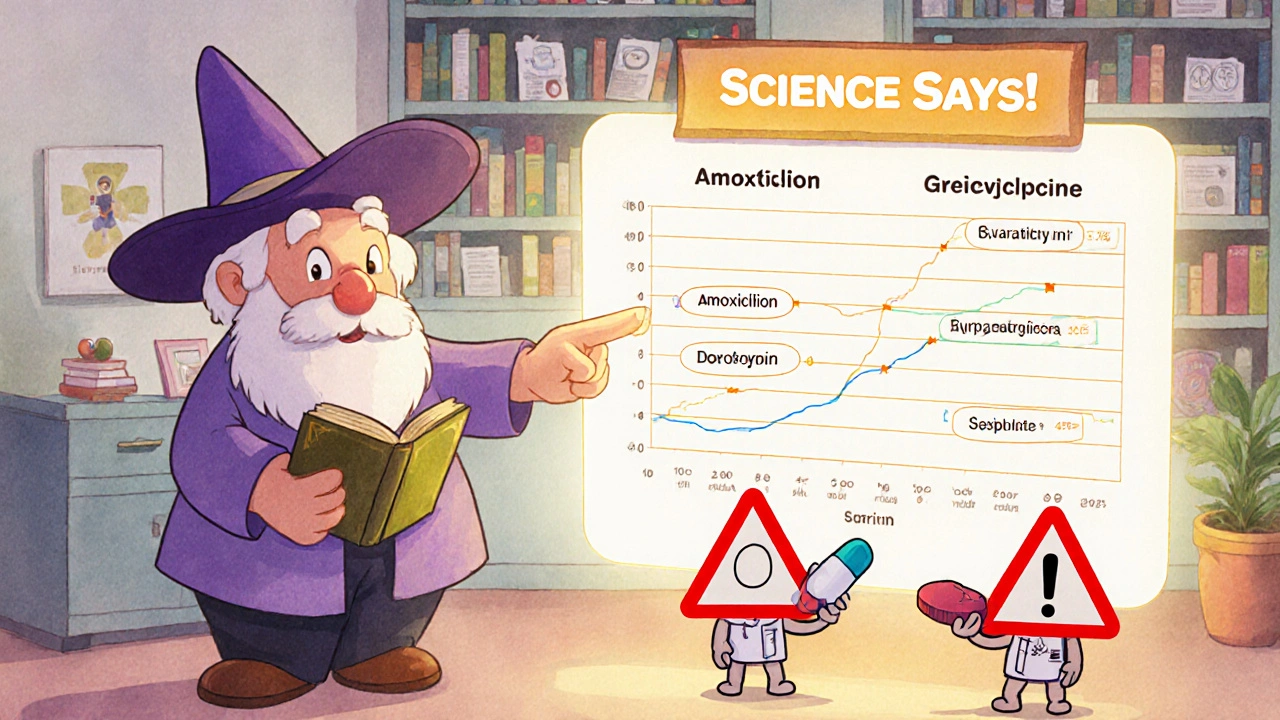
Let’s clear this up. Amoxicillin? No effect. Azithromycin (Zithromax)? No effect. Doxycycline? No effect. Metronidazole? No effect. Ciprofloxacin? No effect. Erythromycin? No effect. These are the antibiotics you’re most likely to get for a sinus infection, strep throat, UTI, or acne. Decades of research, including 35 clinical trials reviewed by the CDC in 2020, show these drugs don’t lower hormone levels enough to impact birth control.A 2011 review in Contraception looked at 14 studies and found no drop in estrogen absorption from penicillin antibiotics, even when gut bacteria were affected. Serum estradiol levels stayed in the normal range (200-400 pg/mL). Another study from 2018 confirmed that even when you take amoxicillin for a week, your birth control hormone levels stay well above the threshold needed to prevent ovulation (which is around 50 pg/mL for ethinyl estradiol).
Why Does This Myth Still Exist?
The myth started in the 1970s with a few scattered case reports of women getting pregnant while on antibiotics and birth control. Back then, scientists didn’t have the tools to test hormone levels accurately. They assumed the antibiotics were the cause. Later, it turned out most of those cases involved rifampin - but no one knew that yet.By the time research caught up in the 2000s, the myth had already stuck. Pharmacists, worried about liability, kept telling patients to use condoms. Doctors, unsure how to explain the science quickly, just said "better safe than sorry." And patients? They heard it so often, they believed it.
Today, 62% of women surveyed by Planned Parenthood in 2022 still think antibiotics reduce birth control effectiveness. On Reddit’s r/TwoXChromosomes, 78% of comments in October 2023 expressed fear about this interaction. Even though the CDC, ACOG, and the FDA have all clarified the facts, misinformation spreads faster than science.
What About Other Medications?
It’s not just antibiotics. Several other drugs can interfere with birth control:- Lamotrigine (for seizures) at doses over 300 mg/day
- Topiramate (for seizures or migraines) at doses over 200 mg/day
- Efavirenz and nevirapine (HIV medications)
- St. John’s wort (herbal supplement) - can drop estrogen levels by up to 57%
These are the real culprits. If you’re on any of these, talk to your doctor. But if you’re just on amoxicillin for a sore throat? You’re fine.
What Should You Do?
Here’s the practical guide:- If you’re prescribed rifampin or rifabutin: Use backup contraception (condoms, diaphragm) for 28 days after finishing the course. This applies to all hormonal methods - pills, patch, ring.
- If you’re prescribed griseofulvin: Same rule - backup for 28 days.
- If you’re prescribed any other antibiotic: No backup needed. Your birth control is still working.
- If you’re unsure: Check the drug name. Rifampin? Rifabutin? Griseofulvin? If yes, ask for clarification. If it’s amoxicillin, azithromycin, doxycycline, ciprofloxacin, metronidazole, or any common antibiotic - you’re good.
Some providers still recommend backup contraception out of caution. That’s their choice. But according to ACOG’s 2022 guidelines, it’s not medically necessary. The American Medical Association surveyed 500 OB/GYNs in September 2023 - 98% agreed only rifamycins require backup.
Confusing Similar-Sounding Drugs
One big source of confusion is rifampin vs. rifaximin. They sound alike, but they’re not the same. Rifaximin (Xifaxan) is used for traveler’s diarrhea and IBS. It doesn’t get absorbed into your bloodstream. It stays in your gut. That means it doesn’t affect liver enzymes. It doesn’t touch your birth control. Yet, many people mix them up.The FDA updated its labeling in January 2023 to make this clear. All hormonal contraceptives now say: "Rifampin, rifabutin, and griseofulvin may reduce effectiveness. Other antibiotics do not." That’s official. That’s the standard.
Why This Matters Beyond Pregnancy Risk
Believing this myth isn’t harmless. It leads to unnecessary stress, confusion, and even skipped doses of birth control because women think they’re "protected" by condoms anyway. It also makes people distrust medical advice. If you’re told to use condoms every time you take antibiotics, and you never get pregnant, you start to wonder: "Is any of this real?"It also creates a burden on healthcare systems. Pharmacists spend minutes each day explaining something that’s not true. Clinics waste time counseling on a non-issue. And women lose confidence in their own bodies.
What’s Next?
Researchers are now looking at whether obesity changes anything. A 2021 study found that women with a BMI over 30 already have a 2.5 times higher risk of birth control failure - regardless of antibiotics. So if you’re overweight and on hormonal birth control, talk to your doctor about your options. But again - antibiotics? Still not the problem.The science is settled. The guidelines are clear. The only antibiotics you need to worry about are rifampin, rifabutin, and griseofulvin. Everything else? You can take them without changing your routine.
If you’ve been using condoms for years just because you were on amoxicillin - you can stop. Your birth control is still working. Trust the data, not the rumor.
Do all antibiotics reduce the effectiveness of birth control pills?
No. Only rifampin, rifabutin, and griseofulvin have been proven to interfere with hormonal birth control. Common antibiotics like amoxicillin, azithromycin, doxycycline, and ciprofloxacin do not affect birth control pill effectiveness. This is backed by decades of clinical research and confirmed by the CDC and ACOG.
What should I do if I’m prescribed rifampin while on birth control?
Use a backup method of contraception - like condoms or a diaphragm - for 28 days after finishing your rifampin course. This applies to all hormonal birth control methods, including pills, patches, and vaginal rings. Rifampin speeds up how your body breaks down hormones, which can lower their levels enough to risk pregnancy.
Is it safe to take amoxicillin with birth control pills?
Yes. Amoxicillin does not reduce the effectiveness of birth control pills. Multiple studies, including a 2011 systematic review and CDC analysis of 35 trials, show no clinically significant drop in hormone levels when amoxicillin is taken with hormonal contraception. You do not need backup contraception.
Why do pharmacists still tell me to use condoms with antibiotics?
Many pharmacists follow outdated advice or err on the side of caution due to fear of liability. A 2022 study found that 35% of pharmacists still recommend backup contraception for all antibiotics, even though medical guidelines say it’s unnecessary. This is a communication gap - not a medical one. Ask for the specific drug name and check if it’s rifampin or similar.
Can St. John’s wort affect birth control like antibiotics do?
Yes. St. John’s wort is an herbal supplement that can reduce estrogen levels by up to 57%, making birth control less effective. Unlike antibiotics, it’s not prescribed, but it’s commonly taken for mood support. If you’re on hormonal birth control, avoid St. John’s wort unless your doctor approves it.
Does rifaximin affect birth control pills?
No. Rifaximin (Xifaxan) is used for traveler’s diarrhea and IBS. It doesn’t get absorbed into your bloodstream, so it doesn’t affect liver enzymes or hormone levels. It’s safe to take with birth control. Don’t confuse it with rifampin - they sound similar but work very differently.
What if I got pregnant while on antibiotics and birth control?
If you were taking rifampin, rifabutin, or griseofulvin, that could be the cause. But if you were on amoxicillin, azithromycin, or another common antibiotic, the pregnancy was likely due to missed pills, vomiting, diarrhea, or other factors - not the antibiotic. Birth control is 99% effective with perfect use, but real-world use drops it to about 93%. Always check your pill-taking habits before blaming the antibiotic.
So let me get this straight… I’ve been using condoms for 7 years because I took amoxicillin for a sinus infection… and it was all for nothing? 😅 My wallet and my partner’s patience thank you for this post.
Wait-so you’re telling me… that the pharmacist who yelled at me for not using a condom while on doxycycline… was wrong?!!? I mean, I didn’t get pregnant, but I also didn’t trust my body for 3 years because of that guy. This is… a lot. I need to go call him.
OMG I CRIED WHEN I READ THIS. I’ve been so stressed out for years thinking I was gonna accidentally get pregnant every time I got a UTI and had to take Bactrim. I even skipped pills once bc I was scared. I’m gonna start trusting my body again. Thank u for doing the research. U r a legend. 💪🩷
The myth persists because fear is easier than facts. We fear what we don’t understand so we create rituals to feel safe. Condoms became a spiritual shield against the unknown. But science doesn’t care about our rituals. It just is. And now we know. Let go of the fear. Trust the data. The body knows how to work. We just forgot to listen.
Let’s be real-pharmacists are scared of lawsuits, not science. ACOG says no backup needed for amoxicillin. CDC says the same. But if you ask a pharmacist? They’ll still hand you condoms like it’s a free sample. This isn’t medical advice-it’s liability theater. Stop letting fear drive your choices.
So rifampin is like the villain of birth control… and rifaximin is just the confused cousin who got mistaken for the bad guy? That’s wild. I always thought they were twins. Now I feel like I’ve been watching a soap opera where the plot twist is… liver enzymes. 🤯
This is such a relief. I’ve been telling my sister for years she doesn’t need condoms with her antibiotics, but she didn’t believe me. Now I can send her this article. Also, St. John’s wort? I didn’t even know that was a thing. Thanks for the heads-up-I’m gonna stop taking my ‘natural mood booster’ now. 😅