
Baseline CK Testing for Statins: When It’s Actually Needed
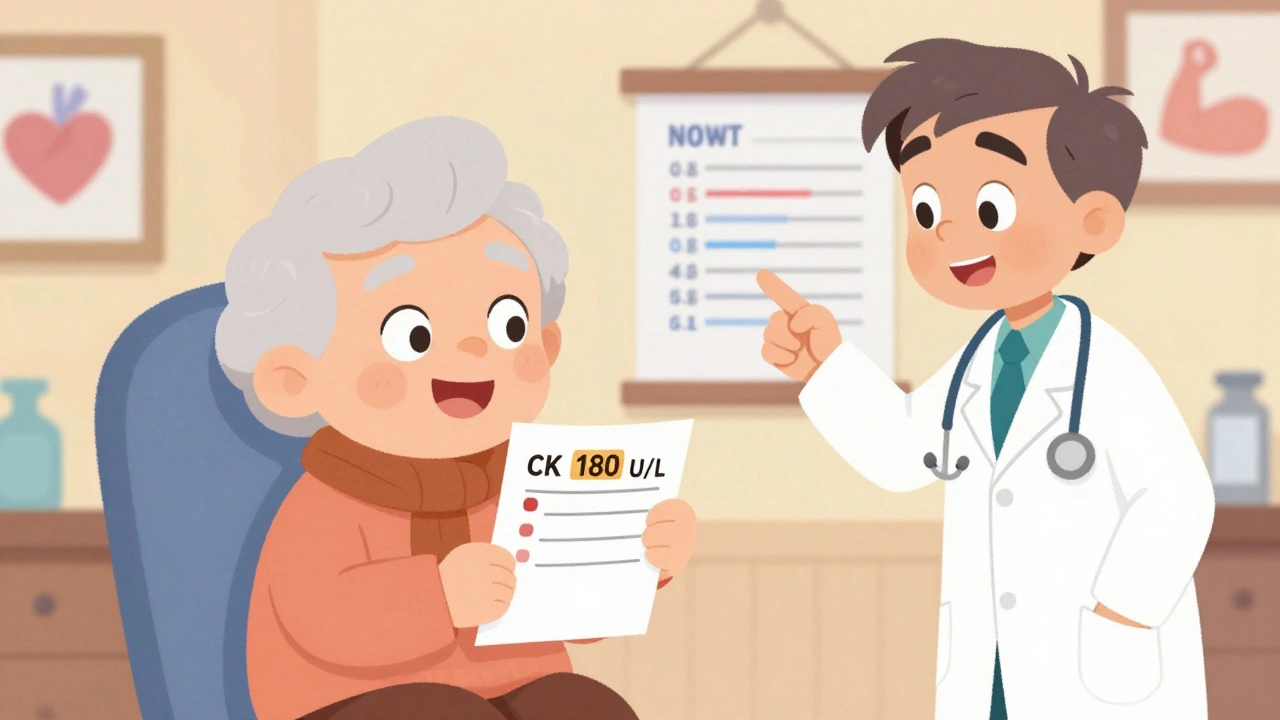
Statin CK Test Risk Calculator
Risk Factors Assessment
Answer the following questions to determine if a baseline CK test is recommended for you before starting statin therapy.
Your Risk Assessment
Based on your selected risk factors, your risk level is:
The National Institutes of Health states that baseline CK testing provides the most benefit for patients with multiple risk factors. For those with only one risk factor, the benefit is less clear but may still be valuable.
When you start a statin, your doctor might order a blood test for creatine kinase (CK). But is it really necessary? Or is it just another routine check that adds cost without helping? The answer isn’t simple. For some people, this test can prevent unnecessary stopping of a life-saving drug. For others, it’s a waste of time and money.
Why CK Testing Matters with Statins
Statin drugs lower cholesterol and cut heart attack risk by up to 30%. But they can also cause muscle pain, weakness, or worse-rhabdomyolysis, a rare but dangerous condition where muscle tissue breaks down and floods the bloodstream with toxins. That’s where creatine kinase (CK) comes in. CK is an enzyme released when muscle cells get damaged. A high CK level in the blood can signal that statins are hurting your muscles. The problem? Most people who feel muscle aches on statins don’t actually have muscle damage. Studies show that 78% of patients reporting muscle pain have CK levels within normal range. Their symptoms are likely from aging, overexertion, or something else entirely. Without a baseline CK test, doctors can’t tell if the pain is from the statin or something else. That’s why skipping the test can lead to patients stopping a drug they desperately need.Who Really Needs a Baseline CK Test?
Not everyone needs this test. But it’s critical for certain groups:- People over 75 - Muscle loss and kidney changes increase risk.
- Those with kidney problems - eGFR below 60 means statins build up in the body, raising toxicity risk.
- Patients on statin-fibrate combos - This pairing increases myopathy risk 6 to 15 times.
- Anyone with hypothyroidism - Up to 12.5% of statin users have this condition, which worsens muscle side effects.
- Those who had muscle pain on statins before - If you stopped a statin due to pain, you’re more likely to react again.
- People on high-dose statins - Atorvastatin 40-80 mg or rosuvastatin 20-40 mg carry a higher absolute risk (0.3% annually vs. 0.05% on low doses).
For healthy, younger adults with no risk factors, baseline CK testing adds little value. The 2023 Choosing Wisely Canada campaign found that 98.8% of abnormal baseline CK results didn’t change treatment. That’s $14.7 million spent annually in Canada on tests that didn’t help.
What’s a Normal CK Level? It’s Not What You Think
Lab reports say “normal” CK is under 195 U/L for men and 110 U/L for women. But that’s misleading. A 2019 study found that 25-30% of healthy people have CK levels above the lab’s “normal” range-because of recent exercise, intramuscular shots, or even genetics. African Americans, for example, often have baseline CK levels 50-100% higher than others. Athletes? Their CK can spike to 2,000 U/L after a hard workout. If you don’t know your personal baseline, a high reading could trigger panic and unnecessary statin discontinuation. That’s why the test must be done before starting the drug-ideally within 2-4 weeks. If you run a 10K the day before, your CK will be sky-high, and the test becomes useless.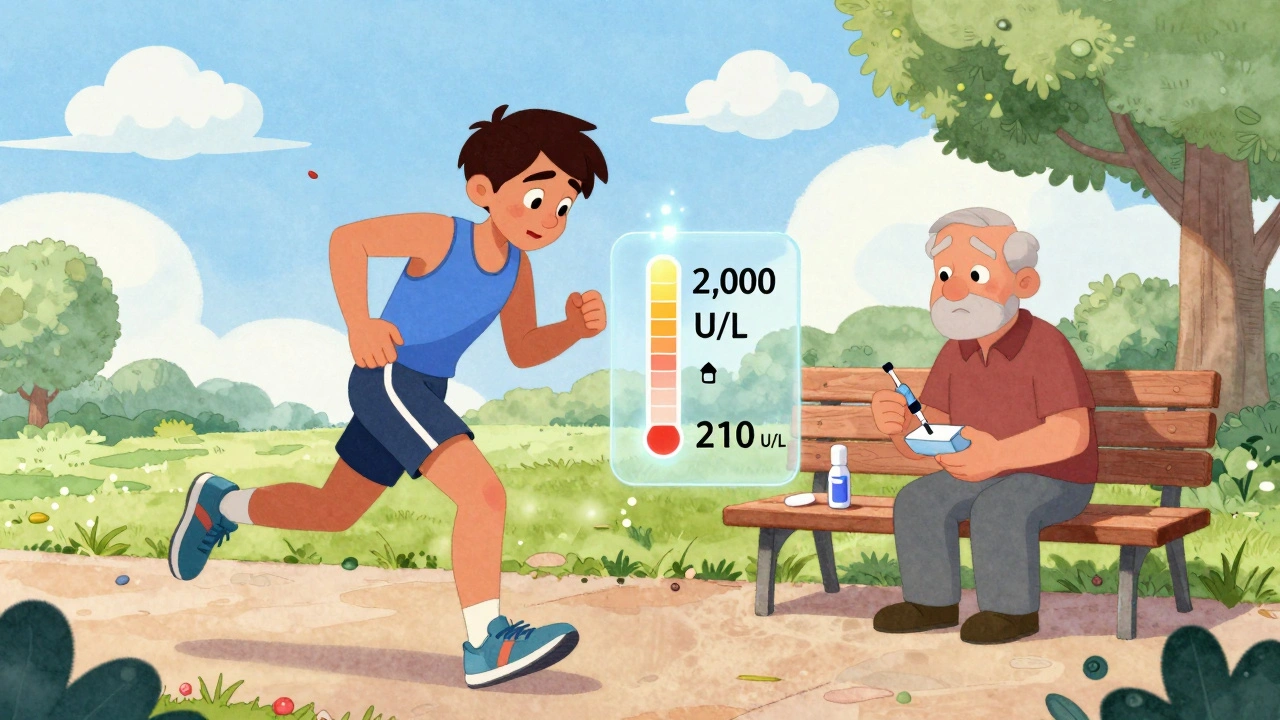
What Happens If Your CK Is High?
If you start a statin and later report muscle pain, your doctor will recheck your CK. Here’s how to interpret it:- CK under 3x upper limit of normal (ULN) - No need to stop the statin. Monitor symptoms.
- CK 3-10x ULN with symptoms - Pause the statin, check thyroid and kidney function, and consult a specialist.
- CK over 10x ULN - Stop the statin immediately. This signals possible rhabdomyolysis.
Even if your CK is high, it doesn’t always mean you can’t take statins again. Many patients can restart a different statin at a lower dose after symptoms resolve. One study showed that 85% of patients who stopped statins due to muscle pain could tolerate a different one after 3 months.
International Guidelines Don’t Agree
You’ll get different advice depending on where you live:- USA (ACC/AHA): Baseline CK is not mandatory but recommended for high-risk patients.
- Europe (ESC/EAS): Optional (Class IIb), mostly for those with risk factors.
- Japan: Required for everyone. Why? Higher reported rates of muscle side effects-12.7% vs. 7.3% in the West.
- Canada (RxFiles): Strongly recommends baseline CK for all statin initiates, but says routine follow-up testing is useless.
The biggest disagreement? Whether testing improves outcomes. Dr. John Kastelein, former head of the European Atherosclerosis Society, says it doesn’t. He points to a Cochrane Review of nearly 48,000 patients showing no difference in muscle injury rates between those monitored and those not.
But Dr. Robert Giugliano from Brigham and Women’s Hospital disagrees. He says baseline CK prevents unnecessary discontinuation in 15-20% of cases. The 2023 Statin Safety Registry found clinics that did baseline testing had 22% fewer statin stops when patients reported pain. That’s not just about safety-it’s about cost. Avoiding one unnecessary discontinuation saves about $2,850 in secondary prevention patients.

What About Genetic Testing?
There’s a new player: genetic testing for SLCO1B1 gene variants. About 12% of Europeans have a version of this gene that makes them 4.5 times more likely to get muscle damage from simvastatin. This test could replace CK monitoring in the future. But right now, it’s not widely used. It’s expensive, not covered by most insurance, and only applies to simvastatin-not all statins. Plus, it doesn’t help with other risk factors like kidney disease or drug interactions. For now, baseline CK remains the most practical tool. Especially for people with multiple risk factors.How to Get the Most Out of the Test
If you’re getting a baseline CK test, make sure it’s done right:- Avoid intense exercise for 48 hours before the blood draw.
- Tell your doctor about any recent injections (like vaccines or steroids).
- Don’t skip your statin before the test-it’s meant to reflect your baseline on therapy.
- Ask for the exact number, not just “normal” or “abnormal.”
- Keep a record of your result. You might need it later if symptoms pop up.
Doctors who document activity levels, medications, and exact CK values are far more likely to make the right call when muscle pain happens. One analysis found that 68% of abnormal CK readings could be explained by just these three factors.
The Bottom Line
Baseline CK testing isn’t for everyone. But for people with kidney issues, older age, thyroid problems, or those on high-dose statins or combo therapy-it’s a smart move. It gives doctors a personal reference point. Without it, muscle pain becomes a guessing game, and patients lose out on proven heart protection.Don’t assume it’s pointless. Don’t assume it’s essential. Ask your doctor: “Do I have any risk factors that make this test useful for me?” If the answer is yes, get it done. If not, save the cost and the hassle. The goal isn’t to test everyone-it’s to protect the right people.
Do I need a baseline CK test if I’m starting a statin for the first time?
Not always. If you’re young, healthy, and taking a low-dose statin with no other risk factors, baseline CK testing offers little benefit. But if you’re over 75, have kidney disease, hypothyroidism, or are on a high-dose statin or statin-fibrate combo, then yes-it’s strongly recommended to establish your personal baseline before starting.
Can I get a false high CK result without taking statins?
Absolutely. Vigorous exercise, recent injections (like vaccines or steroids), muscle injuries, or even being male or of African descent can raise CK levels. That’s why it’s critical to avoid intense activity for 48 hours before the test and to share your full medical history with your doctor. A high CK doesn’t automatically mean statin toxicity.
What if my CK is high but I feel fine?
If your CK is under 3 times the upper limit of normal and you have no muscle symptoms, most guidelines say you can keep taking the statin. Many people have mildly elevated CK without any real muscle damage. Your doctor will likely monitor you and retest later, but stopping the statin isn’t needed unless symptoms appear.
Is routine CK monitoring recommended while on statins?
No. Major guidelines-including ACC, AHA, and RxFiles-agree that routine CK checks in asymptomatic patients provide no clinical benefit and waste resources. Only retest if you develop muscle pain, weakness, or dark urine. That’s when the baseline becomes useful.
Can I restart a statin after stopping it due to high CK?
Yes, in most cases. If your CK returned to normal and symptoms resolved, you can often try a different statin at a lower dose. Studies show about 85% of patients who stopped statins due to muscle pain can tolerate another one after a break. Your doctor will likely start with a low dose and slowly increase while watching for symptoms.
Are there alternatives to CK testing for monitoring statin safety?
Genetic testing for SLCO1B1 variants can identify people at higher risk for simvastatin myopathy, but it’s not widely used yet due to cost and limited scope. The best alternative right now is paying attention to your symptoms. Muscle pain, weakness, or dark urine are more reliable warning signs than routine blood tests. Patient-reported outcomes are now emphasized over CK levels in updated guidelines.
Baseline CK testing isn't about blanket rules-it's about context. I've seen patients stop statins because their CK was 'elevated' after a weekend hike, only to have a heart attack six months later. The real win is knowing your personal baseline before the storm hits. It's not medicine, it's personal data.
They're testing CK to track you. Next they'll scan your DNA for 'statin susceptibility' and charge you extra for 'safe meds'. Big Pharma owns the labs. Don't be fooled.
Oh wow so if I lift weights and get a high CK, I'm just 'sensitive'? Cool. So I'm supposed to believe the same 195 U/L cutoff works for a 70-year-old grandma and a 28-year-old CrossFit guy who just did 100 burpees? LOL. And now we're supposed to pay $14.7 million so doctors can 'think'?
Let me tell you something about the medical industrial complex. They don't care if you live or die. They care if you keep coming back. Baseline CK? It's a trap. A money-making ritual disguised as science. You think they want you to stay healthy? No. They want you on meds forever. And if you stop? You're the problem, not the drug.
The entire paradigm of statin management is broken because it's built on population averages and not individual physiology. We're treating a genetic mosaic as if it were a single homogeneous entity. The fact that African Americans have naturally higher CK levels isn't an anomaly-it's a biological truth that Western medicine refuses to acknowledge because it complicates the algorithm. We're not just wasting money-we're misdiagnosing entire demographics because our reference ranges were calibrated on a narrow, privileged cohort. This isn't medicine. It's colonial science with a stethoscope.
Just get the test if you're over 70 or on high dose. Skip it if you're young and healthy. Done.
Canada recommends it for everyone? That's why their healthcare is a joke. We don't need another bureaucratic checkbox. Americans know better. We don't need tests for everything. Just take the pill and shut up.
Wait-so if I'm from the UK and my CK is high because I'm African? Do I get labeled 'high risk' even if I've never had statins? What if I'm a runner? What if I'm just naturally muscular? I feel like this is just another way to pathologize black bodies. And now we're supposed to pay for it? No thanks.
The notion that baseline creatine kinase testing is a prudent clinical intervention is fundamentally flawed. The evidence does not support a statistically significant reduction in adverse outcomes. To mandate or even recommend such testing in the absence of clinical symptoms is an affront to evidence-based practice and an indictment of modern medicine's descent into proceduralism.
Y'all are overthinking this. If you're gonna take statins, get the test. If you're scared of muscle pain, get the test. If you're old, have kidney issues, or are on combo meds-ABSOLUTELY GET THE TEST. It's not that hard. Stop arguing and do the thing. Your heart will thank you. 😊
Let’s be real-this whole debate is about who gets to define normal. Who decided 195 U/L is normal? A group of white men in a lab in 1982? My body doesn’t care about their numbers. If I feel fine and my CK is 300? That’s my baseline. Not theirs. We need to stop outsourcing our biology to institutions that don’t look like us.
My dad took a statin, got a baseline CK, then had muscle pain 3 months later. His CK was 4x ULN. They paused it, checked his thyroid, and found he was hypothyroid. Restarted the statin at half dose-no issues. That test saved his heart. So yeah, do it if you're at risk. It's not about fear-it's about knowing your body. ❤️
The SLCO1B1 variant is the future, but it's being suppressed by payers because it's not revenue-positive. CK testing is a fee-for-service relic. The real inefficiency isn't the test-it's the lack of pharmacogenomic integration into EHRs. We're still using 20th-century diagnostics in a 21st-century pharmacokinetic landscape. The algorithm is outdated. The data is siloed. The outcome? Preventable statin discontinuation. This isn't clinical negligence-it's systemic failure.