
Canada's Generic Drug System: How It Differs from the USA
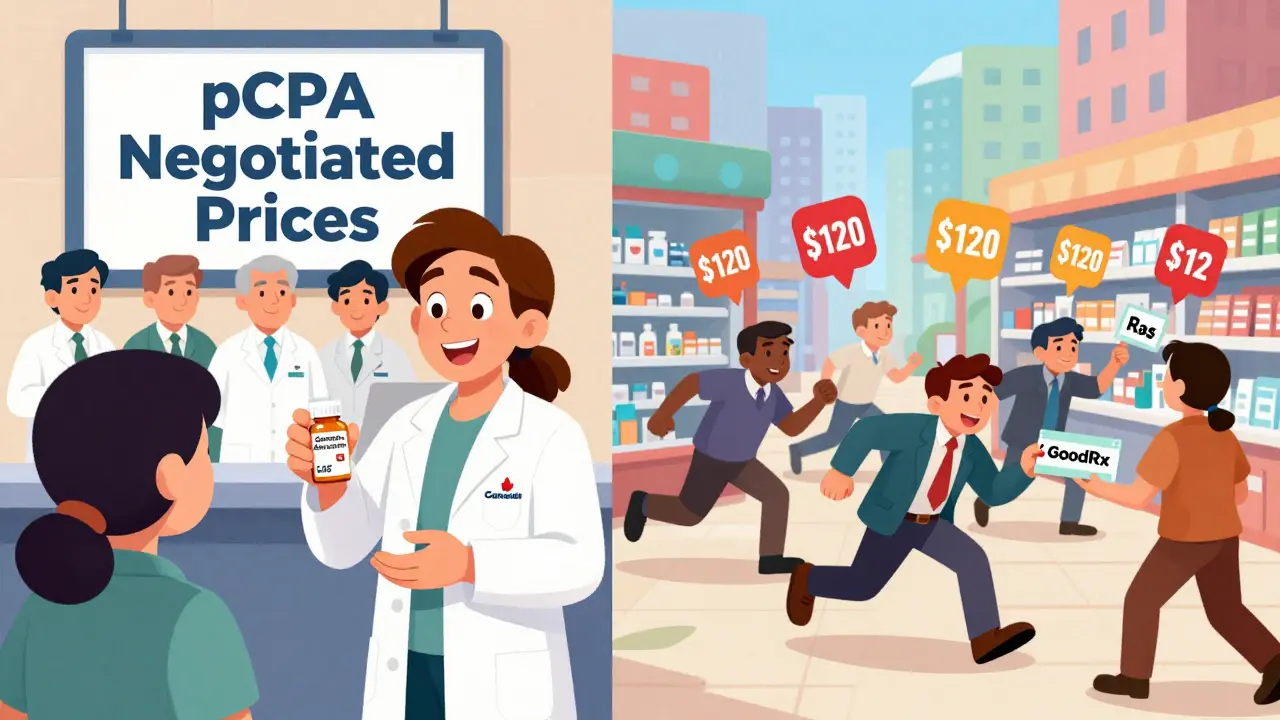
When you need a generic version of a common medication like atorvastatin or metformin, the price you pay can depend entirely on which side of the border you live on. In the United States, you might pay $12 for a 90-day supply. In Canada, the same pills could cost you $45. At first glance, that seems backward. Canada has a reputation for affordable healthcare, so why are generics more expensive there? The answer isn’t about quality or safety-it’s about structure. Canada’s system doesn’t rely on competition to drive prices down. It relies on negotiation. The United States does the opposite: it lets dozens of manufacturers fight for market share, and prices crash. Both systems work-but they work in completely different ways.
How Canada Controls Generic Drug Prices
Canada doesn’t have a free-market approach to generic drugs. Instead, it uses a centralized system called the pan-Canadian Pharmaceutical Alliance (pCPA). This group, made up of provincial and territorial drug plans, negotiates prices as a single buyer. Think of it like a giant co-op that speaks for all public drug programs in the country. When a patent expires on a brand-name drug, the pCPA doesn’t wait for companies to start undercutting each other. They call the shots. They set a price ceiling, and manufacturers either accept it or don’t sell in Canada. This system started taking shape in 2010 and was updated in October 2023 with a new three-year pricing agreement. The goal? Save money for public health plans. And it’s worked. Over the past decade, these negotiations saved Canadian drug plans more than $4 billion. But here’s the twist: those savings mostly came from brand-name drugs, not generics. Why? Because the Patented Medicine Prices Review Board (PMPRB) only controls prices for drugs still under patent. Once a drug becomes generic, the PMPRB has no authority. That means generic prices are left to the pCPA alone-and without enough manufacturers competing, prices don’t drop like they do in the U.S.The U.S. System: Competition at Full Speed
In the United States, there’s no federal price control on generics. Once a patent expires, any company can make the drug. And they do. On average, seven or eight manufacturers enter the market for a single generic drug. That kind of competition forces prices down fast. Within six months of a generic launch, prices often drop by 80 to 90%. That’s why a 90-day supply of generic atorvastatin can cost as little as $12 at a U.S. pharmacy-even less if you use a discount service like GoodRx. But there’s a catch. The U.S. system is messy. With hundreds of private insurers, each with their own formularies, patients often have to check three or more pharmacies to find the lowest price. Pharmacists spend less time negotiating and more time juggling insurance rules. And while prices are low, supply can be unreliable. When one manufacturer has a production issue, there’s no backup plan. The FDA doesn’t step in until a shortage is already affecting hospitals.Why Canada’s Generic Prices Are Sometimes Higher
It’s counterintuitive, but true: Canada’s generic drug prices are often higher than in the U.S. A 2023 study by PharmacyChecker found that 88% of the top 34 prescribed generics were cheaper in the United States. Some of the most common drugs-like levothyroxine, lisinopril, and omeprazole-cost nearly twice as much in Canada. Why? It comes down to scale. Canada has about one-tenth the population of the U.S. That means fewer customers for any one manufacturer. Fewer customers mean less incentive for companies to enter the market. In Canada, you’ll typically see three or four manufacturers for a generic drug. In the U.S., it’s often seven or more. Less competition = higher prices. And because Canada doesn’t allow drug importation from the U.S. (despite state laws trying to make it legal), there’s no pressure to lower prices. The Fraser Institute found that 33% of generics in Canada actually cost more than in the U.S.-and all of them were generics. Meanwhile, brand-name drugs are much cheaper in Canada because of the PMPRB. That creates a strange imbalance: branded drugs are tightly controlled, but generics aren’t. Some experts argue this pushes manufacturers to focus on non-patented drugs where they can charge more.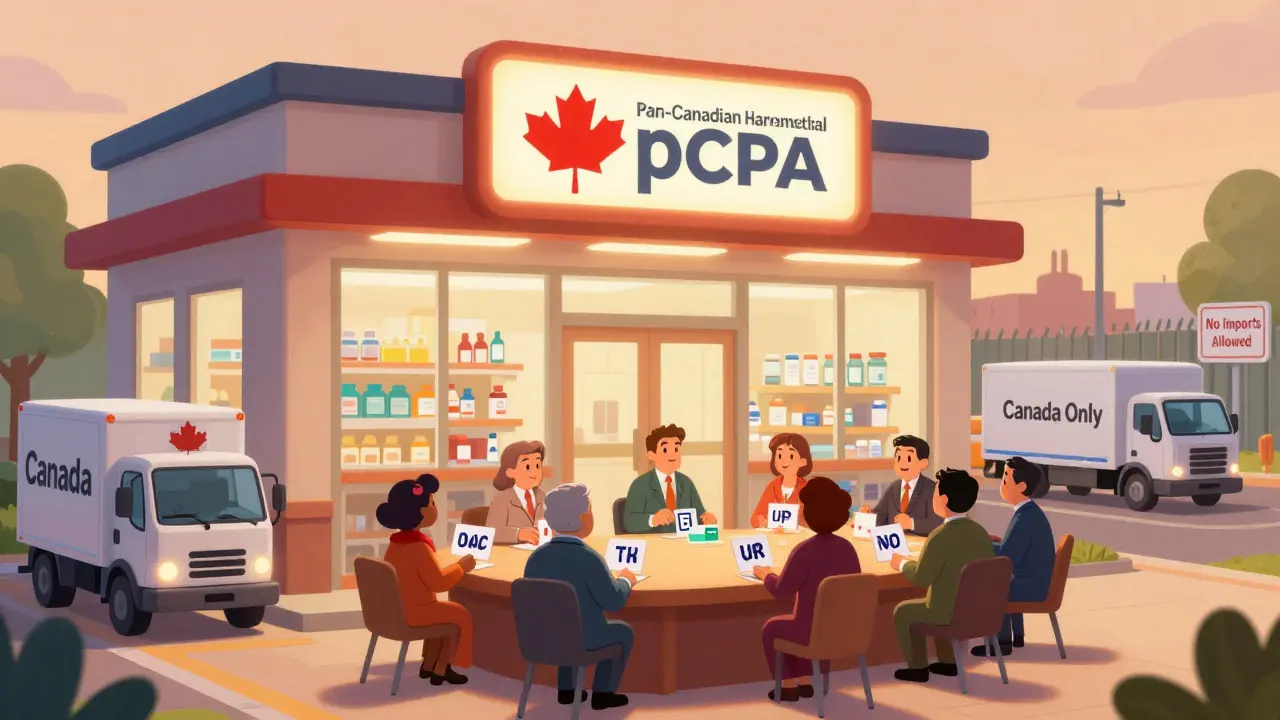
Canada Wins on Supply Chain Stability
But Canada isn’t just about high prices. It’s also about reliability. When a drug goes into shortage, Canada doesn’t wait for hospitals to cry for help. Health Canada actively tracks supply, works with manufacturers, and steps in before things get critical. In 2022, during the albuterol inhaler shortage, Canadian hospitals got priority access. Meanwhile, hospitals in Seattle were left scrambling. Research shows that sole-source drugs (those made by only one company) are more than twice as likely to go into shortage in the U.S. than in Canada. Canada’s system has built-in buffers: they allow private labeling, limit prescriptions to 30-day supplies during shortages, and fast-track approvals when needed. The result? Canadian patients are more likely to get their meds when they need them. A 2023 survey by the Canadian Pharmacists Association found that 68% of patients reported no access issues with essential generics. In the U.S., that number was 49%. For drugs that are critical-like insulin, epinephrine, or heart medications-that stability matters more than a few dollars saved.Who Pays More? Who Gets More?
Canada spends $814 per person on prescription drugs each year. The U.S. spends $1,432. That’s a 43% difference. But here’s the key: Canada’s system doesn’t save money by cutting access. It saves money by negotiating smarter. Generics make up 83% of prescriptions in Canada, compared to 90% in the U.S. So Canadians use generics almost as much-but pay more for them. How is that possible? Because Canada’s public system covers 42% of outpatient drug costs. The rest is paid through private insurance or out-of-pocket. The U.S. is similar-about half public, half private. But in the U.S., private insurers often don’t negotiate. They just pass on whatever the pharmacy charges. In Canada, the pCPA negotiates for everyone. Even private insurers often follow the public price. That’s why pharmacists in Canada spend 5 to 7 hours a week just managing pricing rules. U.S. pharmacists spend less time on pricing and more time on insurance denials. Canada’s system is bureaucratic, but it’s predictable. The U.S. system is chaotic, but often cheaper.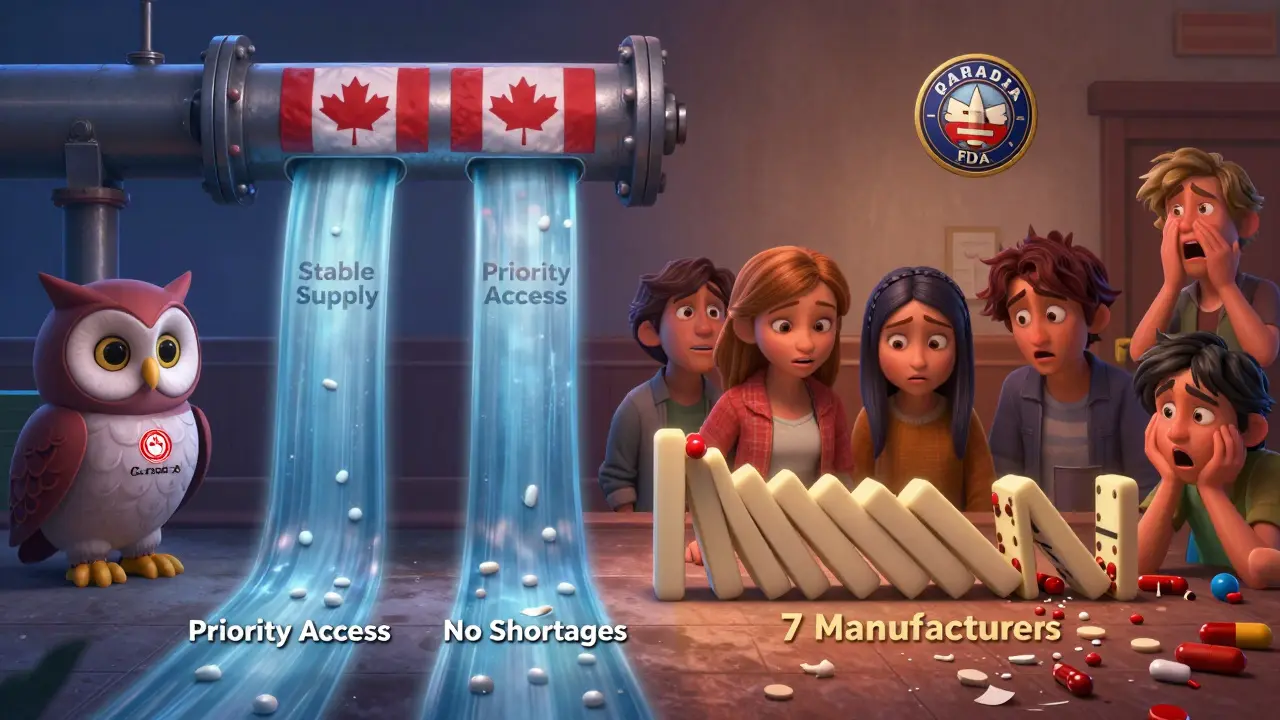
What’s Changing? What’s Next?
In 2023, Canada launched the Supply Chain Resilience Framework to prevent U.S. importation from draining its drug supply. Vermont, Colorado, and soon Florida are trying to bring Canadian drugs into the U.S. But Canada is pushing back. They can’t afford to lose their own supply to lower prices elsewhere. Meanwhile, U.S. generic prices are expected to drop another 5-8% per year through 2026. Canada’s prices are projected to rise 15-20% by 2025 due to global supply chain issues. That gap will only grow. Experts are divided. Some say Canada’s system is broken because it lets generic prices stay high. Others say it’s working-because patients don’t go without. The U.S. gets lower prices but risks shortages. Canada gets stability but pays more. Neither system is perfect. But each one reflects a different belief: Should medicine be a market? Or a right?What This Means for You
If you’re in Canada and frustrated by high generic prices, know this: you’re not alone. But you’re also protected. Your system ensures you won’t wake up one day and find your heart medication gone because a factory in India had a fire. If you’re in the U.S. and love your $12 prescriptions, remember: that low price comes with risk. A single supplier failing can leave thousands without a drug they rely on. There’s no clear winner here. Just two paths. One favors competition. The other favors certainty. Both have costs. Both have benefits.Why are generic drugs more expensive in Canada than in the U.S.?
Canada doesn’t rely on market competition to lower generic drug prices. Instead, it uses centralized negotiations through the pan-Canadian Pharmaceutical Alliance (pCPA). With fewer manufacturers in the Canadian market-about 3.8 per drug compared to 7.3 in the U.S.-there’s less pressure to cut prices. The pCPA sets price ceilings, but without enough competitors, prices don’t drop as low as in the U.S., where dozens of manufacturers enter the market after a patent expires, driving prices down by 80-90% within months.
Does Canada have a generic drug shortage problem?
Canada has fewer and less severe generic drug shortages than the U.S. Health Canada actively monitors supply chains and intervenes before shortages become critical. For sole-source drugs (made by only one company), the risk of shortage is more than double in the U.S. compared to Canada. Canadian authorities can limit prescriptions to 30-day supplies, fast-track approvals, and approve alternative suppliers to keep drugs available-even during global disruptions.
How does Canada’s drug pricing system compare to the U.S. overall?
Canada spends $814 per person annually on prescription drugs, while the U.S. spends $1,432-a 43% difference. Canada achieves this by negotiating lower prices for brand-name drugs through the Patented Medicine Prices Review Board (PMPRB) and coordinating bulk purchases for generics via the pCPA. The U.S. has no federal price controls, so prices are set by the market. While U.S. generics are often cheaper, the overall cost of healthcare is higher due to administrative fees, brand-name drug prices, and lack of negotiation power.
Can Americans buy cheaper drugs from Canada?
Legally, U.S. federal law prohibits importing prescription drugs from Canada, even if they’re cheaper. Some states like Vermont, Colorado, and Florida have passed laws to allow it, but the U.S. Department of Health and Human Services has never authorized the program. Canada has responded by strengthening its supply chain protections to prevent drugs meant for Canadians from being shipped south. So while you can find Canadian pharmacies online that ship to the U.S., doing so is technically illegal and carries risks like counterfeit drugs or lack of regulation.
Do Canadian pharmacists spend more time managing drug prices than U.S. pharmacists?
Yes. Canadian pharmacists spend an average of 5 to 7 hours per week navigating complex tiered pricing systems, provincial rules, and pCPA agreements. U.S. pharmacists spend less time on pricing and more time dealing with insurance denials and formulary restrictions. Canada’s system is standardized but bureaucratic. The U.S. system is decentralized and unpredictable, requiring pharmacists to check multiple insurers and pharmacy benefit managers daily.
Canada's system isn't broken-it's intentional. Less competition means less chaos. You get stability, not bargains. And for people on insulin or heart meds, that’s worth more than $12.
I used to think the U.S. system was the gold standard-until my mom couldn’t get her thyroid med for three weeks because the only manufacturer had a quality issue. Meanwhile, my cousin in Toronto got hers without a hiccup. The U.S. runs on luck and GoodRx coupons. Canada runs on planning. One’s a sprint, the other’s a marathon. And honestly? I’d rather be on the marathon.
Yeah, generics cost more-but I never have to call three pharmacies, argue with my insurer, or pray the pharmacy has stock. That peace of mind? Priceless. I don’t care if it’s $45 instead of $12 if I know I’m not gonna wake up to a ‘medication unavailable’ notice.
Also, the idea that Canada’s system is ‘broken’ because prices aren’t as low as the U.S.? That’s like saying your car is broken because it doesn’t go 200 mph. It doesn’t need to. It gets you where you need to go, safely.
And don’t get me started on how U.S. pharmacies get paid. It’s not about the drug-it’s about the insurance code, the rebate, the formulary tier, the prior auth, the step therapy, the copay accumulator… it’s a damn obstacle course. Canada? You show your card, you pay your share, you walk out. Simple.
I’m not anti-market-I’m pro-stability. And after seeing what happens when supply chains collapse? I’ll take bureaucracy over chaos any day.
Let’s cut through the neoliberal fog. The U.S. doesn’t have a drug market-it has a rent-extraction machine. Pharma owns the FDA, Congress, and your local pharmacy. Canada’s pCPA is the only real check on corporate power in the entire Western world. The fact that you call it ‘expensive’ is a symptom of your conditioning. You’ve been trained to equate low price with value, when in reality, value is access, reliability, and dignity.
When your system collapses because one factory in India has a mold issue, and your diabetic uncle dies because he can’t get insulin-that’s not ‘free market.’ That’s systemic failure dressed up in a ‘low cost’ suit.
And don’t even get me started on the moral bankruptcy of Americans who think it’s okay to import drugs from Canada while Canada’s own citizens are getting squeezed. You want cheap meds? Fix your broken system. Don’t turn Canada into your pharmacy annex.
It’s funny how people act like Canada’s system is some weird outlier. It’s not. Most of the developed world negotiates drug prices. The U.S. is the weird one. We’re the only country that lets corporations set prices like they’re auctioning off sneakers.
And yes, generics cost more here-but so do brand names. And yet, we still spend way less per capita. That’s because we don’t pay for 17 different versions of the same drug because some marketing team thought ‘blue pill’ would sell better than ‘green pill.’
Also, the fact that Canadian pharmacists spend 5-7 hours a week on pricing? That’s because they’re doing their job. In the U.S., pharmacists spend 12 hours a day fighting insurance bots. Who’s really wasting time?
Stop romanticizing chaos. Lower price ≠ better system. Lower stress, fewer shortages, and predictable access? That’s the real win.
OMG I just realized the U.S. is basically a drug roulette wheel 🎰💔
One day my metformin is $12, next week it’s $87 because ‘supply chain issues’ (aka Big Pharma playing monopoly). Meanwhile my Canadian friend just texts me ‘got my pills, $45, no drama.’
Why are we still pretending this is ‘freedom’? It’s just financial anxiety with extra steps. 😭
I hate how everyone acts like Canada’s system is ‘broken’ just because it’s not as cheap. You think your $12 atorvastatin is a gift? It’s a trap. You’re paying with your health every time a shortage hits. I lost my dad because they couldn’t get his heart med. No one’s talking about that. Just the price tag.
Canada doesn’t let people die because a factory had a bad batch. That’s not ‘expensive.’ That’s moral.
Canada’s system isn’t about saving money. It’s about not letting people fall through the cracks. The U.S. system is designed for people who can afford to shop around. For everyone else? Good luck.
As a nurse, I’ve seen both sides. In the U.S., we spent half our day on prior auths. In Canada, we spent it on patients. The difference isn’t price-it’s time. And time is the one thing you can’t get back.
Also, I’ve had patients cry because their insulin got pulled. No one in Canada has ever cried over that. Ever.
There’s a deeper question here: Is healthcare a commodity or a social good? The U.S. treats it like a stock ticker. Canada treats it like a public utility. One system optimizes for profit. The other optimizes for survival. Neither is perfect-but only one acknowledges that people are more important than shareholders.
Oh please. Canada’s system is just a slow-motion collapse disguised as ‘stability.’ You think those price ceilings are sustainable? They’re not. They’re just kicking the can down the road while manufacturers quietly exit the market. And when the last Canadian generic maker leaves? What then? You gonna make your own pills in your basement?
Meanwhile, the U.S. has 8 manufacturers for every drug. That’s innovation. That’s resilience. That’s capitalism working. Canada’s system is just socialism with a side of denial.
And don’t even get me started on the hypocrisy of Canadians who want to import U.S. drugs but won’t let us import theirs. You want your cake and to eat it too? That’s not a system. That’s a scam.
Hey-I get it. It’s confusing. But here’s the thing: you don’t have to choose between cheap and safe. You just have to choose what matters most to you.
If you’re young, healthy, and on a budget? The U.S. system might work for you right now.
If you’re older, on multiple meds, or just want to sleep at night? Canada’s system is the quiet hero you didn’t know you needed.
Neither is perfect. But one of them actually cares if you live.
Canada: $45 for metformin. 🤡
U.S.: $12. 🙌
Also Canada: your kid gets the meds when the factory blows up. 🇨🇦❤️
U.S.: your kid gets a text saying ‘out of stock, try again next week.’ 🇺🇸💔
Who wins? You decide.
Let’s stop pretending this is just about money. It’s about who gets to live. In the U.S., if you’re poor, you’re one paycheck away from rationing your insulin. In Canada, you’re one paycheck away from getting your meds-no matter what.
Yes, the price is higher. But the cost of not having it? That’s the real number. And guess what? The U.S. system is racking up that cost every single day.
I’ve seen people skip doses. I’ve seen people sell their bikes to pay for meds. I’ve seen people cry in the pharmacy because they can’t afford their heart pills.
Canada’s system doesn’t make you choose between rent and medicine. That’s not ‘expensive.’ That’s mercy.
And if you think capitalism is the answer? Look at the stats. The U.S. spends 75% more on healthcare and has worse outcomes. That’s not a market. That’s a failure.
We don’t need more competition. We need more compassion.
u.s. pharmacists are stuck doing insurance math all day. canada pharmacists just give you the pill. no capcha, no form, no ‘we need a doctor’s note for this.’ it’s just… simple. and honestly? that’s the real luxury.
As the author-I just want to say thank you. This conversation is exactly what I hoped for. It’s not about who’s right. It’s about understanding that there’s no perfect system. Just trade-offs. And sometimes, the cost of ‘cheap’ is too high to pay.