
Combination Drug Substitution: Legal and Practical Challenges Explained
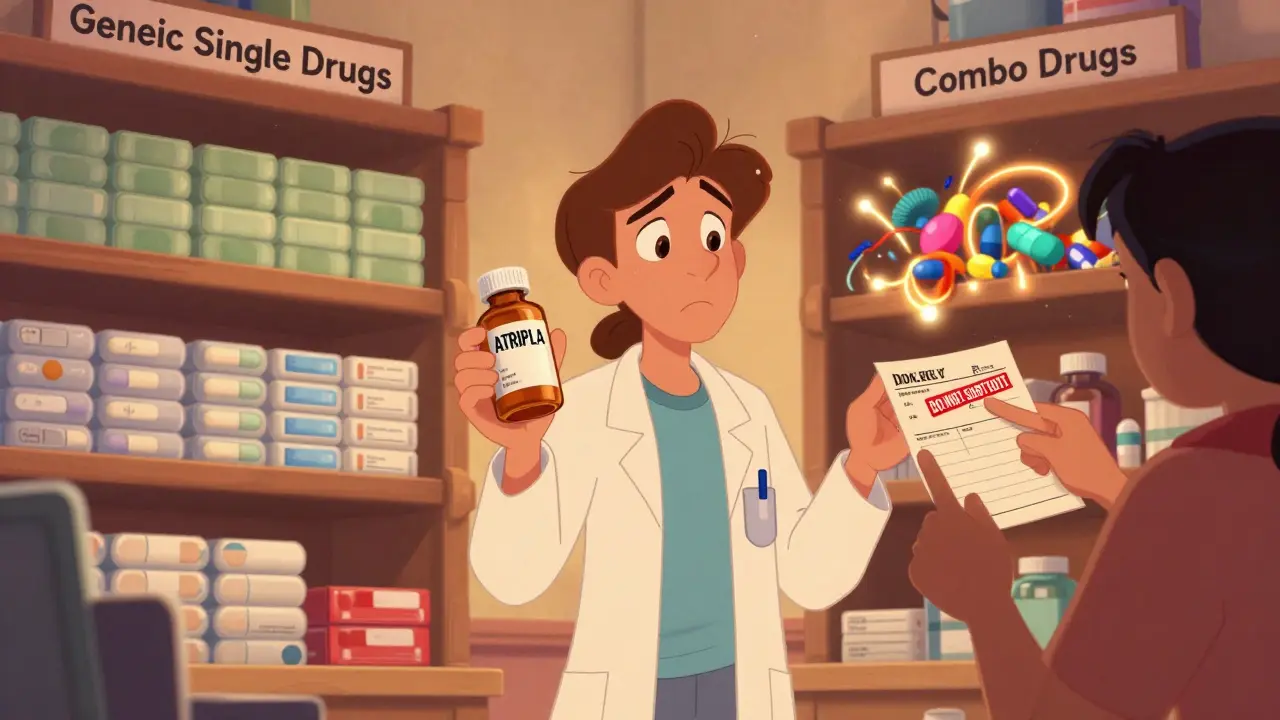
When a doctor prescribes a pill that contains two or more drugs in one tablet - like a combo of blood pressure meds or HIV antivirals - it’s called a combination drug. These aren’t new. ATRIPLA, for example, has been treating HIV since 2006 with three drugs in one capsule. But here’s the problem: when it’s time to refill, can a pharmacist swap it out for something cheaper? The answer isn’t simple. In fact, it’s legally messy, clinically risky, and varies wildly from state to state.
What Makes Combination Drugs Different?
Single-drug generics are straightforward. If your prescription says lisinopril, any pharmacy can swap it for another brand of lisinopril - same active ingredient, same dose, same effect. That’s generic substitution. Simple. But combination drugs? They’re not just two pills stuck together. They’re engineered as one unit. Think of it like a car engine: you can’t swap out just the spark plugs and call it the same engine if the fuel injection system, timing, and exhaust are all custom-tuned together. ATRIPLA isn’t just efavirenz + emtricitabine + tenofovir. It’s those three drugs in precise ratios, with specific release profiles, tested as a single unit by the FDA. The same goes for KEYTRUDA + LENVIMA, approved in 2021 for kidney cancer. These aren’t random mixes. They’re carefully designed therapies.Why Existing Laws Don’t Work
Most U.S. states have laws allowing pharmacists to substitute generic drugs - but those laws were written in the 1980s and 90s, when most prescriptions were for single chemicals. They assume equivalence means identical active ingredients. That’s fine for one drug. But what if the prescription is for a combo drug, and the only available generic is a different combo - say, one with four drugs instead of three? The Alberta College of Pharmacy puts it bluntly: substituting a single drug with a combination product is considered starting new therapy. That’s not a pharmacist’s job. That’s a prescriber’s. Yet, in practice, pharmacists are getting caught in the middle. A 2022 survey by the National Community Pharmacists Association found 68% of independent pharmacists faced a combination drug substitution dilemma at least once a month. Nearly half refused to substitute because they weren’t sure if it was legal. And it’s not just about adding drugs. What if the combo has a modified-release coating? Or if one component has a narrow therapeutic index - meaning even a tiny dose change can cause toxicity or treatment failure? The European Medicines Agency warns against substituting these without a doctor’s input. But in many states, pharmacists aren’t trained to spot that.State Laws Are a Patchwork
There’s no federal rule for substitution of combination products. Instead, you’ve got 50 different state pharmacy boards, each with their own rules. Texas requires pharmacists to document every substitution. In California, pharmacists can only substitute if the prescriber hasn’t marked “dispense as written.” But what if the original prescription was for a single drug, and the pharmacy only has the combo version? Can they swap it? In most places, no - unless the prescriber gives explicit permission. The 2022 court case Smith v. CVS Caremark set a clear precedent: pharmacists cannot substitute a combination product that contains extra active ingredients not listed on the prescription. That’s a big deal. It means if your doctor prescribes a two-drug combo, and the pharmacy only has a three-drug combo with the same two drugs plus a third, they can’t give you the three-drug version - even if it’s cheaper and clinically similar. Meanwhile, Denmark takes a broader view. Their national agency defines substitution as replacing a medicine with another that has the same active substances - even if the formulation changes. But they also require pharmacists to consult with the prescriber if the patient is on a complex regimen. The U.S. doesn’t have that safety net.
Cost vs. Safety: The Real Trade-Off
The push for substitution comes from money. Generic drugs make up 90% of prescriptions in the U.S. but only 23% of total drug spending. Combination drugs? They’re expensive. The global market hit $184 billion in 2022 and is growing fast. Insurance companies and Medicare Part D want to cut costs. Dr. Jane Chen from ICER says expanding substitution for combos could save 15-25% on chronic disease meds. But here’s the catch: the American Heart Association warns that inappropriate substitution in cardiovascular combos could lead to adverse events in up to 8% of patients - especially older adults with multiple conditions. A wrong swap could mean uncontrolled blood pressure, kidney damage, or even a heart attack. The FDA itself has approved only 37 combination products between 2015 and 2022, compared to over 1,200 single-entity drugs. Why? Because proving safety and equivalence for multi-drug combos is harder. And that’s exactly why substitution is risky.What’s Being Done to Fix This?
The FDA released draft guidance in September 2022 on how to prove therapeutic equivalence for fixed-dose combinations - a first step toward standardizing rules. The National Association of Boards of Pharmacy proposed a model law in March 2023 that would classify combos into two tiers: “simple” (two well-known drugs) and “complex” (novel mechanisms, narrow therapeutic index). Only simple combos could be swapped by pharmacists, with strict documentation. Complex ones? Require a doctor’s approval. In Europe, the European Commission is pushing for harmonized rules across member states. The UK’s NHS has already cut £280 million annually by standardizing substitution for heart disease combos - but only after years of physician oversight and clinical audits. Still, the biggest barrier isn’t science - it’s law. Pharmacists aren’t doctors. They can’t change a prescription. Yet, when a patient can’t afford their combo med, they’ll ask for a cheaper alternative. And pharmacists, caught between legal risk and patient need, often make risky calls.
What Patients Should Know
If your prescription is for a combination drug - especially if it’s for HIV, heart disease, diabetes, or cancer - don’t assume a substitution is safe or legal. Always ask:- Is this the exact combo my doctor prescribed?
- Are the active ingredients and doses identical?
- Has my doctor approved this change?
The Future of Combination Drug Substitution
By 2025, experts predict nearly one-third of all new drug approvals will be combination products. That means this problem isn’t going away. The system is broken - and it’s not just about money. It’s about trust. Patients rely on pharmacists to keep them safe. Pharmacists rely on clear laws. And doctors rely on both to follow the prescription. Real change needs three things:- Federal guidance - A uniform standard for what counts as equivalent in a combo drug.
- Clear state laws - No more guessing games. Pharmacists need to know exactly when they can and can’t substitute.
- Prescriber involvement - For complex combos, the doctor must be part of the decision. Not the pharmacist. Not the insurer.
Can a pharmacist substitute a combination drug without my doctor’s permission?
In most U.S. states, no. If your prescription is for a combination drug - even if it’s a generic - pharmacists cannot substitute it with another combination product that has different active ingredients or dosages without explicit approval from your prescriber. Substituting a single drug with a combo drug is considered starting new therapy, which requires prescribing authority. The 2022 court case Smith v. CVS Caremark confirmed that pharmacists cannot add extra active ingredients not listed on the original prescription.
Are all combination drugs eligible for generic substitution?
No. Only combination products that have been officially rated as therapeutically equivalent by the FDA can be substituted - and even then, only under specific conditions. Many newer combination drugs, especially those with novel delivery systems, narrow therapeutic indexes, or multiple new chemical entities, don’t have approved generic equivalents. The FDA has approved far fewer combination generics than single-drug generics. Always check the FDA’s Orange Book or ask your pharmacist for the product’s therapeutic equivalence rating.
Why are combination drugs more expensive than single drugs?
Combination drugs are more expensive because they require extensive clinical testing to prove safety and effectiveness as a single unit. Each drug in the combo must interact properly, have compatible release profiles, and not interfere with each other’s absorption. This adds years and millions in development costs. Unlike single-drug generics, which can be copied quickly, combination generics must be proven equivalent to the brand - a process that’s harder and slower. As a result, many combo drugs remain branded and expensive for years.
Can I ask my doctor to switch me to a combination drug to save money?
Yes, but only if it’s clinically appropriate. Some patients take three separate pills daily. Switching to one combo pill can improve adherence and reduce side effects from multiple doses. However, not all combinations are interchangeable. For example, you can’t swap a beta-blocker and a diuretic for a combo pill unless your doctor confirms the doses match and the combo is approved for your condition. Always discuss cost concerns with your doctor - they may be able to prescribe a generic combo or help you find patient assistance programs.
What should I do if my pharmacy gives me a different combination drug without asking?
Stop taking it immediately and contact your prescriber. Also, call your state’s pharmacy board to report the incident. If the new medication contains extra active ingredients or different doses, it could be dangerous. You have the right to receive exactly what your doctor prescribed. Pharmacists are required to verify prescriptions before dispensing - and if they made a substitution without authorization, that’s a violation of state law.
So let me get this straight - pharmacists can swap out a Tylenol for a generic, but if I’m on a combo pill that’s basically a little pharmaceutical symphony, they can’t touch it? Meanwhile, my insurance company wants me to switch to a $3 generic that’s not even the same combo. This isn’t healthcare, it’s Russian roulette with side effects.
And don’t even get me started on how half the pharmacists don’t even know what a narrow therapeutic index is. They’re just scanning barcodes and hoping for the best.
Man, I’ve been on a combo HIV med for 8 years. My pharmacist once tried to swap it for a ‘similar’ one because it was ‘cheaper.’ I had to call my doctor at 11 p.m. because I almost took it. 🤯
Turns out the new one had an extra drug that made me dizzy for three days. Never again. Always ask. Always verify. Your life isn’t a cost-cutting experiment.
the problem is not just law or pharma… it’s the whole system… we treat medicine like a commodity… but body is not a car… you cant just swap spark plugs and expect same ride… but who cares right? profit over person… again…
The FDA’s therapeutic equivalence ratings for fixed-dose combinations are fundamentally flawed due to bioequivalence assumptions derived from single-agent pharmacokinetics. The lack of pharmacodynamic harmonization metrics renders substitution protocols statistically invalid for polypharmaceutical regimens, particularly those involving CYP450-metabolized agents with non-linear clearance profiles. This is not regulatory ambiguity - it’s systemic negligence.
Of course they’re letting pharmacists swap combo drugs. It’s not incompetence - it’s a corporate conspiracy. Big Pharma wants you on expensive branded meds so they can keep raking in cash. The FDA? Bought and paid for. The ‘model law’? A PR stunt. You think they care if you die of uncontrolled hypertension? No. They care about Q4 earnings.
And don’t believe the ‘patient safety’ talk. That’s the same BS they used to sell Vioxx.
How is it even possible that we live in a country where a pharmacist - someone who literally can’t prescribe an aspirin for a headache - is allowed to decide whether your life-saving combo med gets swapped? It’s not just dangerous. It’s absurd. And the fact that we’re still debating this in 2025? Pathetic.
I’d like to see the CEO of CVS take one of these substituted pills and then tell me it’s ‘clinically equivalent.’
My aunt got switched to a combo pill for her BP and ended up in the ER because the new one had a diuretic she was allergic to. She didn’t even know it changed. The pharmacist said ‘it’s basically the same.’
Don’t trust ‘basically.’ Always check the label. Always ask for the Orange Book rating. And if they get defensive? Walk out. You’re not a lab rat.
Y’all are right to be scared - but don’t lose hope. This is fixable. I work in a clinic and we’ve started giving patients printed cards that say: ‘My combo med = [name]. Do NOT substitute without my doctor’s signature.’
Pharmacists love it. Patients feel empowered. And we’ve had zero bad swaps since. Small wins matter. Keep pushing for clarity.
🫶
My doctor switched me to a combo pill to cut down my pill count. Now I can’t get it refilled without a new script. Worth it.
Coming from India, we’ve had combo generics for years - but here? We treat them like nuclear codes. It’s wild. In Mumbai, a pharmacist will hand you a combo for diabetes and hypertension and say ‘take one, it’s all in one.’ No paperwork. No drama.
Here, you need a notarized letter and a blood oath. We’re not protecting patients - we’re protecting lawyers.
Look, I get that cost matters - but you can’t just treat a multi-drug regimen like a grocery list. I’m a nurse practitioner, and I’ve seen patients on combo antivirals who got swapped to a generic version with a different release profile. One guy had a seizure because his efavirenz levels spiked. He didn’t even know the pill changed.
These aren’t just ‘drugs.’ They’re engineered systems. The FDA’s 37 approved combo products? That’s not a shortage - that’s a warning. If it’s hard to prove equivalence, it’s because it’s dangerous to guess.
And pharmacists? They’re not the enemy. They’re trapped. The system is. We need federal standards, mandatory training on combo pharmacology, and a national database of approved substitutions - not state-by-state chaos. This isn’t about control. It’s about survival.
My doc prescribed me a combo for my heart. I asked the pharmacist if I could get a cheaper version. He looked at me like I asked him to swap my kidneys.
‘Sir, this isn’t laundry detergent.’
And honestly? He was right.
I used to think this was just a legal mess… but now I see it’s deeper. It’s about who gets to decide what’s safe for your body. Is it the doctor who knows your history? The pharmacist who knows your meds? Or the insurance rep who just wants to hit a quarterly target?
It shouldn’t be any of them. It should be you - with real information. And right now? You’re not getting that.
It is with profound respect for the integrity of pharmaceutical science and the sanctity of patient autonomy that I submit this observation: the current regulatory fragmentation across jurisdictional boundaries represents a systemic failure in the alignment of clinical governance with public health imperatives. The absence of harmonized standards for therapeutic equivalence in fixed-dose combinations constitutes a critical vulnerability in the continuum of care, particularly for elderly and multimorbid populations. A unified, evidence-based, and legally enforceable framework is not merely advisable - it is ethically imperative.
bro why are we even arguing about this? just make the law clear. if it's a combo, it's a combo. no swaps unless doc says so. done. why is this hard?