
Common Translation Issues on Prescription Labels and How to Get Help
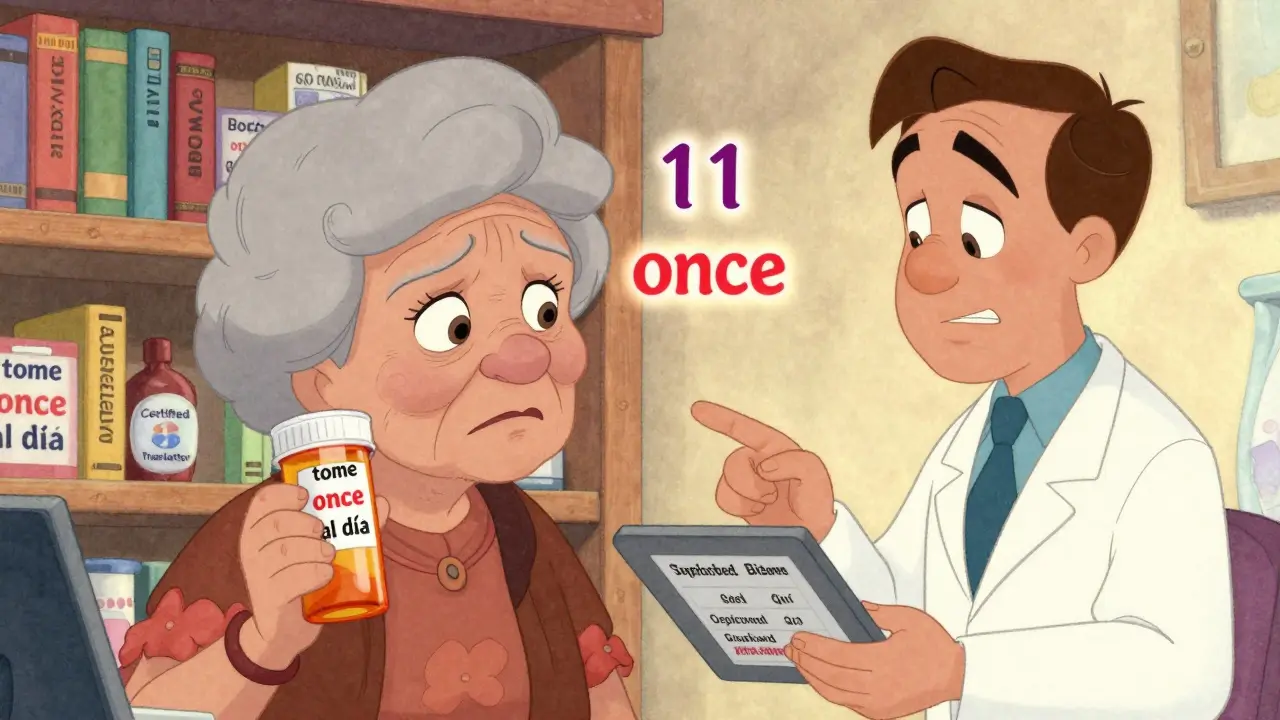
Imagine you’re helping your parent take their heart medication. The label says "tome dos tabletas dos veces diario". You think it means "take two tablets twice a day" - and you’re right. But at the pharmacy down the street, the same instruction was translated as "tome dos tabletas dos veces semanal" - twice a week. One mistake. Two completely different outcomes. One could save a life. The other could land someone in the ER.
This isn’t rare. It’s happening every day in pharmacies across the U.S. And it’s not just Spanish speakers at risk. People who speak Chinese, Vietnamese, Arabic, Tagalog, and dozens of other languages face the same danger when prescription labels are mistranslated.
Why Prescription Labels Get Translated Wrong
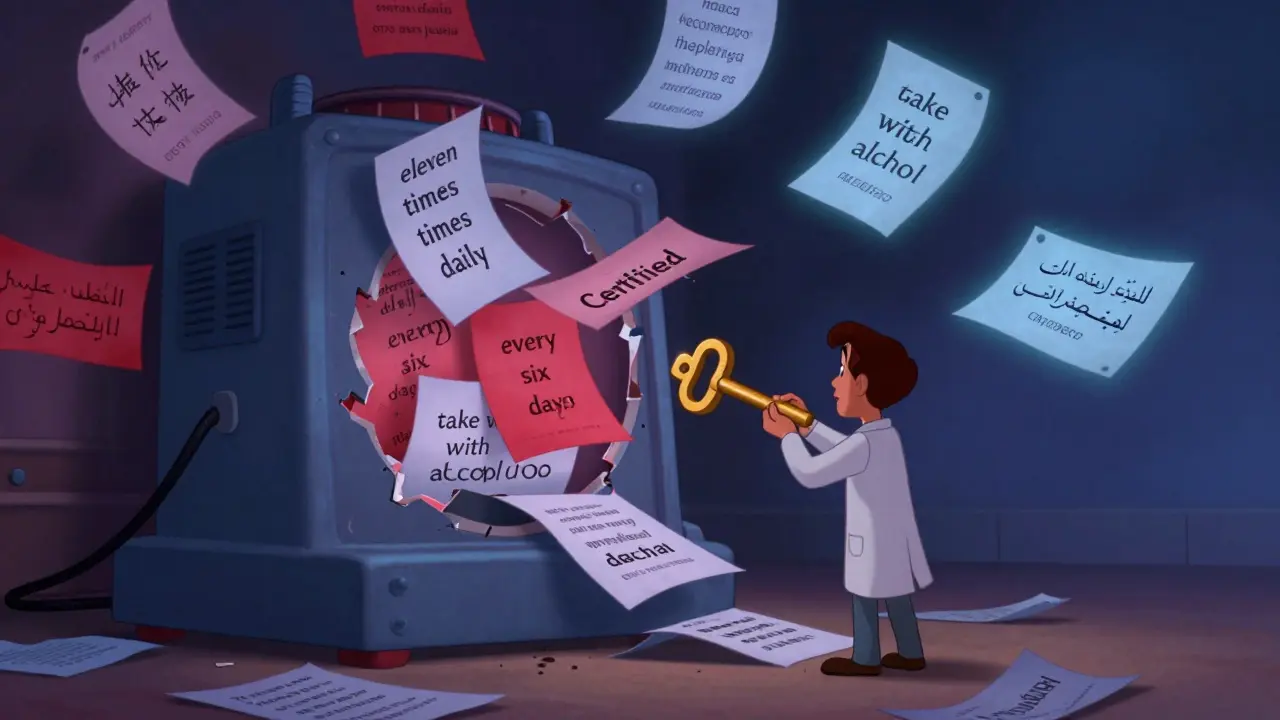
Most pharmacies don’t hire professional translators. They use cheap, automated systems - the kind you’d use to translate a restaurant menu or a tourist sign. These systems don’t understand medical terms. They don’t know that "once" in English means "one time," but in Spanish, "once" means "eleven." So when a label says "take once daily," a computer might translate it as "tome once al día" - which could be read as "take eleven times a day." That’s not a typo. That’s a life-threatening error.
Studies show half of all computer-generated Spanish prescription labels contain dangerous mistakes. The same problem shows up in other languages. A 2022 survey found that 68% of healthcare providers struggled with foreign prescriptions because terms changed from one pharmacy to another. One chain might say "take with food," another says "take after meals." They’re the same thing - but the translation tools don’t know that.
Even worse, some systems mix languages. You’ll see "Spanglish" labels - half English, half Spanish - because the software couldn’t decide which word to use. Patients get confused. They don’t know if they’re supposed to take the pill at 8 a.m. or 8 p.m. They don’t know if "una vez" means once or eleven times. And when they make a mistake, they often don’t tell anyone. They just stop taking the medicine - or take too much.
The Real Cost of a Bad Translation
It’s not just confusion. It’s hospital visits. It’s organ damage. It’s death.
Dr. Yaffa Rashewsky from New York-Presbyterian says a single mistranslated word can turn medicine into poison. And she’s not exaggerating. In California, where strict translation rules have been in place since 2016, medication errors among Spanish-speaking patients dropped by 32%. In states without rules, errors stay high. A 2023 survey found that 63% of limited English speakers were confused by their labels. Nearly 3 out of 10 admitted they’d taken the wrong dose because of bad translations.
One Reddit user shared how their mother was given a label that said "take one pill every six hours" - but the translation said "every six days." She didn’t take it for weeks. Her condition worsened. Another user wrote that their father took a blood thinner labeled "take once daily," but the Spanish version said "take eleven times daily." He ended up in the hospital with internal bleeding.
These aren’t outliers. They’re symptoms of a broken system.
Who’s Responsible?
The law says pharmacies must provide language access. Title VI of the Civil Rights Act requires it. But enforcement is patchy. Only two states - California and New York - have laws that actually force pharmacies to use professional translators. In the rest of the country, it’s optional. Most pharmacies choose the cheapest option: computer translation.
Why? Cost. Automated translation costs pennies per label. Professional translation costs 5 to 15 times more. For a pharmacy filling thousands of prescriptions a day, that adds up fast. But here’s the truth no one talks about: the cost of a mistake is far higher. A single medication error can cost $10,000 to $50,000 in emergency care, hospital stays, and lost productivity. According to McKinsey’s analysis, every dollar spent on proper translation saves $3.80 in avoided harm.
Big pharmacy chains like CVS and Walgreens are starting to change. CVS rolled out LanguageBridge in early 2024 - a system that uses AI to translate labels but then checks every one with a licensed pharmacist. Walgreens launched MedTranslate AI in late 2023. Both cut translation errors by over 60% in pilot stores. But these systems are still rare. Only 23% of pharmacies offer translation in Chinese or Vietnamese. For languages like Arabic or Korean, it’s even worse.
How to Get Help - Right Now
You don’t have to wait for the system to fix itself. Here’s what you can do today:
- Ask for a certified translator. Don’t settle for a printed label. Ask: "Can I speak with someone who speaks my language and understands medicine?" Many pharmacies have phone interpreters or in-person staff. If they say no, ask to speak to the pharmacist directly.
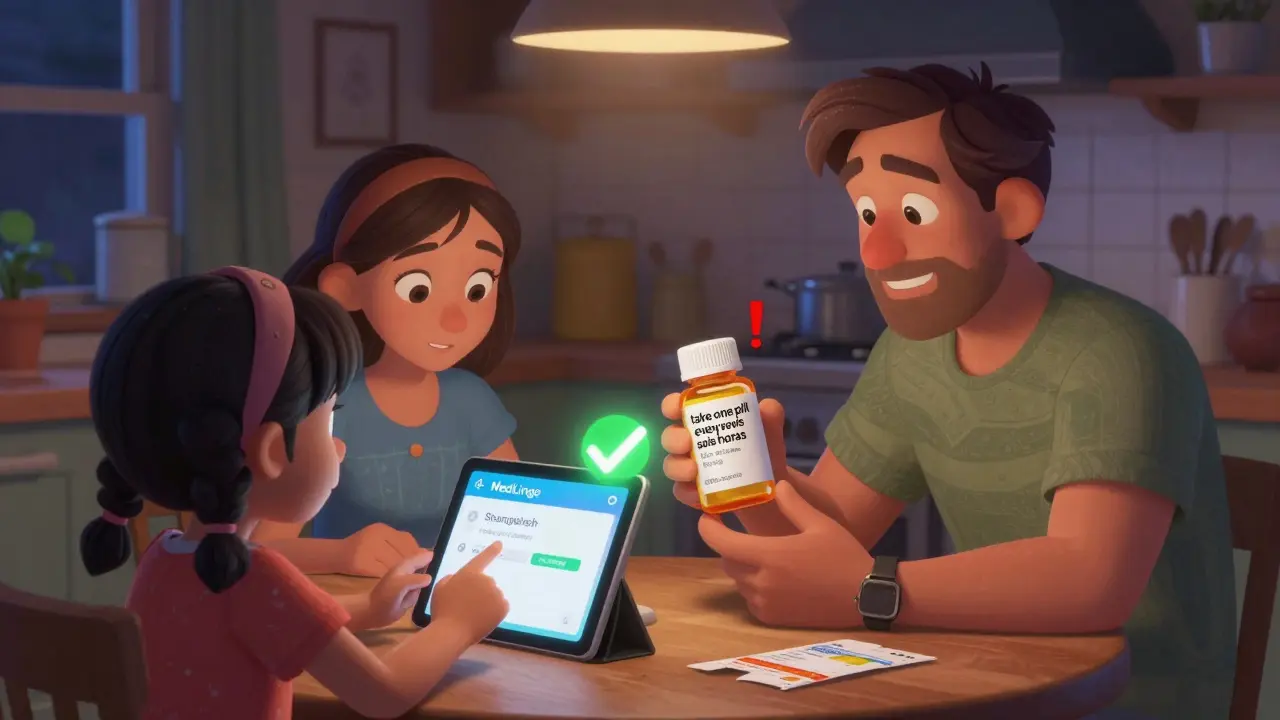
- Use a trusted translation app. Apps like MedLingo or HealthLingo are designed for medical terms. They’re not Google Translate. They know the difference between "once" and "eleven." Show the pharmacist the translation on your phone and ask them to verify it.
- Bring a bilingual family member. If you’re helping someone else, go with them to the pharmacy. Ask the pharmacist to explain the label out loud - in both languages - while you write it down.
- Check your label against your doctor’s instructions. Did your doctor say "take once a day"? Does the label say the same thing? If not, don’t take the pill until you get it cleared.
- Report bad translations. If you see a dangerous error, tell the pharmacy manager. Then call your state’s health department. In California, you can file a complaint with the Board of Pharmacy. In other states, contact your local health clinic or the National Health Law Program.
There’s also a free resource: the Healthcare.gov Language Assistance Tool. It helps you find pharmacies near you that offer certified translation services - and even lets you request a label in your language before you pick up your prescription.
What’s Changing - and What’s Coming
The good news? Things are moving. In 2024, the FDA released new draft guidelines that require all prescription labels to use plain language - no jargon, no ambiguity. That makes translation easier. The HHS launched a $25 million grant program to help pharmacies buy better translation tools. And 17 states are now considering laws like California’s.
Pharmacies that invest in real translation aren’t just doing the right thing - they’re saving money. Kaiser Permanente spent $15,000 per location to upgrade their system. Within two years, medication-related ER visits among non-English speakers dropped by 27%. That’s not just better care. That’s better business.
But change won’t come fast enough for everyone. Right now, if you or someone you care about is taking medicine and doesn’t speak English well, you can’t wait for policy. You have to act.
What to Look for on a Safe Prescription Label
A good translated label doesn’t just translate words - it makes sense. Here’s what to check:
- Clear dosage: "Take 1 tablet by mouth every morning" - not "Take one once daily."
- Consistent terms: If "daily" is used, it shouldn’t switch to "every day" or "each day" in the same label.
- No mixed languages: No "Spanglish." No half-English phrases.
- Verification mark: Some pharmacies stamp or print "Certified by Medical Translator" - that’s a good sign.
- Phone number for questions: A safe label includes a number to call if you’re unsure.
If you see none of these - don’t take the pill. Ask for help.
Final Thought: This Isn’t About Language. It’s About Safety.
Translation isn’t just a service. It’s a lifeline. When a label is wrong, it’s not a mistake - it’s negligence. And the people who pay the price aren’t corporations. They’re grandparents, single parents, refugees, farmworkers, students - people who trust the system to keep them safe.
You don’t need to fix the whole system. You just need to speak up. Ask for help. Verify the label. Report the error. You might save someone’s life - or your own.
What should I do if my prescription label is translated wrong?
Don’t take the medication. Call the pharmacy and ask to speak with a pharmacist or certified translator. If they can’t help, ask for a printed copy of the correct instructions in your language. You can also call your doctor’s office to confirm the dosage. If the error is serious - like "once" being translated as "eleven" - file a complaint with your state’s Board of Pharmacy or the National Health Law Program.
Are pharmacies legally required to translate prescription labels?
Under federal law, pharmacies must provide language assistance to patients with limited English proficiency. But there’s no national law requiring translated labels. Only California and New York have specific rules that force pharmacies to use professional translators. In other states, it’s up to the pharmacy - and many choose the cheapest option, which often leads to dangerous errors.
Can I use Google Translate for my prescription label?
No. Google Translate and other general-purpose apps don’t understand medical terms. They can’t tell the difference between "once" (one time) and "once" (eleven) in Spanish. They don’t know that "alcohol" means rubbing alcohol in Latin America but drinking alcohol in Spain. Always use a medical-specific translation tool like MedLingo or ask a certified translator to verify the label.
Which languages are most commonly mistranslated on prescriptions?
Spanish is the most common, because it’s spoken by over 15 million limited English speakers in the U.S. But Chinese, Vietnamese, Arabic, Tagalog, and Korean are also frequently mistranslated. In fact, only 23% of pharmacies offer translation in Chinese or Vietnamese, and even fewer offer it in Arabic or Russian. The problem is worst for languages that aren’t widely spoken in the U.S.
How can I find a pharmacy that offers good translation services?
Call ahead and ask: "Do you have certified medical translators available for [your language]?" You can also use the Healthcare.gov Language Assistance Tool to find pharmacies near you that offer verified translation services. Pharmacies like Kaiser Permanente, Walgreens (in some locations), and large community clinics are more likely to have trained staff. Look for labels that say "Certified by Medical Translator" - that’s a sign they take it seriously.
What’s the difference between machine translation and professional translation for prescriptions?
Machine translation uses software to convert words - often with 50% error rates for medical terms. Professional translation uses certified medical translators who understand both the language and the medicine. They check for false cognates, regional differences, and dosage clarity. Studies show professional translation has a 98-99% accuracy rate. Machine translation alone is only 65-75% accurate - and that’s not good enough when lives are on the line.
My grandmother took her blood pressure med for weeks because the label said 'once daily' but it was translated as 'once every eleven days.' She didn't realize until her doctor noticed her numbers were off. No one at the pharmacy apologized. Just shrugged and said, 'We use the software.' This isn't a tech issue. It's a moral failure.
Of course this is happening. Pharmacies are corporations, not hospitals. They don't give a damn about your grandma's life if it costs 12 cents more per label. The real crime? The FDA lets this slide. Meanwhile, we're out here fighting over gender pronouns on forms while people die because 'once' got translated as 'eleven.' Fix the system or shut up.
Let me be crystal clear: This isn’t about ‘language access.’ It’s about cultural arrogance. We think Spanish is ‘easy’ to translate because we’ve seen it on taco trucks. But medical terminology isn’t ‘taco’ and ‘burrito.’ It’s pharmacokinetics, contraindications, half-lives. And we outsource it to a bot that thinks ‘dosis’ means ‘dose’ and not ‘a deadly mistake.’ We treat non-English speakers like second-class citizens who should be grateful for any label at all. Shameful.
I am from India, and we have similar issues with Hindi and Tamil prescriptions... but here, sometimes, the pharmacist will call a doctor on phone to verify. Maybe we need more human connection, not more AI... I think this is not only American problem, it is global problem, really...
If you or someone you love is taking medication and the label doesn’t make sense, please don’t guess. Don’t hope it’s okay. Don’t wait for someone else to fix it. Walk back into the pharmacy. Ask for the pharmacist. Ask again. If they don’t help, go to another one. Your life matters more than their convenience. You are not being difficult. You are being smart.
i just saw a label that said 'take 1 pill every 6 hours' but the spanish said 'cada 6 dias'... my aunt took it once a week for a month. she thought she was being careful. no one noticed until she passed out. now i always take the bottle with me to the pharmacy and say 'read it out loud.'
Let’s not romanticize ‘professional translators.’ Even certified medical translators are trained on standardized lexicons. They don’t always account for regional dialects - e.g., 'pastilla' in Mexico vs. 'comprimido' in Spain. The real solution is a standardized, FDA-certified medical terminology ontology with multilingual ontological mappings, not human labor. We need semantic interoperability, not sentiment.
My cousin’s mom got a label that said 'take one every 8 hours' - but the Spanish version said 'tome una cada ocho dias.' She didn’t take it for two weeks. When she finally went to the ER, the doctor asked, 'Why didn’t you call?' She said, 'I didn’t want to be a bother.'
That’s the real tragedy. Not the bot. Not the cost. It’s the silence.
i dont know why this is so hard. if you cant translate it right, dont print it. just give the person a phone number. better to have no label than a wrong one. i dont want to be the one who kills someone because i trusted a machine.
Who benefits from this? Big Pharma. Big Pharmacy. The AI companies selling these broken systems. The government lets it happen because it’s cheaper than fixing it. This isn’t negligence - it’s systemic genocide. They don’t care if your abuela dies. She’s not a voter. She’s not a customer. She’s just a statistic they can ignore until the lawsuit hits.
People act like this is new. It’s not. We’ve had this problem since the 80s. But now it’s worse because we outsource everything to robots and pretend it’s progress. We don’t need more apps. We need more people who speak the language and know what 'hypertensive crisis' means. Stop outsourcing humanity.
In India, we have a system called 'MediCall' - trained volunteers who go to clinics and explain prescriptions in local languages. It costs less than $2 per label. No AI. Just trained people who care. Why can't America do this? Is it because we think only machines are 'modern'?
Look, I know this feels overwhelming. But you are not powerless. You can ask for help. You can demand a translator. You can write to your state rep. You can share this post. You can take the time to read the label out loud with someone who speaks the language. Small actions add up. One person asking for help can save a hundred lives. You are the change. Don’t wait for someone else to do it. Start today. You’ve got this. 💪❤️
So CVS and Walgreens finally got their act together… after 20 years of people dying. Meanwhile, my local pharmacy still uses Google Translate. I asked them why. They said, 'We’re small. We can’t afford it.'
Yeah. And I can’t afford to lose my dad. Guess who’s paying the price?