
First Generic Approval: Why It Matters and What It Means for Drug Prices and Access
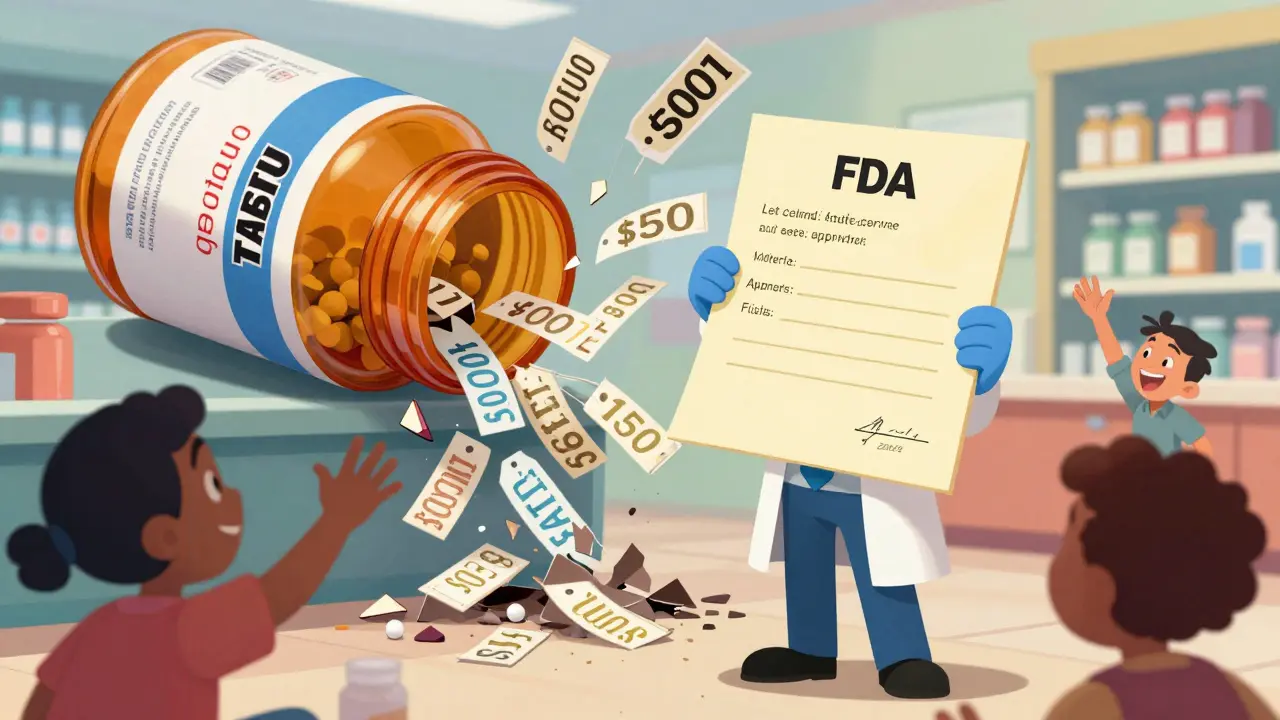
When a brand-name drug loses its patent, it doesn’t immediately become cheaper. Someone has to be first to prove they can make it just as well-and that’s where first generic approval changes everything. This isn’t just a bureaucratic milestone. It’s the moment that drops drug prices by 70-90%, opens access for millions, and triggers a chain reaction that reshapes how medicine is bought and sold in the U.S.
The system that makes this possible started in 1984 with the Hatch-Waxman Act. Before that, companies wanting to sell generic versions of drugs had to run full clinical trials, even though the original drug’s safety and effectiveness were already proven. That made generics too expensive to produce. The Act changed that. It let generic makers submit an Abbreviated New Drug Application (ANDA), skipping the costly trials and instead proving their version works the same way through bioequivalence tests. But there was a twist: the first company to file gets 180 days of exclusive rights to sell the generic. That’s not just a reward-it’s the engine that drives the whole system.
What Exactly Is a First Generic Approval?
A first generic approval goes to the first company to submit a complete ANDA for a drug after its patent expires. But it’s not just about being first to mail in the paperwork. To qualify, the applicant must also file what’s called a Paragraph IV certification. That’s a legal notice saying the brand-name drug’s patents are either invalid or won’t be infringed. This triggers a 45-day window where the brand-name company can sue. If they do, the FDA can’t approve the generic for up to 30 months while the court case plays out.
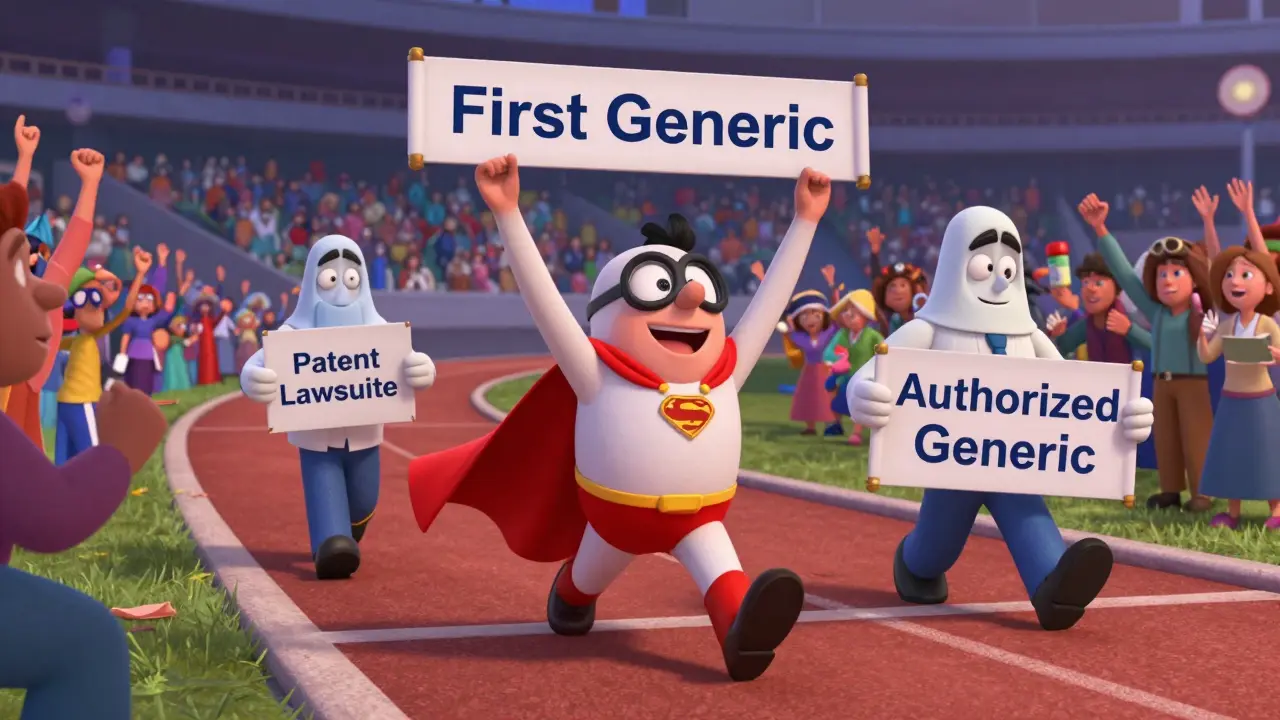
The real power comes after approval. During those 180 days, no other generic can enter the market. The first company has the field to itself. That’s why they can price their version 15-20% below the brand-name drug and still make huge profits-sometimes $100 million to $500 million on blockbuster drugs. For example, when Amgen launched the first generic version of Humira in September 2023, it captured 42% of the market in just 90 days.
But it’s not always smooth. If multiple companies file on the same day, they can share the exclusivity. And if the first company doesn’t start selling within 75 days of approval, they lose the exclusivity. Even worse, brand-name manufacturers sometimes launch their own unbranded version-called an authorized generic-right when the first generic hits the market. That can eat into sales by 20-30%.
Why This Matters for Patients and Providers
For patients, first generic approval means affordability. Before a generic hits, a drug like Eliquis (apixaban) might cost $500 a month. After the first generic arrives, it can drop to $150. That’s not a small difference-it’s the difference between taking the medicine and skipping doses.
A 2024 survey of 1,200 U.S. pharmacists found that 87% saw improved patient access because of first generics. Seventy-three percent reported better adherence-patients were more likely to fill their prescriptions consistently. Patient reviews on Drugs.com show first generics getting 4.2 out of 5 stars, nearly identical to the 4.3 average for brand-name drugs. People aren’t noticing a difference in how they feel. They’re noticing the price.
But there are hiccups. When the first generic of Eliquis faced manufacturing delays, its market launch was pushed back 90 days. During that time, prices stayed high because no other generic could enter. Pharmacists reported supply shortages and price spikes. These aren’t rare glitches-they’re part of the system’s fragility.
The Business Side: High Risk, High Reward
Getting first generic approval isn’t cheap. Preparing an ANDA takes 18 to 24 months and costs $50 million to $100 million. Bioequivalence studies alone can run $2 million to $5 million. Then there’s the legal battle. If the brand-name company sues, legal fees can hit $5 million to $15 million. That’s why only companies with deep pockets or specialized expertise go after it.
Tea is the biggest player, with 14 first generics approved in 2023. Hikma Pharmaceuticals came in second with 11. These companies don’t just have regulatory teams-they have patent lawyers, manufacturing experts, and supply chain specialists all working in sync. The FDA gives these applications priority review, cutting approval time to 10-12 months instead of the usual 14-18. But even with that speed, only 78% of submitted applications are approved on the first try. The rest? They get rejected for missing data, flawed studies, or facility issues.
What’s Changing in 2026?
The landscape is shifting. In 2023, the FDA approved 112 first generics-12% of all generic approvals that year. That’s up from just 87 in 2020. Why? Because more big drugs are losing patents. Over $156 billion worth of branded drugs are set to lose exclusivity by 2028.
New rules are helping. The 2022 CREATES Act stops brand-name companies from blocking generic testers from getting samples of their drugs. The 2022 Inflation Reduction Act removed the clock stop for drugs with Risk Evaluation and Mitigation Strategies (REMS), making it harder to delay generics. And the FDA’s 2024 Strategic Plan is pushing harder to approve complex generics-like inhalers and topical creams-that were once too hard to copy.
But challenges remain. Authorized generics still pop up in 38% of cases. Patent thickets-where drugmakers file dozens of overlapping patents to block generics-are still common. And biologics? They’re a whole different ballgame. The first biosimilar approval took 13 years after the law was passed. Only 43 have been approved so far.
The Bigger Picture: Savings and Impact
Since 1984, generics have saved the U.S. healthcare system over $1.7 trillion. First generics are responsible for the biggest chunk of that. In 2020, the Congressional Budget Office estimated the Hatch-Waxman system saves $13 billion a year. And it’s not just about money. It’s about access. A study in Health Affairs found that 42% of first generics were delayed between 2010 and 2020 because of legal tactics by brand-name companies. That’s not innovation-it’s obstruction.
Today, over 90% of prescriptions in the U.S. are filled with generics. That’s up from 19% in 1984. That shift didn’t happen by accident. It happened because the system gave one company a real incentive to be first. And that first move set off a cascade of lower prices, better access, and more competition.
If you’re wondering why drug prices drop so sharply after a patent expires, the answer is simple: the first generic approval is the spark. It’s not glamorous. It’s not flashy. But it’s the single most powerful tool we have to make medicine affordable.
What does "first generic approval" mean?
First generic approval is when the FDA grants approval to the first company to submit a complete Abbreviated New Drug Application (ANDA) for a generic version of a brand-name drug after its patent expires. This company gets 180 days of exclusive marketing rights, during which no other generic can enter the market. It’s the key trigger that drives down drug prices.
Why is the 180-day exclusivity period so important?
The 180-day exclusivity period gives the first generic manufacturer a monopoly on the market. During this time, they can sell their version at a discount to the brand-name drug and capture 70-80% of the generic market. For high-value drugs, this can mean $100 million to $500 million in profits. Without this incentive, few companies would risk the cost and legal battles of being first.
Can a brand-name company still sell a generic version?
Yes. Brand-name manufacturers can launch their own unbranded version, called an authorized generic, during the 180-day exclusivity period. This is legal and common. It can reduce the first generic’s market share by 20-30%, cutting into its profits. This tactic is often used to protect revenue without violating patent laws.
How long does it take to get first generic approval?
The FDA aims to review first generic applications in 10-12 months, faster than the 14-18 months for standard generics. But preparation takes 18-24 months. Companies must run bioequivalence studies, build manufacturing capacity, and often fight patent lawsuits. The clock doesn’t start until the application is submitted-and it can be delayed by legal challenges.
What happens if multiple companies file at the same time?
If two or more companies file ANDAs on the same day and both meet all requirements, they can share the 180-day exclusivity. The FDA doesn’t give it to just one. But this rarely happens. Most companies try to file slightly before others. When exclusivity is shared, profits are split, and the incentive to be first weakens.
Are first generics as safe and effective as brand-name drugs?
Yes. The FDA requires first generics to prove they are bioequivalent to the brand-name drug. That means the amount of drug absorbed into the bloodstream (AUC) and the peak concentration (Cmax) must be within 80-125% of the brand. Studies show the average difference in absorption between generics and brand-name drugs is just 3.5%-less than the variation between two batches of the same brand-name drug.
Why do some first generics take longer to reach the market?
Delays often come from patent lawsuits, manufacturing issues, or FDA requests for more data. A company might get approval but not start selling for months because of production problems. In one case, the first generic of Eliquis faced a 90-day delay due to manufacturing issues, keeping prices high. These delays hurt patients and undermine the system’s goal of fast, affordable access.
Let me tell you something-this first generic approval system is the unsung hero of American healthcare. I mean, think about it: a single company submits a pile of paperwork, fights off lawsuits, invests millions, and suddenly, a $500-a-month drug drops to $150. That’s not magic. That’s policy. And yet, nobody talks about it. No one’s making documentaries. No TikTok trends. Just pharmacists nodding knowingly at the counter while patients cry tears of relief. The system’s flawed? Sure. Authorized generics? Sneaky. Patent thickets? Criminal. But the core idea-that you reward the first mover to break a monopoly-works. It’s not perfect, but it’s the closest thing we have to a working market mechanism in pharma. And honestly? We should be screaming about this from the rooftops.
YESSSS this is why I do what I do. First generic = life changer. Saw a diabetic patient go from skipping doses to managing her HbA1c like a pro after the first generic of Jardiance hit. No difference in how she felt. Just… cheaper. And that’s the whole damn point. We don’t need flashy ads or celebrity endorsements. We need someone to file the damn ANDA. And when they do? It’s not just a win for patients-it’s a win for sanity. The system’s broken? Fix it. Don’t break it further. Let the first mover win. Period.
Consider the implications: the entire structure of pharmaceutical economics hinges on a 180-day monopoly granted to the first filer of a Paragraph IV certification. This is not a market-driven outcome-it is a state-sanctioned oligopoly, engineered by legislative fiat. The Hatch-Waxman Act, while well-intentioned, created a perverse incentive structure where profit is maximized not by innovation, but by legal maneuvering and timing. The fact that companies now wait for patent cliffs like gamblers at a roulette table reveals a systemic corruption. And when the brand-name firm launches its own authorized generic? That’s not competition-it’s collusion by proxy. The FDA, in its zeal to expedite, has become an enabler of a rigged game. The real scandal isn’t high drug prices-it’s that we’ve institutionalized price gouging under the banner of ‘affordability.’
Bro. The first generic is the OG of drug market disruption. 🤯 Like, imagine you’re the first to crack a safe that’s been locked for 20 years. You get 6 months to empty it. No cops. No competition. Just you, a duffel bag, and $500M. That’s the ANDA game. Tea? Hikma? They’re the Robin Hoods of pharma-stealing from the rich (pharma giants) and giving to the poor (patients). But here’s the twist: the brand-name companies? They’re not just sitting back. They’re launching their own knockoffs-authorized generics-like a thief hiring a lookalike to confuse the cops. It’s genius. It’s dirty. It’s capitalism. And honestly? I’m here for it. 💥
There’s something beautiful about how this works. It’s not about who’s ‘better’-it’s about who’s first. No lobbying. No PR campaigns. Just a well-prepared application and a bold Paragraph IV. The market rewards speed, precision, and nerve. And yeah, the system’s got holes-authorized generics, delays, patent trolling-but the fact that we’ve saved $1.7 trillion because of this? That’s not luck. That’s design. We need more of this. Not less. The next time you fill a $10 prescription for a drug that used to cost $500? Thank the guy who spent two years in a lab and a million bucks on lawyers. He’s the real MVP.
Oh so now we’re romanticizing corporate lawyers who file paperwork at 3am? 😏 Let’s be real-this ‘first generic’ thing is a lottery ticket with a 78% rejection rate. And the companies that win? They’re not saints. They’re hedge funds with lab coats. Meanwhile, patients still wait months because of ‘manufacturing delays’-which are usually just ‘we’re waiting for the brand to drop its authorized version.’ The system’s not broken. It’s designed to look like it’s working. And hey-maybe that’s enough. But don’t pretend this is about patients. It’s about who gets to cash in first.
THEY’RE HIDING SOMETHING. WHY IS THE FDA SO FAST FOR FIRST GENERICS? WHY DO THEY GET PRIORITY REVIEW? WHY ARE THERE NO AUDITS ON THE BIOEQUIVALENCE STUDIES? I’VE SEEN THE DATA-IT’S NOT ALL RELIABLE. AND THEN YOU HAVE BRAND COMPANIES LAUNCHING THEIR OWN GENERICS? THAT’S NOT COMPETITION. THAT’S A RIG. THE 180-DAY EXCLUSIVITY? IT’S A BACKDOOR MONOPOLY. AND THE FACT THAT ONLY 78% OF APPLICATIONS GET APPROVED ON THE FIRST TRY? THAT’S NOT A FEATURE. THAT’S A BUG. AND THE WHOLE SYSTEM? IT’S DESIGNED TO KEEP YOU FROM SEEING THE TRUTH. THE DRUGS AREN’T CHEAPER. THEY’RE JUST MORE CONFUSING.
Just wanted to say I really appreciate how clearly this was laid out. I’ve been working in pharmacy for 12 years and I’ve seen this play out over and over-patients relieved, then confused when the price jumps again because of an authorized generic. It’s messy. But the core idea? Solid. The system’s not perfect, but without that first push, we’d still be paying $600 for insulin. Honestly, I think we need more transparency around who files when, and maybe even a public tracker. Not to punish, but to honor the ones who actually do the hard work.
I’m from a country where generics are just… available. No drama. No exclusivity. No lawsuits. Just affordable meds. Coming to the U.S. and seeing this whole ‘first generic’ circus was eye-opening. It’s not that we don’t need competition-it’s that we’ve turned competition into a high-stakes game show. The patients don’t care who filed first. They just want the pill to cost less. And honestly? Maybe we’re overcomplicating it. If the goal is access, maybe we need to rethink the incentive entirely. Not ‘who’s first’-but ‘who’s fastest at scale.’
Wow. So much text. Basically: first one in gets rich. Cool. Now go fix insulin.