
Garlic Supplements and Anticoagulants: What You Need to Know About Bleeding Risk
Garlic Supplement Safety Checker
Check Your Garlic Supplement Safety
Important Safety Information
This tool is for informational purposes only. Always consult your healthcare provider before making any changes to your medications.
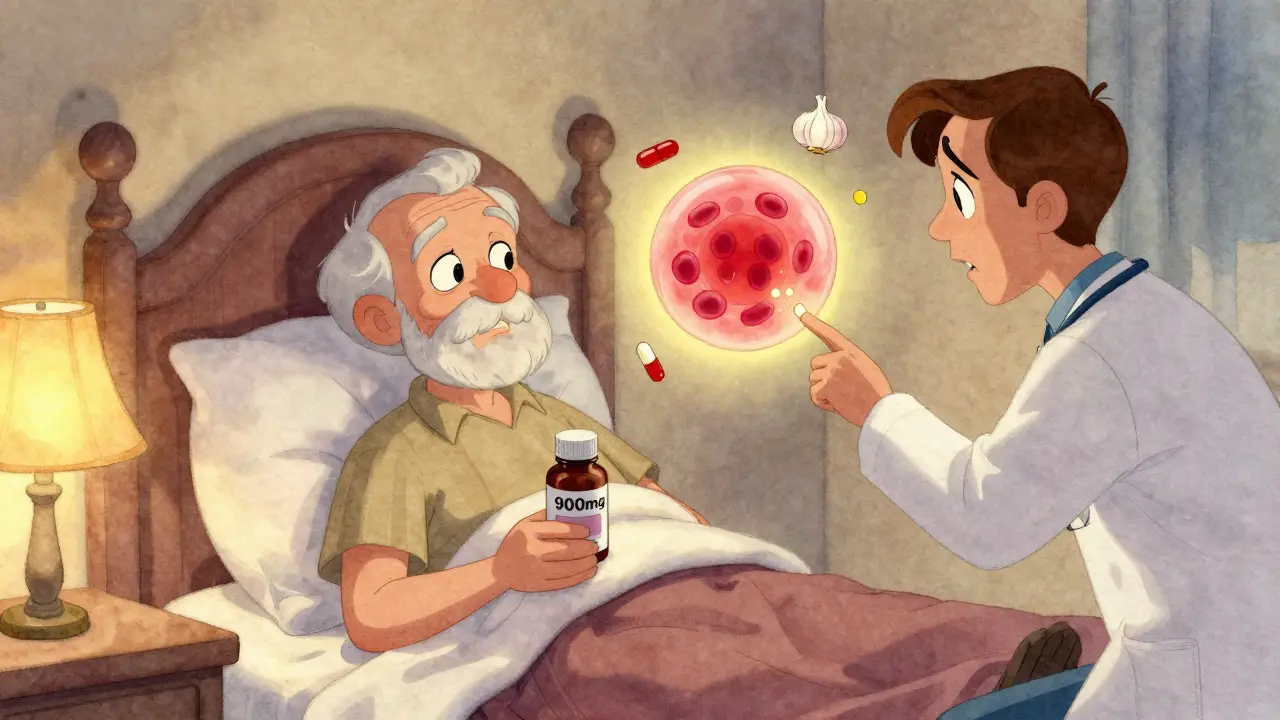
If you’re taking a blood thinner like warfarin, apixaban, or rivaroxaban, and you also take garlic supplements, you could be at risk for serious bleeding - even if you feel fine. This isn’t just a theoretical concern. Real people have ended up in emergency rooms, had surgeries delayed, or faced life-threatening complications because they didn’t know garlic supplements can act like a second blood thinner in the body.
Garlic is often praised for heart health. People take it to lower blood pressure, reduce cholesterol, or just because they think it’s "natural." But here’s the catch: the same compounds that might help your arteries also stop your platelets from sticking together. And when those platelets can’t do their job, even a small cut can turn into a big problem - especially when you’re already on a medication designed to thin your blood.
How Garlic Interferes with Blood Clotting
The real culprit behind the bleeding risk is a compound called ajoene. It’s found in raw garlic and most concentrated supplements, especially oil-based ones. Ajoene doesn’t just slow down clotting - it shuts it down at the molecular level. It blocks two key pathways: one that helps platelets stick to each other, and another that lets them bind to fibrinogen, the glue that forms clots. The effect isn’t temporary. Once ajoene binds to platelets, those cells are out of commission until your body makes new ones - which takes 7 to 10 days.
That’s why even stopping garlic a few days before surgery isn’t always enough. A 2017 study in the Journal of the American College of Surgeons found that 68% of patients continued taking garlic supplements within a week of their surgery, even after being asked. Many didn’t even think of garlic as a "supplement." They just ate garlic pills like vitamins.
What Happens When Garlic Meets Blood Thinners
Anticoagulants work in different ways. Warfarin slows down clotting factors made by the liver. DOACs like apixaban block specific enzymes in the clotting cascade. Garlic doesn’t directly affect these mechanisms - but it adds another layer of suppression. Think of it like turning down two volume knobs instead of one. The result? Your blood takes much longer to clot.
Studies show garlic supplements can raise INR (a measure of how long your blood takes to clot) by 1.0 to 2.5 points in people on warfarin. That might not sound like much - until you realize that a normal therapeutic range is 2.0 to 3.0. Go above 4.0, and you’re in danger territory. One case report in Chest described a patient whose INR jumped from 2.8 to 5.6 after starting a 900 mg garlic supplement. He developed internal bleeding and needed a blood transfusion.
It’s not just warfarin. Even newer drugs like apixaban and rivaroxaban aren’t safe. A Reddit user on r/anticoagulants reported nosebleeds lasting over 30 minutes after combining 900 mg of garlic with apixaban. Emergency room visits like this aren’t rare. A 2019 case in the Journal of Neurosurgery: Spine described a man who developed a spinal hematoma - a dangerous pool of blood around the spine - after taking 2,400 mg of garlic daily. He needed emergency surgery.
Not All Garlic Supplements Are the Same
Here’s where things get tricky. Not every garlic product carries the same risk. The amount of ajoene depends entirely on how it’s made.
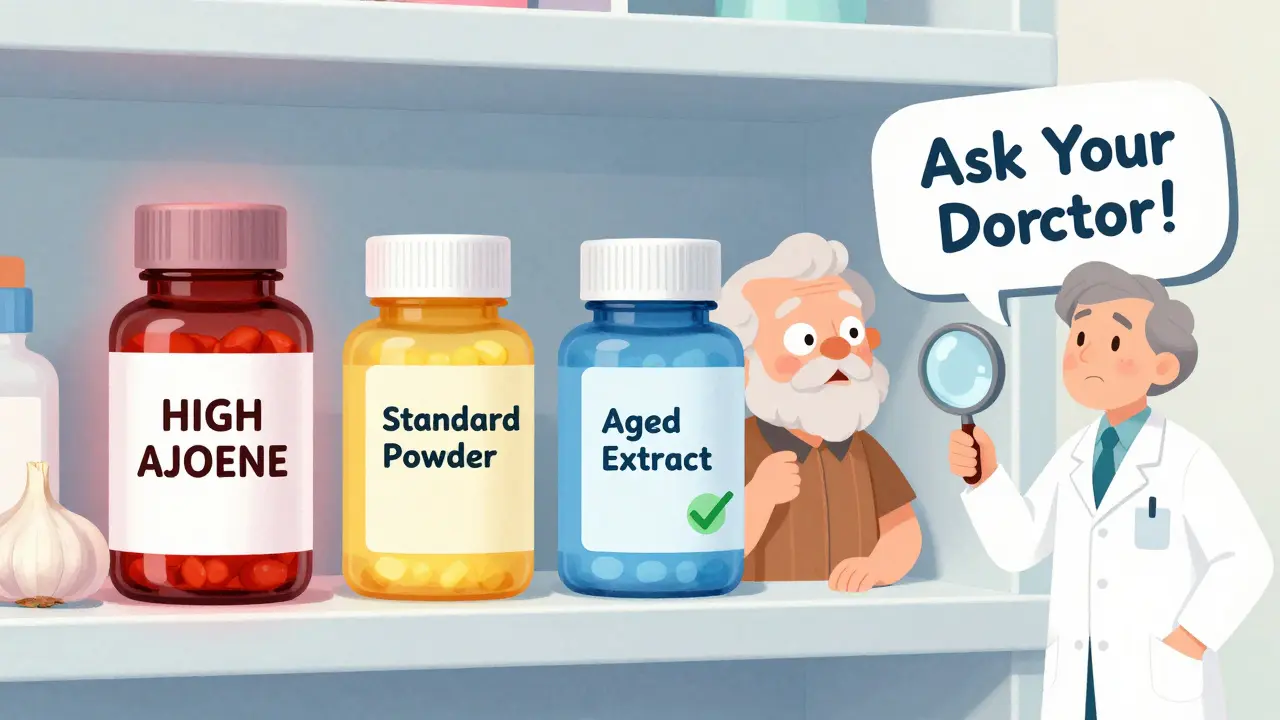
- Oil macerates (garlic soaked in oil) have the highest ajoene - up to 1.0 mg per gram. These are the most dangerous.
- Standard powdered supplements (600-1,200 mg daily) contain 0.1-0.3 mg of ajoene per gram. Still enough to cause problems.
- Aged garlic extract (like Kyolic) has almost no ajoene. It’s processed differently, and studies show it doesn’t affect platelets the same way. This might be the only safe option for people on blood thinners.
Most labels don’t tell you which type you’re getting. A 2019 FDA warning pointed out that garlic supplement potency varies by up to 15 times between brands. You could be taking a product with 10 times more ajoene than you think - and you’d never know.

Who’s Most at Risk?
The people most likely to be affected are older adults. In the U.S., 18.3% of people over 65 take garlic supplements. Nearly a quarter of them - about 3.1 million Americans - are also on anticoagulants. That’s a massive overlap, and most don’t realize the danger.
High-risk situations include:
- Surgery - Especially colorectal, neurosurgery, or prostate procedures. In one study, two patients had uncontrolled bleeding during laparoscopic surgery because they took garlic daily. They had to switch to open surgery and needed temporary colostomies.
- Dental work - Even a simple tooth extraction can lead to prolonged bleeding if platelets are suppressed.
- Major trauma - A fall, car accident, or head injury becomes far more dangerous if your blood can’t clot properly.
Doctors don’t always ask the right questions. A 2020 study in Patient Education and Counseling found that patients rarely mention garlic unless asked directly. If you say "I take herbal supplements," your doctor might think of echinacea or ginseng - not garlic pills on your nightstand.
What Should You Do?
If you’re on a blood thinner:
- Stop all garlic supplements - including pills, capsules, and oils - at least 14 days before any surgery or dental procedure. Some guidelines say 7 days, but 14 is safer.
- Don’t assume aged garlic is safe - While Kyolic’s aged extract shows less platelet effect, independent verification is limited. Until more data is available, treat it as risky.
- Ask your doctor - Say: "I take garlic pills. Is this safe with my blood thinner?" Don’t wait for them to ask.
- Check your labels - If the label says "standardized to X% allicin," that doesn’t tell you about ajoene. Look for "aged garlic extract" - it’s your best bet.
- Monitor for bleeding - Unusual bruising, nosebleeds, blood in urine or stool, or prolonged bleeding from cuts are red flags.
For those not on blood thinners: garlic supplements are generally fine. But if you’re planning surgery, even if you’re not on medication, tell your surgeon. Many patients don’t realize garlic can affect clotting on its own.
The Bigger Picture
Garlic supplements are a $1.27 billion industry. Sales are growing fast. But regulation hasn’t kept up. The FDA has warned about inconsistent potency. The European Medicines Agency now requires clear warnings on labels. And in 2023, the FDA proposed new rules requiring standardized ajoene labeling - but those won’t be enforced until late 2024.
Meanwhile, manufacturers are trying to fix the problem. Kyolic claims its aged garlic has 98% less antiplatelet activity. But without independent testing, you can’t be sure.
The real problem? Lack of awareness. A 2022 GoodRx survey found that 83% of garlic supplement users had no idea it could interact with blood thinners. Two out of three never talked to their doctor about it.
This isn’t about fear. It’s about informed choices. Garlic has benefits. But when you’re on a blood thinner, those benefits come with a hidden cost - one that can cost you your life if you don’t know about it.
What’s Next?
The NIH is funding a $2.4 million study to measure exactly how different garlic supplements interact with apixaban. Results are expected in late 2024. Until then, the safest advice remains: if you’re on a blood thinner, skip the garlic pills. Your body will thank you.
Can I take garlic supplements if I’m on warfarin?
No. Garlic supplements can raise your INR significantly, pushing it into a dangerous range. Even small doses have caused bleeding episodes in people on warfarin. The safest choice is to stop all garlic supplements and talk to your doctor before restarting anything.
Is aged garlic extract (like Kyolic) safe with blood thinners?
It’s likely safer than other forms because it contains almost no ajoene. However, independent studies are limited, and manufacturers aren’t required to prove it. Until more data is available, it’s still best to avoid all garlic supplements if you’re on anticoagulants.
How long before surgery should I stop garlic supplements?
The American Society of Anesthesiologists recommends stopping garlic supplements at least 14 days before surgery. Some European guidelines say 7 days, but because garlic’s effects can last up to 10 days, 14 days is the safest window to ensure your platelets are fully functional.
Do garlic supplements affect all blood thinners the same way?
The interaction is strongest with warfarin because both affect clotting through overlapping pathways. But garlic also increases bleeding risk with DOACs like apixaban, rivaroxaban, and dabigatran. The mechanism is different - garlic affects platelets, while DOACs target clotting factors - but together, they multiply the risk.
Can I eat garlic in food if I’m on blood thinners?
Yes. Eating garlic in normal amounts as part of your diet - like in cooking or sauces - is generally safe. The problem comes from concentrated supplements, which deliver 5 to 10 times more active compounds than food. You’d need to eat over a whole head of garlic daily to reach supplement-level doses.
Why don’t supplement labels warn about this?
In the U.S., dietary supplements aren’t required to list drug interactions unless the manufacturer voluntarily does so. Only 42% of garlic supplement labels include any warning about blood thinners. The FDA has pushed for standardized labeling, but enforcement is still weak. Until regulations change, assume any garlic supplement could be risky.
Man, I thought garlic pills were just for your immune system. Didn’t realize they were basically adding another blood thinner to the mix. I’ve been taking them for years thinking I was being healthy. Guess I’m stopping now. Thanks for the wake-up call.
OMG this is SO important!! I’ve been popping garlic capsules like candy since my mom said they’re ‘nature’s aspirin.’ Now I’m terrified. I’m on Xarelto and just had a nosebleed last week that lasted 20 minutes. I thought it was dry air. Turns out it was my stupid supplements. Going to toss the whole bottle today. #WakeUpCall
Why are Americans so blind? You take supplements like they’re candy, then wonder why you bleed from a paper cut. In India, we know garlic is food-not medicine. If you want to be healthy, eat real garlic in your curry, not some chemically processed pill. This is why your healthcare system is broken.
The biochemical mechanism is fascinating. Ajoene’s irreversible binding to platelet glycoprotein IIb/IIIa receptors effectively renders them anergic for the duration of their lifespan. The pharmacokinetic implications are profound, especially when layered atop pharmacodynamic interference from direct oral anticoagulants. The clinical data is clear. The regulatory failure is unconscionable.
Just stop the garlic pills. Done. No debate. If you’re on blood thinners, don’t take them. Period.
There is a deeper truth here. Modern medicine has forgotten that nature does not operate in isolation. Garlic, like all plants, is a symphony of compounds. When we isolate and concentrate them, we break the natural balance. The body does not know the difference between a clove and a pill-but it does know when harmony is lost. This is not about risk. It is about resonance.
So let me get this straight. We live in a country where you can buy a bottle of ‘natural blood thinner’ at CVS without a prescription… but you need a PhD to get a flu shot? I’m not mad. I’m just disappointed.
I’ve been on warfarin for 5 years and took garlic supplements for 3. I didn’t know there was a risk. My INR was fine. Then I had a bruise the size of a baseball after bumping my arm. My doctor said, ‘Did you take anything else?’ I said ‘Just garlic.’ She looked at me like I’d just confessed to a crime. I’m never doing that again.
Wow. Another fearmongering article. You know what else thickens blood? Sugar. Processed carbs. Stress. But no one’s banning those. Why pick on garlic? This is just Big Pharma pushing their narrative. I’ll keep taking mine. I’m not a lab rat.
Let me explain this with scientific rigor. The ajoene molecule has a molecular weight of 242.3 g/mol and binds covalently to cysteine residues on the GPIIb/IIIa receptor. This is not theoretical. The IC50 for platelet aggregation inhibition is 1.2 μM. A single 900mg capsule delivers 1.8mg of ajoene-over 7x the threshold for significant antiplatelet activity. This is not a myth. It’s biochemistry. And yet, 83% of users are clueless. Pathetic.
Wow 😮 I never knew garlic could do this! I take Kyolic every day and thought I was being smart. Now I’m scared. Should I stop? 😢 I love garlic but I love my life more. Please someone tell me if Kyolic is safe…
People like you are why I don’t trust medicine anymore. You scare people with ‘studies’ and ‘case reports.’ I’ve been on warfarin for 12 years and took garlic pills every day. No bleeding. No issues. You’re just creating panic to sell more tests. I’ll keep doing what works for me.
This is why you don’t trust the FDA. They let companies sell 15x potency variations under the same label. They don’t require ajoene content disclosure. They let people die because ‘it’s a supplement.’ This isn’t healthcare. It’s a free market experiment with human blood as the test subject.
Thank you for sharing this vital information with such clarity and care. Your detailed breakdown of mechanisms, risks, and actionable steps is exactly what patients need. I’ve shared this with my entire care team. Knowledge is power-and you’ve empowered us all.
UPDATE: I just called my pharmacist. She said Kyolic is probably fine, but only if it’s the real aged extract. I checked my bottle-it says ‘aged garlic extract’ on the front. I’m keeping it. But I’m tossing the other 3 bottles I didn’t even know I had. Thank you for the nudge. 🙏