
Hip Pain: How Labral Tears and Arthritis Affect Movement - And What You Can Do

When your hip starts hurting, it’s easy to blame aging, overuse, or a bad workout. But if the pain sticks around - especially when you sit, squat, or twist - it might be something deeper. Labral tears and hip arthritis aren’t just common; they’re often linked, and understanding how they interact can change everything about how you manage the pain.
What’s Really Going on in Your Hip?
Your hip joint is a ball-and-socket, but it’s not just bone meeting bone. Around the socket (the acetabulum) sits a rubbery ring called the labrum. It’s only 3 to 5 millimeters thick, but it does heavy lifting: it seals the joint, keeps fluid inside to lubricate the cartilage, and helps hold the ball of your femur snug in place. When this labrum tears - often from repetitive twisting, deep squatting, or structural issues like cam impingement - you lose that seal. That’s when things start to break down. At the same time, hip osteoarthritis (OA) creeps in. Cartilage, the smooth cushion between bones, wears thin. Bone starts to rub on bone. Osteophytes (bone spurs) form. The joint gets stiff. The pain? It’s not always sharp. It’s often a dull ache in the groin, side of the hip, or even down the thigh - worse after sitting too long or walking farther than usual. Here’s the twist: these two problems don’t just happen one after the other. They feed each other. A torn labrum increases pressure on the cartilage by up to 92%, speeding up wear. And if you already have arthritis, the joint is less stable, making the labrum more likely to tear from normal movement. Studies show 70-90% of people with cam-type impingement have a labral tear. And 54% of those with hip OA also have a torn labrum - even if they never had a specific injury.Why Activity Modification Isn’t Just ‘Resting More’
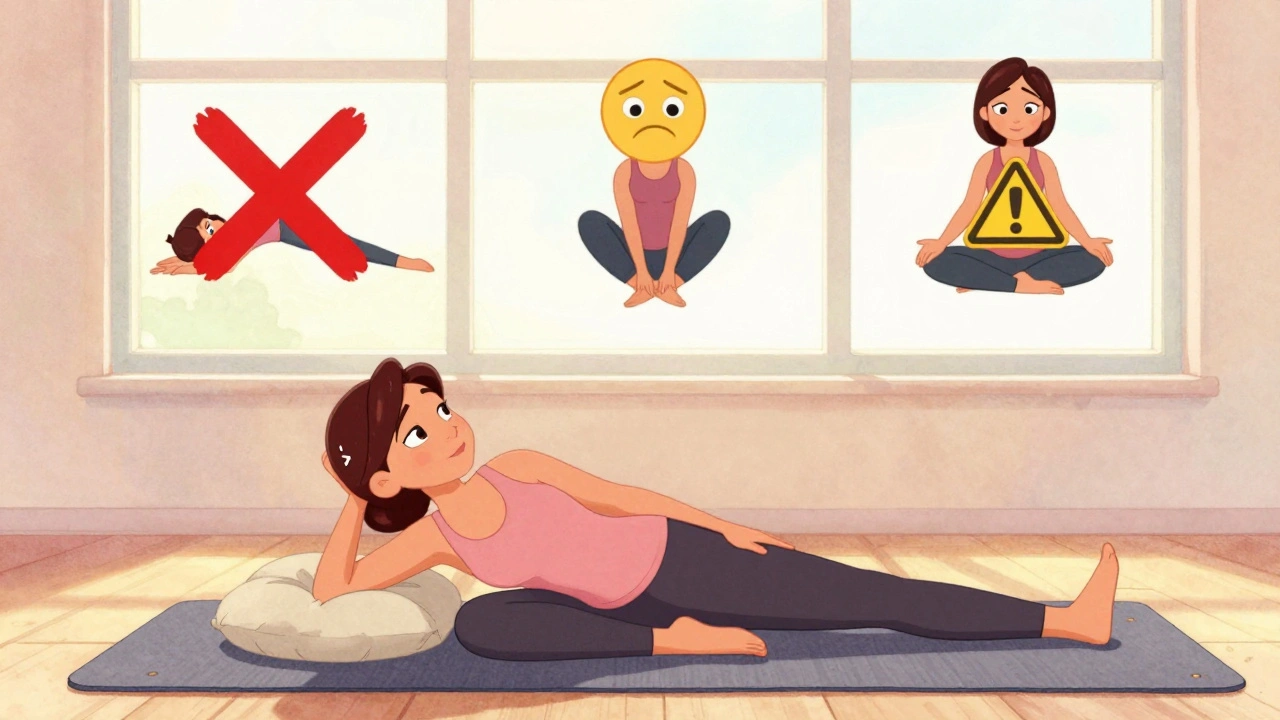
Most people think “modify your activity” means stop exercising. That’s not it. It means change how you move. If you’re sitting at a desk for hours, your hips are bent past 90 degrees - the exact position that grinds a torn labrum against bone. Same if you’re doing deep squats, lunges, or yoga poses like pigeon. These movements combine hip flexion with internal rotation - the “pain provocation position” that triggers sharp pain in 87% of people with labral tears, according to patient surveys. Activity modification is about finding workarounds that protect your joint without making you inactive. For example:- Use a pillow between your knees when sleeping - it keeps your hips aligned and reduces pressure on the labrum.
- Swap cross-legged sitting for sitting with feet flat on the floor. Use a cushion to lift your hips slightly if needed.
- When standing, avoid leaning on one hip. Shift your weight evenly.
- Use a raised toilet seat - it cuts hip flexion by 15-20 degrees, making bathroom visits less painful.
- In the car, place a wedge cushion behind your lower back. It reduces hip bend by 10-15 degrees during long drives.
What Exercises Actually Help - and Which Ones to Skip
You don’t have to give up movement. You just need to pick the right kinds. Best options:- Swimming (especially freestyle and backstroke): Zero impact, full range of motion without compression.
- Elliptical machine: Mimics walking without the jarring impact of pavement.
- Stationary cycling: Keep the seat high so your knee doesn’t rise above your hip. Avoid resistance that forces deep hip flexion.
- Physical therapy exercises: Focus on strengthening your gluteus medius (hip abductor). Strong abductors stabilize the pelvis and reduce stress on the labrum. Aim for controlled movements like side-lying leg lifts and clamshells - not deep squats.
- Deep squats and lunges - especially with toes pointed inward.
- High-impact running - even on soft surfaces. The repetitive load accelerates cartilage wear.
- Yoga poses like pigeon, lotus, or deep forward folds - they force the hip into extreme flexion and rotation.
- Heavy deadlifts or kettlebell swings - they load the joint in a position that aggravates impingement.
When Medications and Injections Help - and When They Don’t
NSAIDs like ibuprofen (400-800mg three times daily) can reduce inflammation and pain short-term. But they don’t fix the root problem. And long-term use risks stomach, kidney, and heart issues. Corticosteroid injections give relief for about 3.2 months on average, and 68% of patients feel better. But repeated injections - more than three a year - can damage cartilage by 12%. That’s not worth it if you’re trying to delay surgery. Viscosupplementation (hyaluronic acid shots) is marketed for knee OA, but it’s also used in the hip. Results are mixed: 55% of patients get 15-20% pain reduction, but the effect fades after six months. A newer option, Durolane, lasts longer - up to six months - and was FDA-approved in 2023. Still, it’s not a cure. These treatments are best used as temporary bridges while you build strength and adjust movement habits. They’re not substitutes for activity modification.Surgery: When It Makes Sense - and When It Doesn’t
Hip arthroscopy to repair a labral tear has a 85-92% satisfaction rate at five years - but only if you’re young, active, and have early-stage arthritis. If you have cam-type impingement (an alpha angle over 55 degrees on MRI), surgical correction combined with labral repair gives 73% better outcomes than conservative care alone. That’s why younger patients (under 40) are now getting surgery earlier than ever - the average age dropped from 45 in 2015 to 38.7 in 2023. But if you’re over 60 and your X-ray shows Kellgren-Lawrence Grade 3 or 4 arthritis (severe joint space narrowing), surgery won’t stop the degeneration. In fact, 45% of these patients still need a total hip replacement within five years - whether they had surgery or not. Dr. Thomas Vail from UCSF warns: “Overemphasizing labral tears in older patients leads to unnecessary procedures.” If your cartilage is already gone, repairing the labrum won’t bring it back. In those cases, focus on pain control, strength, and preparing for eventual joint replacement - not chasing a fix that won’t last.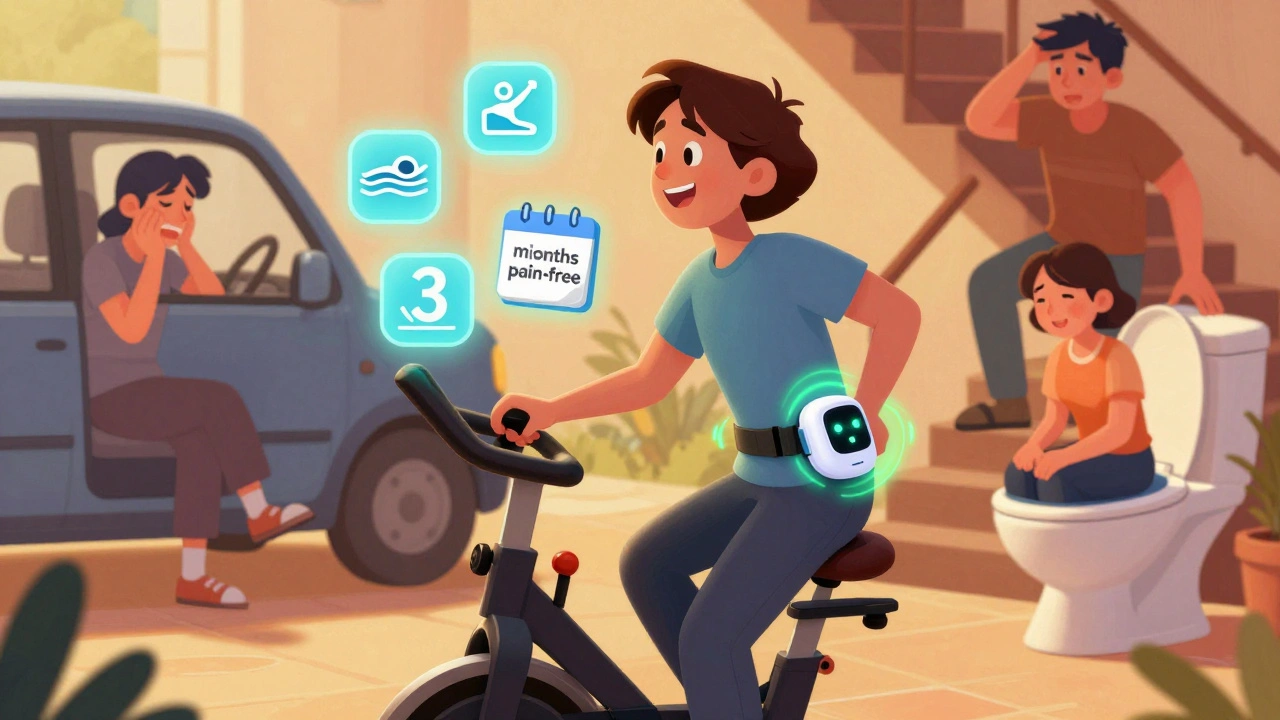
The Invisible Disability
One of the hardest parts isn’t the pain. It’s the misunderstanding. Sixty-eight percent of patients say people don’t believe their pain because “you look fine.” You’re not in a wheelchair. You’re not on crutches. But you can’t sit through a movie, climb stairs without pain, or play with your kids the way you used to. This is why tracking your triggers matters. Keep a simple log: “Pain after sitting 40 minutes,” “Worse when twisting to reach the back seat,” “Better after swimming.” This helps you adjust your day - and helps your doctor understand your real-world challenges.What Works Best - The Bottom Line
There’s no one-size-fits-all fix. But here’s what the data shows works:- For people under 50 with labral tears and mild OA: Combine activity modification with physical therapy. You can delay surgery by 3.5-5 years.
- For people over 60 with advanced arthritis: Focus on low-impact movement, weight management, and pain control. Surgery won’t reverse cartilage loss.
- For everyone: Avoid positions that combine hip flexion and internal rotation. That’s the golden rule.
- Wearables that give real-time feedback on hip position reduced pain episodes by 52% in a 2023 Stanford study. If you’re tech-savvy, this might be worth exploring.
Can a labral tear heal on its own?
No. The labrum has very limited blood supply, so it doesn’t heal like a muscle or ligament. But you can stop it from getting worse. Activity modification and physical therapy reduce stress on the tear, which often leads to significant pain relief - even without surgery.
Is hip arthritis the same as osteoarthritis?
Yes. When people say “hip arthritis,” they almost always mean osteoarthritis - the wear-and-tear kind. It’s different from rheumatoid arthritis, which is autoimmune. Osteoarthritis in the hip progresses slowly, and it’s graded from 0 (normal) to 4 (severe) on the Kellgren-Lawrence scale.
Can I still run with a labral tear or hip arthritis?
Most people can’t. Running puts 3-5 times your body weight through the hip joint with each step. For someone with a torn labrum or cartilage loss, that’s like grinding sandpaper inside the joint. Swimming, cycling, or using an elliptical are far better options. If you’re determined to run, limit it to short distances on soft surfaces and stop immediately if pain increases.
Why does my hip hurt when I sit for too long?
Sitting bends your hip past 90 degrees - the exact position that squeezes a torn labrum between the ball and socket. If you also have cam impingement (extra bone on the femur), the pressure is even worse. After 30-45 minutes, the joint fluid gets compressed, inflammation builds, and pain flares. Standing up or walking helps because it relieves the pressure.
Should I get an MRI if I have hip pain?
Not always. Studies show 38% of people over 50 have labral tears on MRI - but no pain. Imaging finds structural changes, but it doesn’t tell you if those changes are causing your symptoms. Your doctor should first evaluate your movement, pain patterns, and physical exam. Only if conservative care fails should you consider an MRI to plan next steps.
What’s the best way to sleep with hip pain?
Sleep on your back with a pillow under your knees to keep hips slightly bent. If you sleep on your side, put a pillow between your knees to keep your pelvis aligned. Avoid sleeping on the painful side without support - that compresses the joint. Many patients report 76% less nighttime pain with this simple change.
Man, this hit home. I’ve been dealing with hip pain for years and thought it was just from squatting too heavy at the gym. Turns out I was grinding my labrum into dust every time I did a deep lunge. Swapped to cycling and swimming and my pain dropped like a rock. No more NSAIDs. Just movement that doesn’t scream at my joints.
Also, the pillow between the knees trick? Life changer. I sleep like a baby now.
Let me tell you - this isn’t just ‘hip pain.’ This is the quiet, sneaky thief of mobility. That 92% pressure spike from a torn labrum? That’s not a statistic - it’s your future if you keep doing pigeon pose like it’s yoga gospel. I used to be the guy who bragged about touching my toes. Now I’m the guy who uses a raised toilet seat like it’s a throne. And I’m okay with that. Smart isn’t sexy, but it’s sustainable.
So… just don’t sit? Cool. Got it.
I love how you broke this down - not just ‘rest more’ but ‘move better.’ That’s the kind of advice that doesn’t make you feel broken. I’m 52 and was terrified I’d never play with my grandkids again. Now I do - just without the deep squats. I even made a little chart of ‘pain triggers’ and posted it on my fridge. My husband thinks I’m crazy. I think I’m wise.
Also, the wedge cushion in the car? Genius. I’m never going back.
Oh wow. Another ‘hip pain guru’ pushing ‘activity modification’ like it’s some mystical cure. Let me guess - you also think ‘eating clean’ fixes autoimmune disease? The labrum doesn’t heal? Newsflash - neither does cartilage. You’re just delaying the inevitable. If you’re over 40 and have cam impingement, you’re one bad twist away from a hip replacement. Stop pretending you can outsmart biology with pillows and ellipticals. This is just the pre-op phase of your new titanium hip. Embrace it. Or get PRP and stop pretending you’re a yogi who ‘outsmarted’ degeneration.
P.S. Stanford wearable study? Small sample size. Correlation ≠ causation. Just saying.
Thank you for this thoughtful, well-structured overview. I appreciate how you acknowledge the complexity of hip pathology without oversimplifying. Many patients are misled into believing that surgery is a silver bullet, when in fact, the biomechanical reality is far more nuanced. I’ve seen too many cases where labral repair was performed without addressing underlying impingement or cartilage degradation - leading to poor outcomes. Your emphasis on movement patterns and joint loading is precisely what’s missing from mainstream advice. Keep sharing this kind of clarity.
Biggest thing i missed in the post - glute medius is the MVP. If you can’t do a clamshell without your hip flinching, you’re not ready for anything else. I had a labral tear and thought it was ‘just a tear’ - turns out my glutes were asleep. Did 6 weeks of side leg lifts and clamshells with a band - pain halved. Also, avoid sitting on soft couches. They make your hips sink too deep. Get a firm chair. Or a yoga block. Trust me.
PS: typo in ‘kettlebell swings’ - said ‘kettlebell swigns’ in my notes. Oops.
I’m 61 and have Kellgren-Lawrence Grade 4 arthritis. I didn’t have a labral tear - just bone-on-bone. I tried everything: injections, PT, supplements. Nothing stuck. What worked? Walking 20 minutes a day on level ground. No hills. No stairs. Just steady, slow movement. I didn’t ‘fix’ my hip - I learned to live with it. The key isn’t avoiding pain. It’s avoiding the panic that makes you do stupid things. This post nailed it. Don’t chase a cure. Chase consistency.
Love the balance here. Too many people go straight to surgery or straight to denial. This is the middle path - the one that doesn’t sell you a miracle but gives you real tools. I’m a physical therapist in Dublin and I hand this out to every patient with hip pain. The pillow-between-knees tip? I’ve been saying that for years. Still, people look at me like I’m magic. It’s not magic. It’s biomechanics. And it works.
Oh, so now we’re all supposed to be biomechanical monks? No deep squats, no running, no yoga, no sitting without a wedge, no sleeping without a pillow army? What’s next? Wearing hip braces to the bar? I get it - you’re trying to save people from surgery. But let’s not pretend this is ‘living.’ This is a 24/7 vigil against your own body. At some point, you have to ask: is this really better than a hip replacement? Because I’ve met people who got the surgery and now play pickleball. Meanwhile, I’m counting how many pillows I need to sleep like a pretzel. Just saying - sometimes the ‘smart’ choice is just the one that lets you enjoy life again. Not just avoid pain.
I cried reading this. Not because I’m weak - because I’ve been told for years that my pain was ‘all in my head.’ I’m 39. I can’t sit through a movie. I can’t carry my daughter. I can’t even put on my socks without wincing. And I’ve been called lazy. I’ve been called dramatic. I’ve been told to ‘just stretch more.’ This article? It’s the first time someone looked me in the eye - through text - and said: ‘I see you. This isn’t weakness. This is biology.’ Thank you. I’m printing this and showing my doctor tomorrow. I’m not asking for permission to feel this anymore.
This is an extraordinary synthesis of clinical evidence and lived experience. The distinction between structural pathology and symptomatic expression is critical - and often neglected in both medical literature and patient discourse. I particularly appreciate the emphasis on positional mechanics as a modifiable variable. The 52% reduction in pain episodes via real-time hip feedback aligns with emerging literature on proprioceptive retraining in chronic joint disorders. I would only add that the psychological component - the stigma of ‘invisible disability’ - warrants further exploration in interdisciplinary care models. This is not merely orthopedic; it is phenomenological. Well done.
Okay but can we talk about how no one ever tells you that your hip pain makes you a terrible parent? Like, I used to chase my kids around the park. Now I sit on the bench and pretend I’m ‘watching.’ I used to dance at weddings. Now I nod and smile while everyone else moves. I got a wearable hip tracker last month - it buzzes when I bend too far. I felt like a robot. But then I realized - it’s not about being perfect. It’s about being present. I danced with my daughter last night. I didn’t do a single squat. I just held her and swayed. And for the first time in years, I didn’t feel like I was failing. So yeah - modify your movement. But don’t forget to move with love. 🤍
Also, the pillow trick? I put one between my knees AND under my lower back. I’m basically a human burrito now. Worth it.