
How to Identify a Legitimate Generic Drug at the Pharmacy
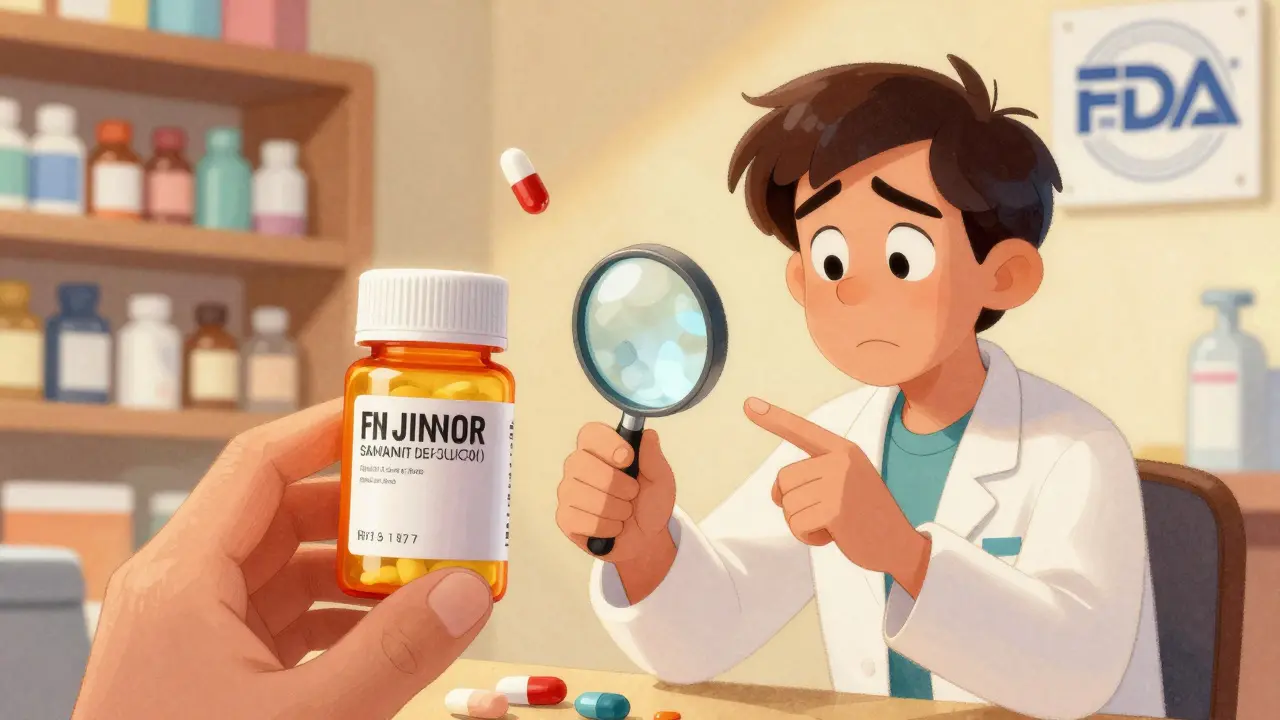
Buying a generic drug should be simple - it’s cheaper, just as effective, and approved by the same agencies that oversee brand-name pills. But if you’ve ever opened a prescription bottle and thought, “This doesn’t look right,” you’re not alone. Legitimate generic drugs look different from their brand-name versions. That’s by design. But that difference is also what counterfeiters exploit. So how do you know if what you’re holding is real - or a dangerous fake?
What Makes a Generic Drug Legitimate?
A legitimate generic drug isn’t a copy. It’s a legally approved version of a brand-name drug, made after the original patent expires. The U.S. Food and Drug Administration (FDA) requires these generics to contain the exact same active ingredient, in the same strength, and work the same way in your body. That’s not marketing. It’s science. To get approved, a generic must prove it’s bioequivalent - meaning your body absorbs it at the same rate and to the same extent as the brand-name version. The FDA’s standard? Within 80% to 125% of the brand’s performance. Real-world data shows most generics hit 99% - nearly identical.Legitimate generics are made in FDA-inspected facilities. The agency conducts over 2,500 inspections a year on generic drug plants. They test more than 1,000 samples annually. And they don’t just check the pills - they check the whole supply chain, from raw ingredients to the final bottle.
Here’s the catch: Legitimate generics can - and often do - look different. Color? Different. Shape? Different. Even the imprint on the pill? Usually different. Why? Because trademark laws prevent generics from copying the exact appearance of brand-name drugs. So if your generic looks nothing like the brand you used to take, that’s normal. It’s not a red flag - it’s the law.
What to Look for on the Bottle
The container holding your medicine tells you more than you think. A legitimate generic drug will always have clear, accurate labeling. Look for these five things:- Manufacturer’s name - Not just “Pharmacy Solutions,” but a real company like Teva, Sandoz, or Mylan.
- Drug name and strength - Example: “Metformin 500 mg.” No abbreviations like “Met 500.”
- Lot number - A unique code that links the batch to its production records.
- Expiration date - If it’s missing, or looks smudged, walk away.
- Prescription label - Your name, the prescribing doctor’s name, pharmacy details. If it’s handwritten on a baggie, that’s a major warning.
Counterfeiters cut corners. You’ll see crooked labels (78% of fake drugs reported to the FDA have this), foreign language text on U.S. products, or missing expiration dates. One pharmacy worker in Melbourne told me he once saw a “generic” Viagra bottle labeled in Russian - with no English at all. That’s not a mistake. That’s illegal.
Inspect the Pill Itself
Hold the pill up to the light. Look closely. A legitimate generic will look factory-made - smooth, even, consistent. No cracks. No bubbles. No powder sticking out. No odd smell.Here’s what real pills should look like:
- Uniform color throughout - no patchy or faded spots.
- Clear, sharp imprint - letters or numbers pressed into the surface, not painted on.
- Consistent scoring - if the pill is scored (has a line down the middle), the line should be clean and even.
- No crumbling - if it breaks apart easily in your fingers, it’s not right.
Counterfeit pills often have:
- Blurry or missing imprints
- Uneven edges or rough texture
- Unusual odor - like plastic, chemicals, or metal
- Wrong size - too big, too small, or oddly thin
One man in Sydney noticed his generic blood pressure pill had a different taste - bitter and metallic. He’d taken the same generic for years. He called his pharmacist. Turns out, the batch had been switched without notice. He returned it. The pharmacy pulled the entire lot. That’s how you catch a problem early.
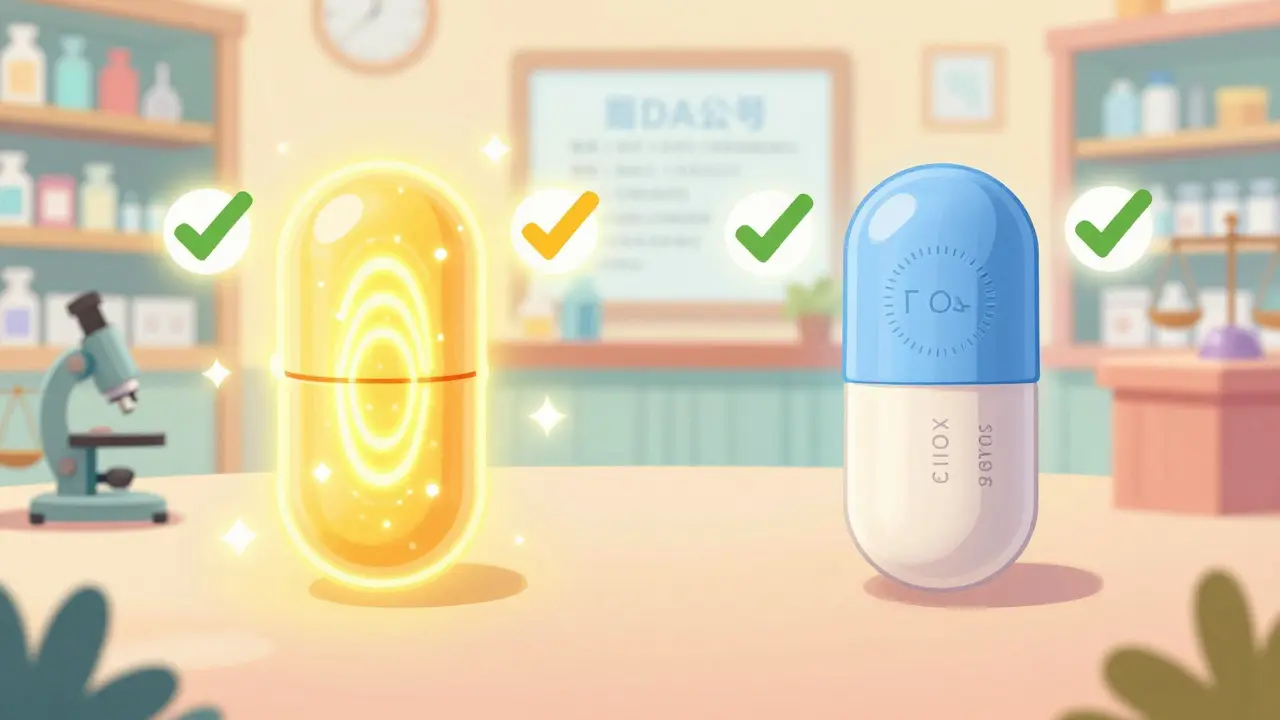
Where You Buy Matters More Than You Think
You can get a legitimate generic drug from your local pharmacy, your hospital, or a verified online pharmacy. But not all online pharmacies are safe.The National Association of Boards of Pharmacy (NABP) runs a program called .pharmacy. If a website has that badge, it’s been verified. You can check it yourself at nabp.pharmacy. As of 2023, only 62 online pharmacies in the U.S. and Australia met their strict standards.
Here’s what to avoid:
- Websites that sell pills without a prescription
- “Too good to be true” prices - $5 for a 30-day supply of insulin? That’s not a deal. That’s a trap.
- Sites with poor grammar, broken English, or no physical address
- Pop-up ads on social media promising “miracle generics”
According to the FDA, 96% of websites selling counterfeit drugs operate outside legal supply chains. That means no oversight. No traceability. No accountability.
Use the FDA’s Orange Book to Verify
The FDA’s Orange Book is a public database that lists every approved generic drug and its brand-name equivalent. It includes the generic’s manufacturer, approval date, and therapeutic equivalence rating.How to use it:
- Go to the FDA’s Orange Book website.
- Search by the brand-name drug (e.g., “Lipitor”).
- Look for the generic version - it will list the manufacturer and the “AB” rating.
- “AB” means it’s bioequivalent and interchangeable. “BX” means it’s not rated as equivalent - avoid those unless your doctor approves.
As of September 2023, the Orange Book listed over 14,800 approved generic drugs. If your drug isn’t there, it’s not FDA-approved.
Check the Lot Number
Every legitimate drug has a lot number. It’s not just for tracking - it’s your safety net.If you suspect something’s wrong:
- Find the lot number on the bottle.
- Go to the FDA’s Drug Shortages and Recalls page.
- Search by lot number or drug name.
- If there’s a recall, you’ll see it immediately.
In 2022, a batch of generic metformin was recalled because of a cancer-causing contaminant. People who checked their lot numbers caught it before taking a single pill.
Technology Is Helping - But Don’t Rely on It Alone
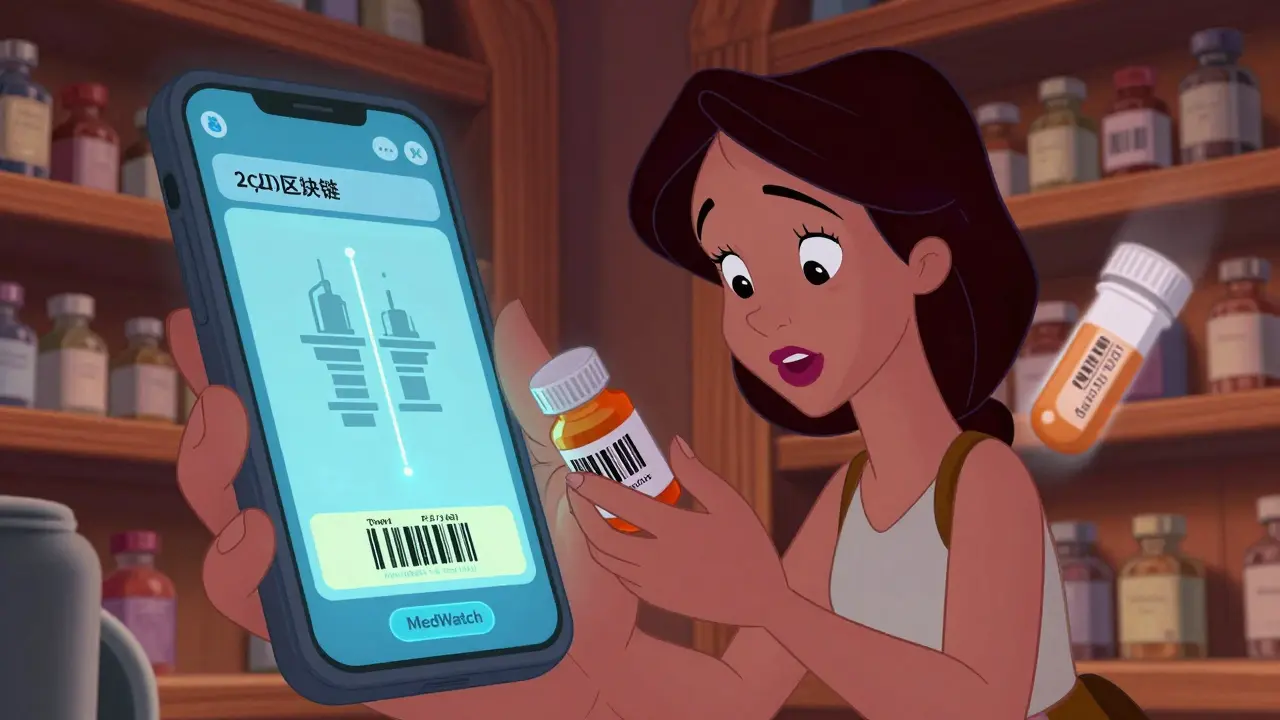
New tools are making verification easier. Many generic pills now have 2D barcodes. Apps like MediSafe let you scan them to confirm authenticity. Blockchain systems in pharmacies can trace a pill from factory to shelf in minutes.But here’s the reality: Counterfeiters are getting smarter. Some now use recycled legitimate packaging. Others 3D-print pills that look perfect under the naked eye.
Technology helps - but your eyes and your instincts matter more. Always combine tech with physical checks.
What to Do If Something Feels Off
If you notice anything unusual - a different color, a weird taste, a missing label, a price that’s way too low - don’t take it. Don’t guess. Don’t hope it’s fine.Here’s what to do:
- Stop taking the medication.
- Take it back to the pharmacy and ask them to check it.
- Call the pharmacy’s corporate office if you’re not satisfied.
- Report it to the FDA’s MedWatch program. You can do it online in under 5 minutes.
In 2022, the FDA received over 1,200 reports of counterfeit drugs. Most came from people who trusted their gut. One woman in Melbourne noticed her generic thyroid pill tasted bitter. She called her pharmacist. It turned out the batch had been switched with a counterfeit from an unverified supplier. Her quick action prevented others from being harmed.
Bottom Line: Trust the System - But Verify
Legitimate generic drugs are safe, effective, and saving billions every year. The system works - but only if you play your part. You don’t need to be a pharmacist to spot a fake. You just need to know what to look for.Remember: Legitimate generics look different - but never look wrong. If it feels off, it probably is. Check the label. Check the pill. Check the pharmacy. Report anything suspicious. Your health isn’t worth risking on a guess.
Let’s be real - the FDA doesn’t give a shit about your pill color. They care about bioequivalence. If it’s AB-rated, it’s good. The rest is corporate branding nonsense. You think Pfizer cares if you know it’s not the blue pill? No. They just want you to pay more.
Counterfeiters don’t need to fake the chemistry. They just need to fake the *look*. And we’re trained to equate appearance with authenticity. That’s the scam. The system works - if you stop trusting your eyes and start trusting the data.
This is so important. I used to panic every time my generic looked different. Now I just check the label and move on. Your health matters more than aesthetics.
I appreciate the thorough breakdown. Many people don’t realize that the FDA inspects generic manufacturing facilities with the same rigor as brand-name ones. The consistency in testing protocols is genuinely impressive - and underappreciated.
It’s worth noting that bioequivalence thresholds are not arbitrary; they’re grounded in decades of pharmacokinetic research. The 80–125% range ensures clinical equivalence without unnecessary overregulation.
As someone who’s lived in three countries and filled prescriptions everywhere, I’ve seen how different generics look - and how the same drug can be a red capsule in the US and a white oval in Germany. It’s all about trademark law, not quality.
What matters is the lot number and the pharmacy’s reputation. If you buy from a licensed pharmacy, you’re protected. If you’re buying from a shady website? Even the right-looking pill can kill you.
Let me ask you this - if the FDA approves these generics, why are they always cheaper? Why do the same companies that make the brand-name drugs also make the generics? Coincidence? Or is this a controlled monopoly disguised as competition?
The ‘bioequivalence’ standard? A loophole. They test on 24 healthy young men. What about elderly diabetics? Pregnant women? People with liver disease? The data doesn’t reflect real life. And the inspections? They get 48-hour notice. You think that’s random? Think again.
They want you to trust the system. But the system is owned by the same corporations that profit from brand-name drugs. The ‘generic’ is just the Trojan horse. And you’re the sucker holding the pill bottle.
Check the Orange Book? Sure. But also check who owns the manufacturer. Chances are, it’s Pfizer, Novartis, or Merck. Same people. Same profits. Different color.
bro i got a generic xanax once that tasted like metal and i was like 🤢💀
called the pharmacy they were like ‘oh yeah that batch got recalled’
so i just took the next one and it was fine lol
but yall need to check your pills
also if it’s in a baggie with handwriting → run
I used to be scared of generics too - until my mom got on a $3 one for her cholesterol and her numbers improved. Now I ask for generics every time. If it’s FDA-approved and the label looks clean, I’m good.
Also - if you’re buying online, just stick to .pharmacy sites. Anything else is gambling with your life.
The regulatory framework governing generic pharmaceuticals is among the most robust in the medical industry. The FDA’s requirement for bioequivalence, coupled with routine facility inspections and post-market surveillance, ensures a high degree of safety and efficacy. Consumers should feel confident in the integrity of the system.
It’s fascinating how deeply we anthropomorphize medicine. We don’t just want a drug that works - we want it to look like the one we remember. The pill becomes a symbol of continuity, of safety, of identity. When the shape changes, the mind rebels. ‘This isn’t the same,’ we say - even though the chemistry is identical.
But here’s the deeper truth: we’ve been conditioned to equate familiarity with safety. That’s not science. That’s psychology. And the pharmaceutical industry exploits it - not just by making generics look different, but by making us fear the difference.
The real danger isn’t the pill that looks different. It’s the belief that a pill must look familiar to be safe. That’s the lie they sell us. And we keep buying it - even when it’s cheaper, even when it’s proven, even when it saves lives.
Maybe the real counterfeit isn’t the pill with the wrong imprint.
Maybe it’s the story we tell ourselves about what ‘real’ medicine looks like.
Check the lot number. Always. Even if it looks fine. One time I skipped it and ended up with a bad batch of metformin. Took me three weeks to figure out why my blood sugar was all over the place.
Don’t be lazy. Scan it. Look it up. Five minutes could save you from a hospital visit.
Also - if a pharmacy won’t let you see the label? Walk out. No questions asked.
I work in a pharmacy in rural Iowa. We get a lot of generics from India and China. Most are fine. But sometimes the labeling is off - English is broken, or the font looks weird. We always call the distributor before dispensing.
People don’t realize how global this supply chain is. A pill made in Hyderabad ends up in your bottle in Des Moines. That’s not a flaw - it’s efficiency. But it means we need to be vigilant.
Trust the system, but verify. Always.
One of the most overlooked aspects of generic drug safety is the role of excipients - the inactive ingredients. While the active pharmaceutical ingredient (API) must match the brand, excipients can vary. For most people, this is irrelevant. But for those with allergies - lactose, gluten, dyes - these differences matter profoundly.
I’ve seen patients with celiac disease react to a generic version because it used wheat starch as a binder, while the brand used corn starch. The FDA doesn’t require excipient disclosure on the bottle. That’s a gap. You have to ask the pharmacist. Or check the manufacturer’s website. Or call the toll-free number on the label.
So yes, check the pill. But also check the *ingredients*. Because ‘bioequivalent’ doesn’t mean ‘identical in every component.’ It means ‘equivalent in effect.’ And that’s not the same thing.
And if you’re on a narrow-therapeutic-index drug - warfarin, lithium, thyroid meds - you should stick with the same manufacturer unless your doctor explicitly switches you. Even AB-rated generics can have subtle differences in dissolution profiles that matter over time.
Knowledge isn’t just power here. It’s safety.
YOU PEOPLE ARE IDIOTS. If you’re taking a generic without checking the Orange Book, you’re playing Russian roulette with your life. I’ve seen people die from fake metformin. Fake blood pressure pills. Fake insulin. And you’re just trusting the pharmacist like she’s your mom? HA.
They don’t tell you this, but 40% of generic manufacturers have FDA warning letters. 40%. That’s not a typo. That’s a scandal. And you’re still swallowing the little pills like they’re candy?
STOP BEING LAZY. CHECK THE LOT. CHECK THE MANUFACTURER. CHECK THE ORANGE BOOK. IF YOU DON’T, YOU DESERVE WHAT HAPPENS TO YOU.
Why do we let foreign countries make our medicine? China. India. They don’t care about Americans. They care about profit. The FDA inspects? Yeah, right. They get a tour. The real factories? Hidden. The pills? Made in basements.
This isn’t medicine. It’s a national security issue. We used to make our own pills. Now we’re dependent on hostile nations. And you’re worried about the color?
Wake up. This isn’t about your cholesterol. It’s about who controls your life.