
How to Read Expiration Dates on Medication Packaging Correctly
When you pick up a prescription or grab a bottle of ibuprofen from the shelf, you probably glance at the expiration date and assume it’s clear-cut. But here’s the truth: expiration dates aren’t just random numbers. They’re science-backed deadlines that tell you when a medication is guaranteed to work as intended. And if you misread them, you could be taking something that’s ineffective-or worse, risky.
What Does an Expiration Date Actually Mean?
The expiration date on your medicine isn’t a "use-by" date like milk. It’s the last day the manufacturer can guarantee the drug will be fully potent, safe, and stable under proper storage conditions. This isn’t a guess. It’s based on years of testing. Manufacturers put pills, liquids, and patches through extreme heat, humidity, and light to see how long they hold up. The date you see is the point after which they can no longer promise the medicine will work as labeled.
The U.S. Food and Drug Administration (FDA) has required expiration dates on all prescription and over-the-counter drugs since 1979. The same standard applies in Australia, Canada, and most of Europe. But here’s where people get confused: the date on the pharmacy label is often different from the one on the original bottle.
Manufacturer Date vs. Pharmacy "Beyond-Use" Date
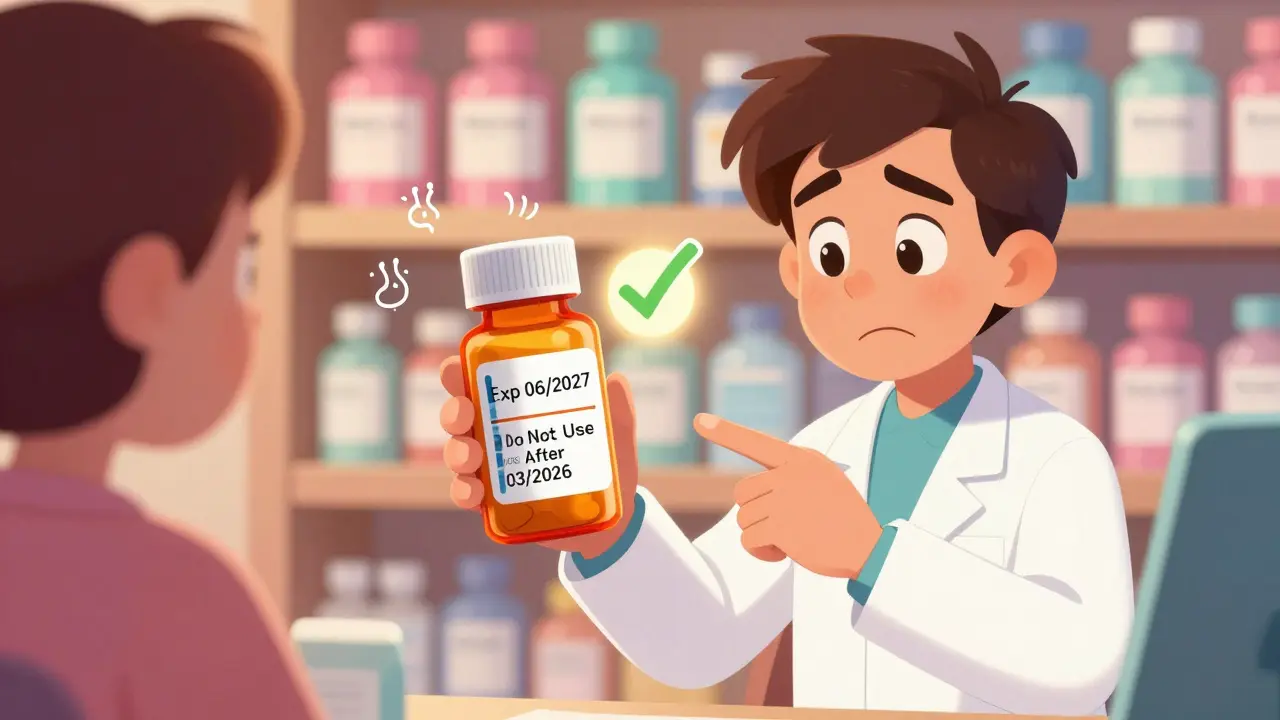
If you’ve ever thrown out a $200 medication because the pharmacy label said "discard after 1 year," you’re not alone. Pharmacies don’t retest drugs when they repackage them. So they assign a "beyond-use" date-usually one year from when you picked it up-even if the original bottle says it’s good for three more years.
For example: You get a prescription for amoxicillin. The manufacturer’s bottle says "Exp 06/2027." But the pharmacy puts it in a small container and writes "Do not use after 03/2026." That pharmacy date is the one you should follow. Why? Because once the seal is broken and the pill is repackaged, exposure to air, moisture, and handling can degrade it faster.
There are exceptions. Antibiotic liquids, like amoxicillin suspension, break down quickly. Their beyond-use date is often just 14 days. Insulin? That’s usually 28 days after opening. Always check the pharmacy label and ask if you’re unsure.
How to Read Different Expiration Date Formats
Expiration dates don’t look the same everywhere. Here’s how to decode them:
- MM/YY or MM/YYYY - If it says "08/23," it expires on August 31, 2023. The last day of the month is the cutoff.
- DD/MM/YYYY - Common in Europe and Australia. "15/07/2025" means July 15, 2025.
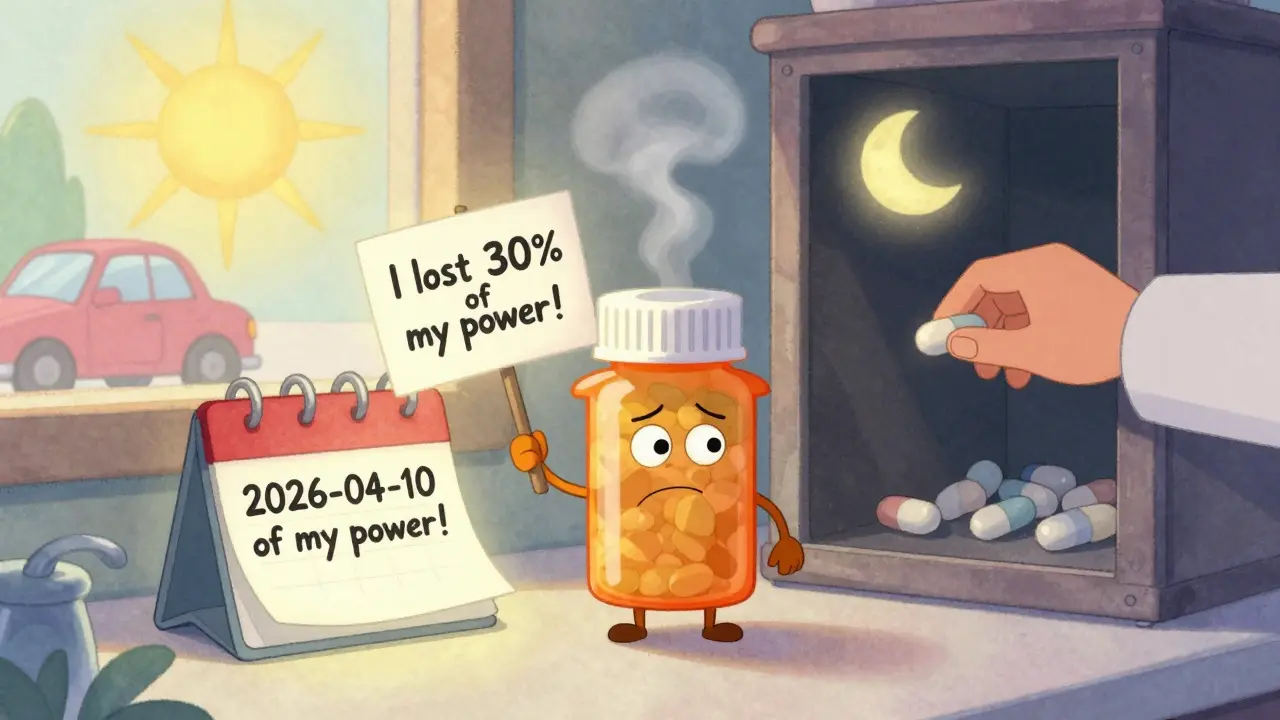
- YYYY-MM-DD - This is the new global standard. WHO recommends it. If you see "2026-04-10," it’s April 10, 2026.
- "Use by" or "Exp" - These mean the same thing. "Use by 12/2024" = December 31, 2024.
Some labels use symbols instead. Look for a calendar icon with a slash through it-that’s the universal symbol for expiration.
Which Medications Are Dangerous After Expiration?
Most drugs don’t suddenly turn toxic after their expiration date. In fact, the FDA’s Shelf Life Extension Program found that 90% of tested drugs remained effective years past their label date-if stored perfectly. But some are exceptions. Never take expired versions of these:
- Insulin - Loses potency fast. Can lead to dangerously high blood sugar.
- Birth control pills - Reduced effectiveness increases pregnancy risk.
- Thyroid meds (like levothyroxine) - Even small drops in potency can cause major hormonal shifts.
- Antiplatelet drugs (like aspirin or clopidogrel) - If they don’t work, you could have a heart attack or stroke.
- Eye drops - Once opened, they’re prone to bacterial growth. Expired ones can cause serious eye infections.
Dr. Sarah Pace, an internal medicine physician, says: "I’ve seen patients who took expired antibiotics and didn’t get better. Then they came back with worse infections. That’s how antibiotic resistance starts."
What Happens When Medication Expires?
Expired drugs don’t usually become poisonous. But they can:
- Loose potency - A 10% drop in strength might not seem like much, but if you’re taking an antibiotic, that could mean the infection survives.
- Change chemically - Some compounds break down into harmless byproducts. Others? Not so harmless. Tetracycline was once linked to kidney damage when expired-but that was decades ago. Modern versions don’t have this issue.
- Grow bacteria - Liquid meds, eye drops, and inhalers with preservatives can become contaminated if the preservative degrades.
And here’s the sneaky part: you won’t always see signs. A pill might look fine but have lost 30% of its strength. A liquid might look clear but be full of microbes.
How to Store Medication to Maximize Shelf Life
Expiration dates assume you store the drug correctly. If you don’t, it expires faster.
- Keep it dry - Don’t store pills in the bathroom. Moisture from showers breaks them down.
- Avoid heat - Don’t leave medicine in a hot car or near a stove. Heat speeds up chemical breakdown.
- Use original packaging - The bottle, foil blister packs, and cartons protect against light and air.
- Refrigerate if needed - Some insulins, eye drops, and liquid antibiotics require fridge storage. Check the label.
- Keep out of sunlight - Light can degrade certain drugs. Store in a dark cabinet.
One patient in Melbourne kept her thyroid meds in a sunlit windowsill. After six months, her TSH levels spiked. She didn’t realize the pills were degraded-until her doctor asked about storage.
What to Do If You’re Not Sure
When in doubt, don’t guess. Here’s what to do:
- Check both labels - Compare the manufacturer’s date with the pharmacy’s beyond-use date. Go with the earlier one.
- Look for changes - Pills that are discolored, crumbly, or smell weird? Toss them. Liquids that are cloudy, chunky, or have particles? Don’t use them.
- Ask your pharmacist - They’re trained to know which drugs are safe past expiration and which aren’t. Ask: "Is this still effective?"
- Use apps - Apps like MedSafe or MyTherapy let you scan barcodes and track expiration dates automatically.
- Don’t rely on memory - Write the discard date on the bottle with a marker. Mark it 3 months before the real expiration for critical meds.
What About Old Pills in the Back of the Cabinet?
Most people have a drawer full of expired meds. That’s normal. But here’s a rule: if it’s been more than a year past expiration, and it’s not an emergency backup (like an EpiPen), toss it. The risk isn’t worth it.
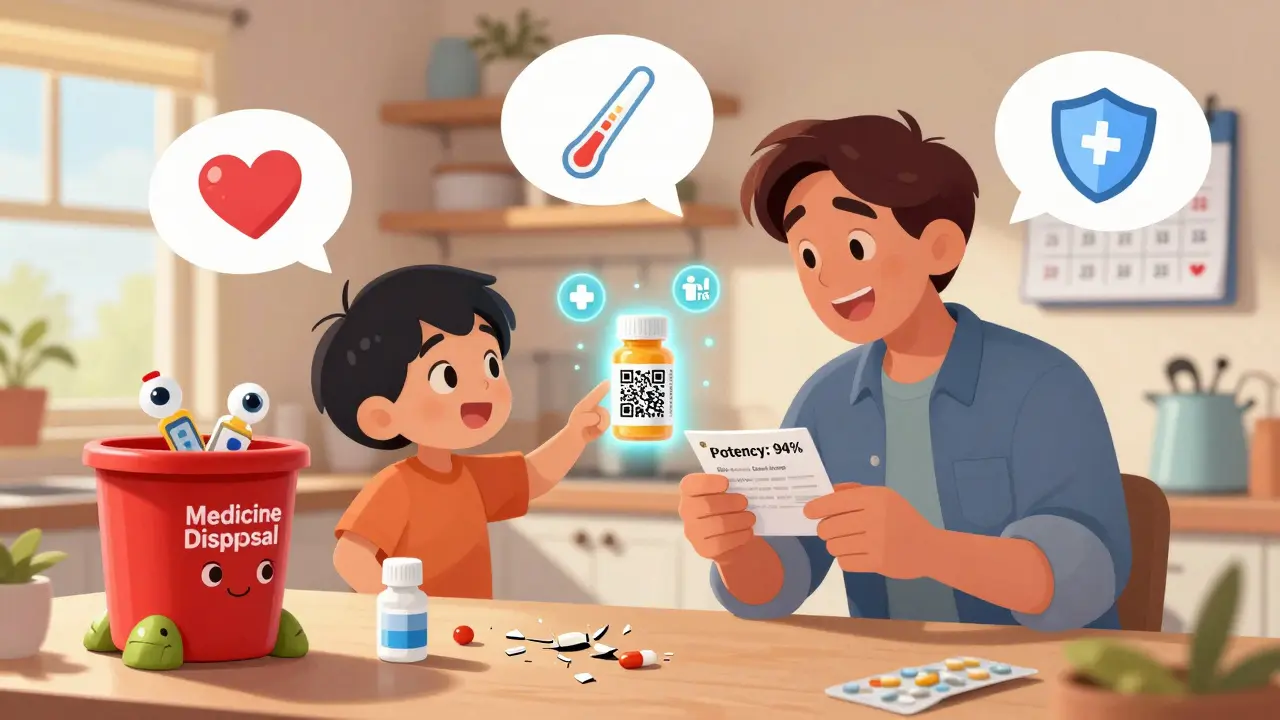
For safe disposal: don’t flush them. Don’t throw them in the trash. Take them to a pharmacy drop-off box. In Australia, most pharmacies have a free take-back program. The Department of Health recommends this for all expired or unused medications.
The Future: Smart Labels and QR Codes
Pharmaceutical companies are starting to use tech to reduce confusion. Merck now uses smart labels on insulin that change color if the drug got too warm. The European Medicines Agency now requires thermochromic ink on labels that shift color if stored above safe temperatures.
And soon, you might scan a QR code on your pill bottle and see real-time data: "This batch was stored at 28°C for 45 days. Potency: 94%. Safe to use." The FDA is pushing for this. It’s coming. But for now, you still need to know how to read the date yourself.
Final Rule: When in Doubt, Don’t Take It
Medication safety isn’t about saving money. It’s about staying healthy. Taking an expired antibiotic might not kill you-but it could let an infection grow out of control. Taking expired insulin might not seem like a big deal-but it could land you in the hospital.
Always check the date. Always ask your pharmacist. Always store it right. And if you’re ever unsure? Toss it. It’s not worth the risk.
Can I still use medicine after the expiration date?
For most medications, yes-safely and effectively-for a short time past the date, if stored properly. But certain drugs like insulin, thyroid meds, birth control, and antibiotics should never be used past expiration. The main risk is reduced potency, not toxicity. When in doubt, consult a pharmacist.
Why do pharmacies put different expiration dates on prescriptions?
Pharmacies assign a "beyond-use" date based on how long the medication is likely to stay stable after being repackaged. This is usually one year from dispensing, even if the original bottle says it lasts longer. This is a safety precaution because once the seal is broken, exposure to air and moisture can degrade the drug faster than the manufacturer’s test predicts.
How do I know if my medication has gone bad?
Look for changes: pills that are discolored, cracked, or sticky; liquids that are cloudy, have particles, or smell strange; ointments that separate or smell off. If you notice any of these, don’t use it-even if the date hasn’t passed. Storage conditions matter more than the date on the label.
Is it safe to take expired painkillers like ibuprofen?
Ibuprofen and similar OTC pain relievers usually remain safe and effective for a year or two past expiration if kept dry and cool. But after several years, they lose potency. If you take them for chronic pain and they don’t seem to work, it’s likely they’ve degraded. Don’t risk it-replace them.
Where can I safely dispose of expired medication in Australia?
Most pharmacies in Australia offer free take-back programs for expired or unused medications. You can drop them off at any pharmacy with a Medicine Disposal Box. Do not flush them down the toilet or throw them in the trash. This prevents contamination of water supplies and reduces accidental poisoning.
I get that expiration dates matter, but honestly? I’ve taken expired ibuprofen for years and never once felt worse. My grandpa took penicillin from 1998 and cured his sinus infection. Science says one thing, lived experience says another. 🤷♂️
This is actually super helpful! I always thought the pharmacy date was just them being overly cautious. Now I know why they do it. Also, I just started using that MedSafe app-game changer. 🙌
I love how this breaks down the real science behind expiration dates. So many people panic over a date that’s a few months off, but the truth is, most meds are fine if stored right. The real villain? Humidity. My bathroom cabinet is a death trap for pills. 😅
Storage conditions are more important than most realize. I once had a patient whose thyroid levels spiked because they kept their medication on a sunny windowsill. Simple fix, huge impact.
For anyone who’s nervous about throwing meds away: your local pharmacy probably has a drop box. No need to flush or trash. It’s free, safe, and better for the planet. Small act, big difference.
I just checked my cabinet and found a 2019 EpiPen 😱 I thought it was fine because it still looked okay. Not anymore. Going to drop it off tomorrow. Thanks for the wake-up call! 🚨
If it looks weird, smells weird, or doesn’t work like it used to-toss it. No exceptions. Your body will thank you.
I’ve been a pharmacist for 18 years. Let me tell you-the biggest danger isn’t expired pills. It’s people assuming they’re safe because they look fine. That’s how resistance starts. A 10% drop in antibiotic potency? That’s enough for bacteria to learn how to fight back. Don’t gamble with your microbiome.
This post hit me right in the soul. I used to think expiration dates were just corporate nonsense. Then my sister almost lost her baby because her birth control was expired. We didn’t know. No one told us. I wish I’d read this 5 years ago. 💔🫶
Let’s be brutally honest: the pharmaceutical industry profits from fear. Expiration dates are artificially short. Why? Because they want you to buy more. The FDA’s own data shows 90% of drugs remain potent for years. You’re being manipulated. And don’t even get me started on the pharmacy 'beyond-use' date-another revenue stream. 🧠💸