
How to Store Controlled Substances to Prevent Diversion: A Practical Guide for Healthcare Facilities
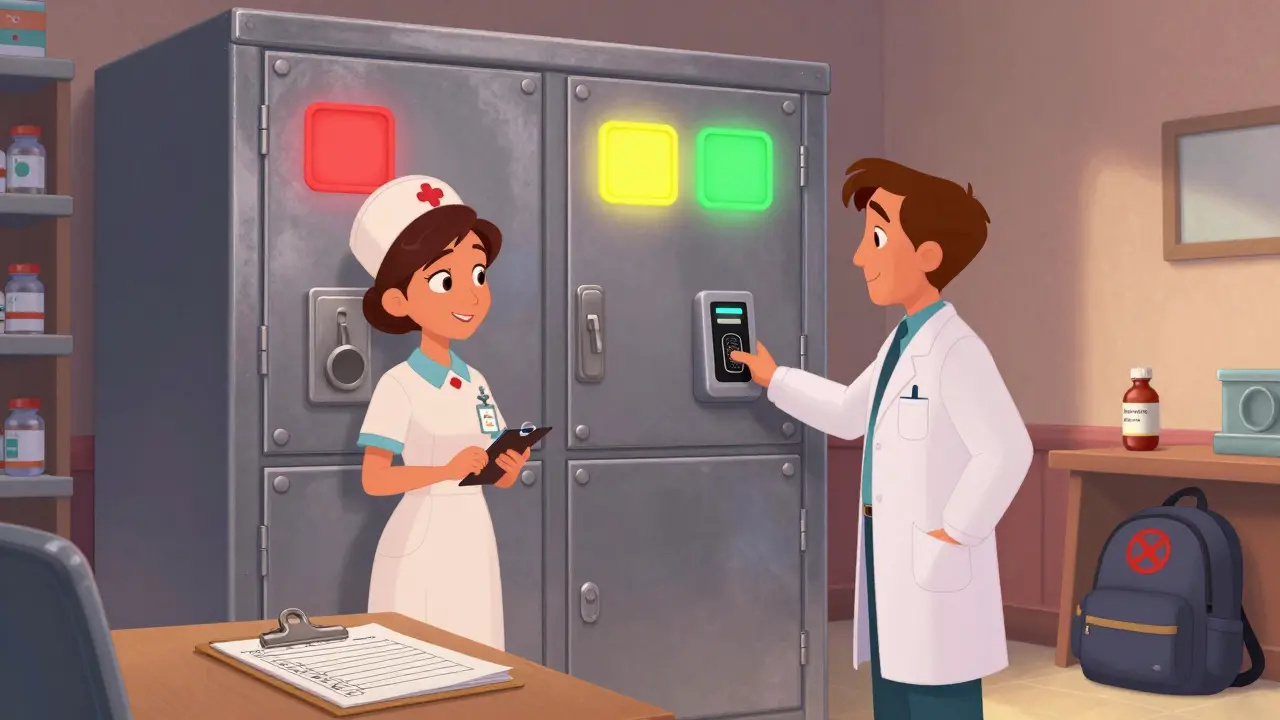
Storing controlled substances safely isn’t just about locking a cabinet. It’s about stopping theft before it happens - and protecting patients, staff, and your facility from serious legal and ethical consequences. In 2025, with DEA inspections up 37% since 2019 and penalties averaging $187,500 per violation, poor storage practices are no longer an oversight. They’re a liability.
Why Controlled Substance Storage Matters
Every year, an estimated 37,000 incidents of diversion occur in U.S. healthcare settings. That’s not just pills going missing. It’s opioids ending up on the street, patients getting contaminated doses, and nurses losing their licenses. The problem isn’t always bad actors - it’s weak systems. A locked cabinet with no log, a pharmacy bag left unattended, or a single person handling all refills - these are the gaps that get exploited. The DEA’s Controlled Substances Act (CSA) doesn’t just ask for security. It demands effective controls. And under 21 CFR Part 1301, that means more than a padlock. It means processes that track every pill from arrival to disposal - and make it nearly impossible to steal without being caught.Physical Storage Requirements: What the Law Actually Says
The DEA doesn’t specify “use a safe” or “install cameras.” Instead, it says storage must be “a manner adequate for safeguarding.” That leaves room for interpretation - which is why most facilities follow the ASHP Guidelines (2018) as the gold standard. Here’s what works:- Access limited to one or two authorized staff only - no shared keys or codes.
- Storage units must be physically secure: steel-reinforced cabinets, bolted to the floor, with no visible tampering points.
- Location matters. Storage areas should be away from public hallways, not near exits, and never hidden behind curtains or in closets. Visibility reduces opportunity.
- Personal bags, purses, and backpacks are banned in medication storage zones. In 31% of diversion cases, stolen drugs were hidden in personal items.
Manual vs. Automated Storage: The Real Difference
If you’re still using a manual ledger and a metal cabinet, you’re operating at high risk. Facilities relying on paper logs and manual counts have diversion rates 4.2 times higher than those using automated dispensing cabinets (ADCs), according to DEA audit data from 2021-2022. Why? Manual systems have blind spots:- No real-time tracking - you only know something’s missing when you do a monthly count.
- No user identification - anyone with a key can access the cabinet.
- No audit trail - if a dose disappears, you can’t prove who took it.
- Pharmacy vaults
- Emergency department crash carts
- Post-op recovery units
- ICUs

Where Diversion Happens - And How to Plug the Gaps
Most theft doesn’t happen in the pharmacy vault. It happens in transit. The DEA found that 68% of large-scale diversion cases occurred during:- Compounding medications (mixing IV bags)
- Transferring drugs from pharmacy to floor stock
- Returning unused doses
- Never allow a single person to handle both ordering and dispensing. Split responsibilities.
- Require two signatures for any manual transfer - even if it’s just one vial.
- Use pre-filled, tamper-evident syringes for high-risk drugs. No more empty vials being swapped for saline.
- Track all waste. If a nurse disposes of a drug, they must witness it with a second person and document the serial number. No exceptions.
Staff Training and Culture: The Hidden Layer
Technology won’t save you if your staff thinks the rules are “just for show.” A 2022 survey of 1,247 facilities found that 63% faced staff pushback when tightening storage rules. People complained about “extra steps.” They resented being watched. But after six months of consistent enforcement - and clear communication - 89% said security awareness improved. How to do it right:- Don’t just hand out a policy PDF. Run live drills. Show how easy it is to steal if controls are weak.
- Train everyone - not just pharmacists. Nurses, techs, even cleaners need to know: if you see a bag left unattended, report it.
- Make reporting anonymous. Use a hotline or online form. No names. No blame.
- Recognize staff who catch issues. A simple “thank you” in a team meeting builds culture faster than any policy.
What to Do If You Find a Diversion
If you suspect a drug is missing:- Don’t confront anyone yet. Document everything: dates, times, quantities, who had access.
- Review electronic logs. Look for outliers - someone who always takes the last dose, or refills at odd hours.
- Lock down the area. Freeze access until the investigation starts.
- Report to your compliance officer. If the loss exceeds 10% of your monthly inventory, you must notify the DEA within one business day.
What’s Changing in 2025
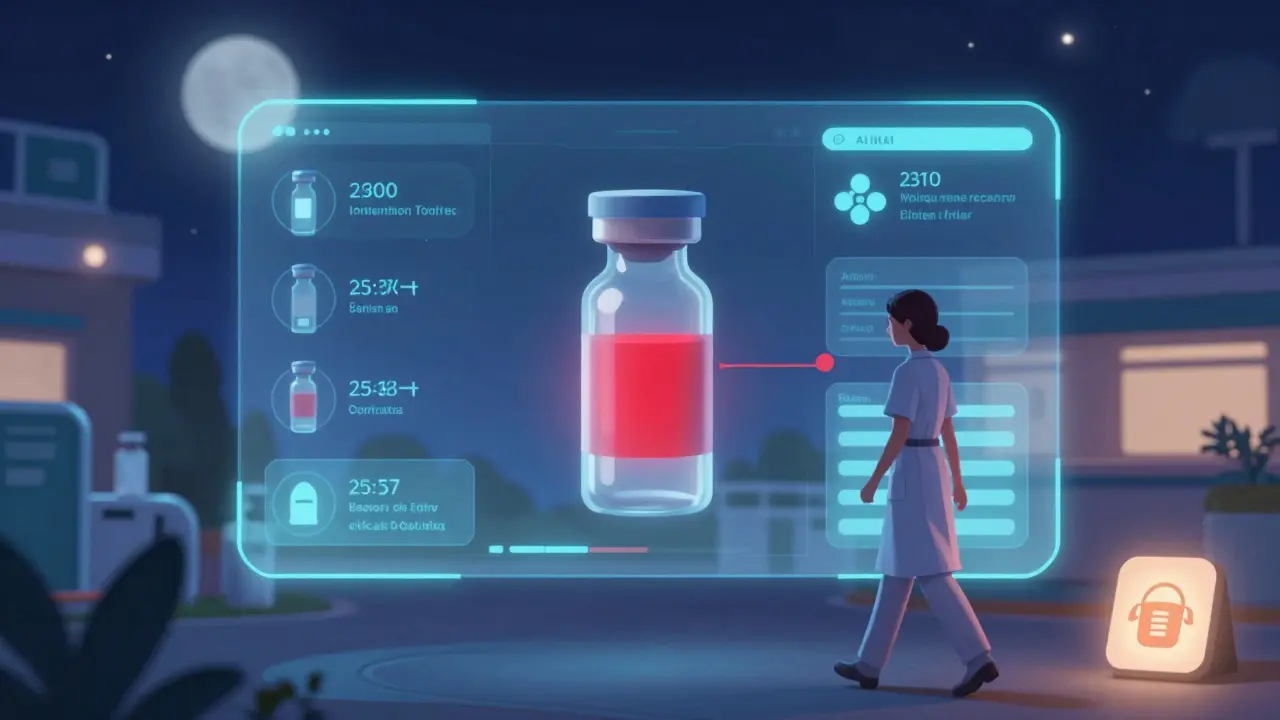
As of January 1, 2025, any facility handling more than 10kg of Schedule II substances annually must have real-time inventory tracking. No more monthly counts. No more Excel sheets. Every pill must be accounted for as it moves. The ASHP is also rolling out Version 2.0 of its Guidelines, with new rules targeting “flushing” - where diverted drugs are replaced with saline or water in IV bags. That’s now a red flag. And AI is coming. Hospitals like Mayo Clinic and Johns Hopkins are testing systems that watch for patterns: a nurse who refills 12 doses in one shift, then takes a 20-minute break. Or a vial that’s scanned in, then never scanned out. These systems cut false alarms by 63% and catch 92% of incidents within 48 hours. You don’t need AI tomorrow. But you need a plan to get there.Bottom Line: Security Isn’t Optional
Storing controlled substances isn’t about checking a box. It’s about protecting people. Patients who need pain relief. Staff who don’t want to lose their careers. And your facility, which could be fined, sued, or shut down over one missed protocol. Start here:- Map every handoff point - from delivery to disposal.
- Identify the top three risk areas.
- Install dual control or ADCs where it matters most.
- Train your team with real examples, not just rules.
- Review logs daily. Look for the small things - a refill at 3 a.m., a missing serial number, a signature that looks off.
Every time I see a facility skip dual control because it's 'too slow,' I cringe. That's not efficiency-that's negligence dressed up as convenience. One missing vial can destroy a career, and it's always the same story: someone thought they were too busy to follow protocol. Don't be that person.
Color-coded labels are genius. Simple, visual, and works across language barriers. I implemented this in our rural clinic last year-no more confused nurses grabbing the wrong vial. Diversion reports dropped, and staff actually started asking for more color codes. Sometimes the best solutions are the ones that don't require new tech.
adc cost is crazy but dual control with two signatures is free and 89% better than paper logs
Let’s be real-the DEA doesn’t care about your budget. They care about compliance. If you can’t afford an ADC, you shouldn’t be storing Schedule II drugs. Period. That’s not a suggestion, it’s a liability equation. You think a $45k machine is expensive? Try a $187k fine, a federal audit, and a nursing license on the line. The math doesn’t lie.
AI-driven anomaly detection is the future, and honestly? It’s already here. At our hospital, the system flagged a nurse who consistently refilled oxycodone right before her break-every single day. Turned out she was swapping vials with saline. The system caught it in 14 hours. No human count, no tip, no drama. Just data. And guess what? She had no idea she was being watched. That’s the power of passive monitoring. Stop thinking of tech as a cost. Think of it as a shield.
You call this a ‘practical guide’? This reads like a corporate compliance sales pitch disguised as public service. Real-world facilities don’t have $75k to burn on ADCs. Rural clinics? Small ERs? They’re using locked drawers with a clipboard. And you’re telling them they’re ‘high risk’? Sure. But you’re also telling them they’re failing before they even tried. There’s a difference between ‘adequate’ and ‘ideal.’ The law says ‘adequate.’ You’re pushing ‘ideal’ as if it’s mandatory. That’s not helpful-that’s elitist. And the color-coded labels? Cute. But if your staff can’t read, color means nothing. Maybe train them to read first, then worry about vial shades.
Let’s cut the fluff. The entire post is just ASHP guidelines with a side of fearmongering. 37,000 diversion incidents? Where’s the source? DEA audit data from 2021-2022? That’s not a citation, that’s a vague reference. And ‘92% caught within 48 hours’ by AI? Name the study. Mayo and Hopkins are testing? Cool. But that’s two hospitals out of 6,000. This isn’t a guide-it’s a marketing brochure for ADC vendors. And don’t get me started on ‘color-coded labels.’ That’s not security, that’s a kindergarten system. If your nurses need color to know what’s Schedule II, they shouldn’t be handling controlled substances.
I’ve seen what happens when you ignore this stuff. A nurse I worked with started stealing hydromorphone after her mom passed. Not because she was evil-because she was broken. And the system didn’t catch it until she overdosed on the same drug she was stealing. That’s not a policy failure. That’s a human failure. The real win isn’t the locked cabinet-it’s the culture that says, ‘We see you, we’re here, and we won’t let you fall alone.’ Train people. Listen. Act before it’s too late.
Anonymous reporting changed everything for us. Before, people were terrified to speak up-thought they’d be labeled a snitch. We set up a simple, encrypted form with no login required. First month: 12 reports. Two were legit. One led to a nurse diverting tramadol. We didn’t fire her. We got her help. She’s back on the floor now, sober, and she thanks us every day. That’s the kind of win no audit can measure.
How is it even legal to let nurses handle opioids without retinal scans? This is 2025. We track our coffee orders with biometrics. But we let people walk away with fentanyl using a keycard? This system is a joke. Someone’s kid is going to die because someone ‘forgot’ to lock the cabinet. And then we’ll all say ‘we didn’t know.’ Wake up.
For those saying ADCs are too expensive-look at your turnover costs. One nurse loses her license, you hire a replacement, train them, deal with the morale hit, the audit, the potential lawsuit. That costs 3x the price of an ADC over three years. This isn’t a cost-it’s an investment in stability. And if your staff resists new protocols? That’s a leadership problem, not a policy one. You don’t enforce rules-you build ownership.
The law says adequate not perfect and you are conflating compliance with excellence
Actually, your comment about turnover costs is exactly why this whole system is broken. You’re treating nurses like assets to be protected, not humans with complex lives. The real problem isn’t the cabinet-it’s the burnout. The 12-hour shifts. The understaffing. The fact that people are stealing because they’re exhausted, not because they’re criminals. Fix the system, not the lock.