
Nutrition During Chemotherapy: How to Manage Nausea and Maintain Weight
When you're going through chemotherapy, eating can feel like a second job. Your body is fighting cancer, but the treatment itself is making you feel sick, tired, and sometimes just plain not hungry. Nausea hits at random times. Food tastes metallic. Even your favorite meals smell wrong. And then there’s the fear: weight loss during chemo isn’t just about looking different-it can mean your treatment gets delayed, your strength drops, and recovery takes longer.
Why Your Body Needs More Than Just Calories
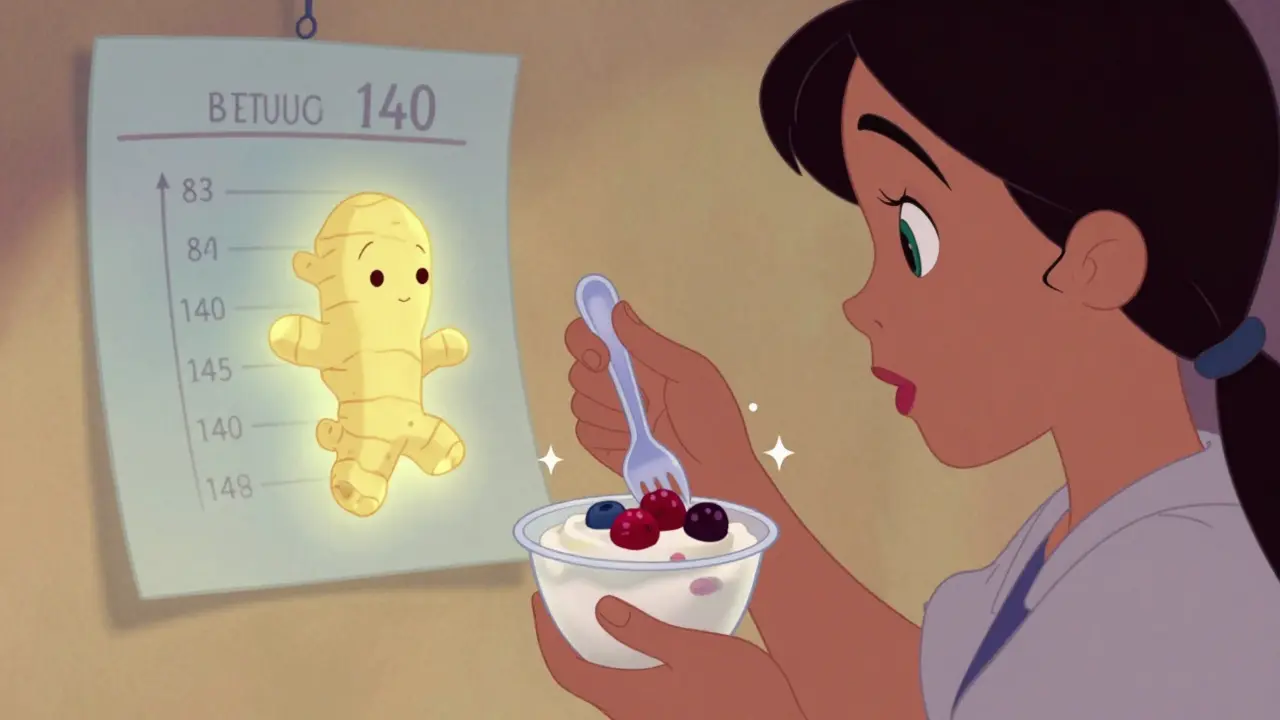
Your body isn’t just trying to survive chemo-it’s trying to repair itself. Chemotherapy attacks fast-growing cells, including cancer cells, but it also damages healthy ones in your gut, mouth, and muscles. That means your protein needs jump from the standard 0.8 grams per kilogram of body weight for a healthy adult to 1.2 to 2.0 grams per kilogram during treatment. For someone weighing 70 kg (about 154 lbs), that’s 84 to 140 grams of protein every day. That’s not a suggestion-it’s a medical requirement.Calories matter too. Healthy adults need about 20-25 kcal per kg of body weight. During chemo, that number goes up to 25-30 kcal per kg. If you’re losing weight, it’s not because you’re not trying hard enough. It’s because your body is burning through energy faster than ever, and your appetite isn’t keeping up.
How to Beat Nausea Without Giving Up Food
Nausea is the #1 reason people stop eating during chemotherapy. But it’s not hopeless. The key isn’t to force yourself to eat big meals-it’s to change how and when you eat.- Small, frequent meals-five to six times a day, not three. Each meal should be around 300-400 calories. That’s easier on your stomach and keeps your energy steady.
- Drink between meals, not with them. Sipping water or tea during a meal fills your stomach too fast, making nausea worse. Drink 30 minutes before or after eating.
- Avoid greasy, fried, or strongly scented foods. Studies show 73% of patients feel worse after eating fatty foods. Skip the bacon, fried chicken, or heavy sauces. Cold foods like chilled yogurt, applesauce, or watermelon have less odor and are often better tolerated.
- Try ginger. Ginger chews, ginger tea, or even candied ginger helped 287 patients on Cancer Survivors Network reduce nausea. It’s not magic-but it’s backed by science.
- Use plastic utensils. Metal can taste bitter after chemo. Plastic spoons and forks help. So do rinsing your mouth with baking soda water (1/2 tsp in 1 cup water) before eating.
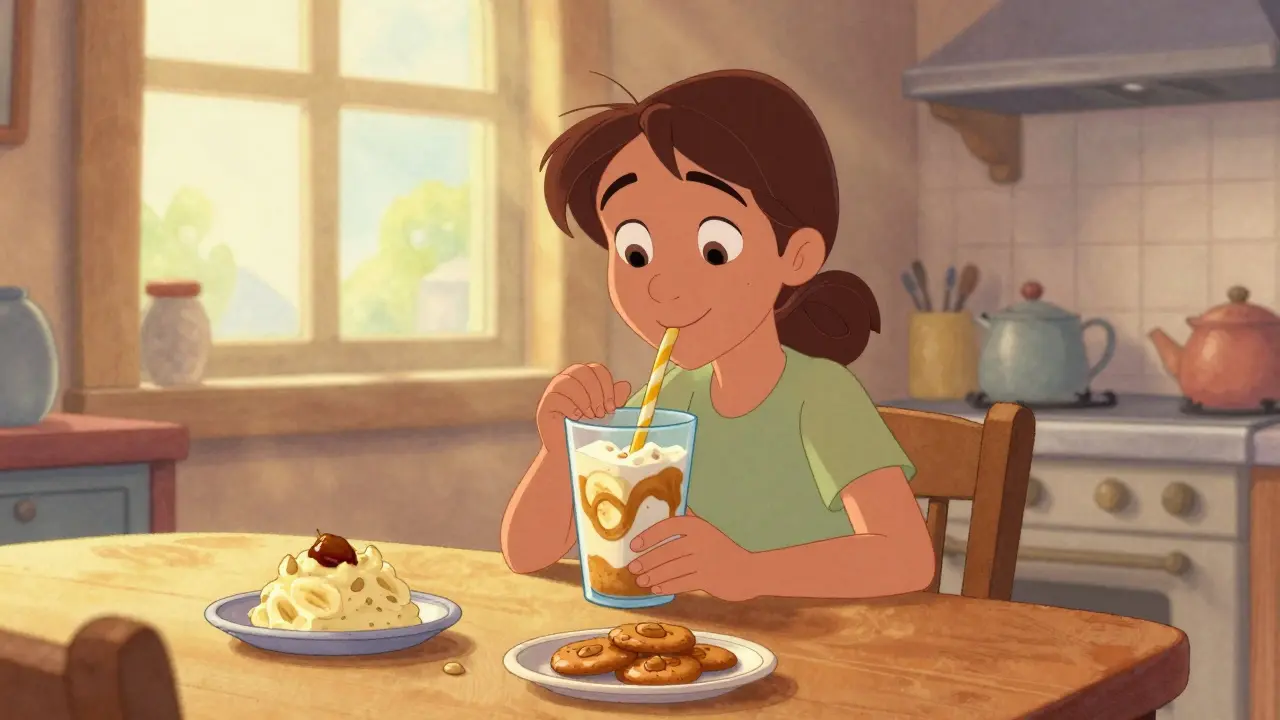
One patient in Melbourne shared: “I stopped eating breakfast because I felt sick every morning. Then I tried eating a peanut butter banana smoothie at 10 a.m. instead. No nausea. I kept doing it. Now I eat like that every day.”
Protein Is Your Best Friend-Here’s How to Get It
You don’t need fancy supplements to hit your protein goal. Real food works better and costs less.- Full-fat Greek yogurt-17g protein per 100g. Mix with honey and berries for a cold, soothing snack.
- Peanut butter-8g protein per 2 tablespoons. Spread on toast, stir into oatmeal, or eat with apple slices.
- Eggs-6g protein per egg. Scrambled, boiled, or in an omelet with cheese. Make sure yolks are fully cooked (160°F/71°C) to avoid infection risk.
- Lean meats-chicken, turkey, fish. Cook thoroughly. Avoid raw or rare meat. Salmon is great-it’s rich in omega-3s, which help fight appetite loss.
- Protein shakes-homemade ones work best. Blend 1 cup full-fat milk, 2 tbsp peanut butter, 1 banana, 1 tbsp honey, and a scoop of whey or soy protein. That’s 30g+ protein in one drink.
Many patients skip protein because they think it’s “too heavy.” But if you’re losing muscle, your body can’t fight infection or recover from treatment. Protein isn’t optional-it’s your armor.
Food Safety Isn’t Optional-It’s Life-Saving
Chemotherapy weakens your immune system. What’s harmless to a healthy person can be dangerous to you.- No raw eggs. That means no homemade mayonnaise, Caesar dressing, or cookie dough. Use store-bought versions labeled “pasteurized.”
- No rare meat or sushi. Cook all meat until it’s steaming hot inside. Fish should flake easily with a fork.
- Wash everything. Fruits and veggies need to be scrubbed-even if you’re peeling them. Bacteria can hide on the skin.
- Reheat leftovers until they’re steaming hot. Don’t eat anything left out for more than 2 hours.
One patient lost weeks of treatment after eating undercooked chicken. She didn’t get sick from the food itself-but from the infection it triggered. Her chemo was paused for 18 days. That’s time you can’t get back.
What to Do When You Just Can’t Eat
Sometimes, even the best plan fails. Your mouth hurts. Your stomach is empty but refuses to take anything in. That’s when you need backup.- High-calorie snacks keep you going. Keep peanut butter crackers, trail mix, cheese sticks, or granola bars in your bag, by your bed, in the car.
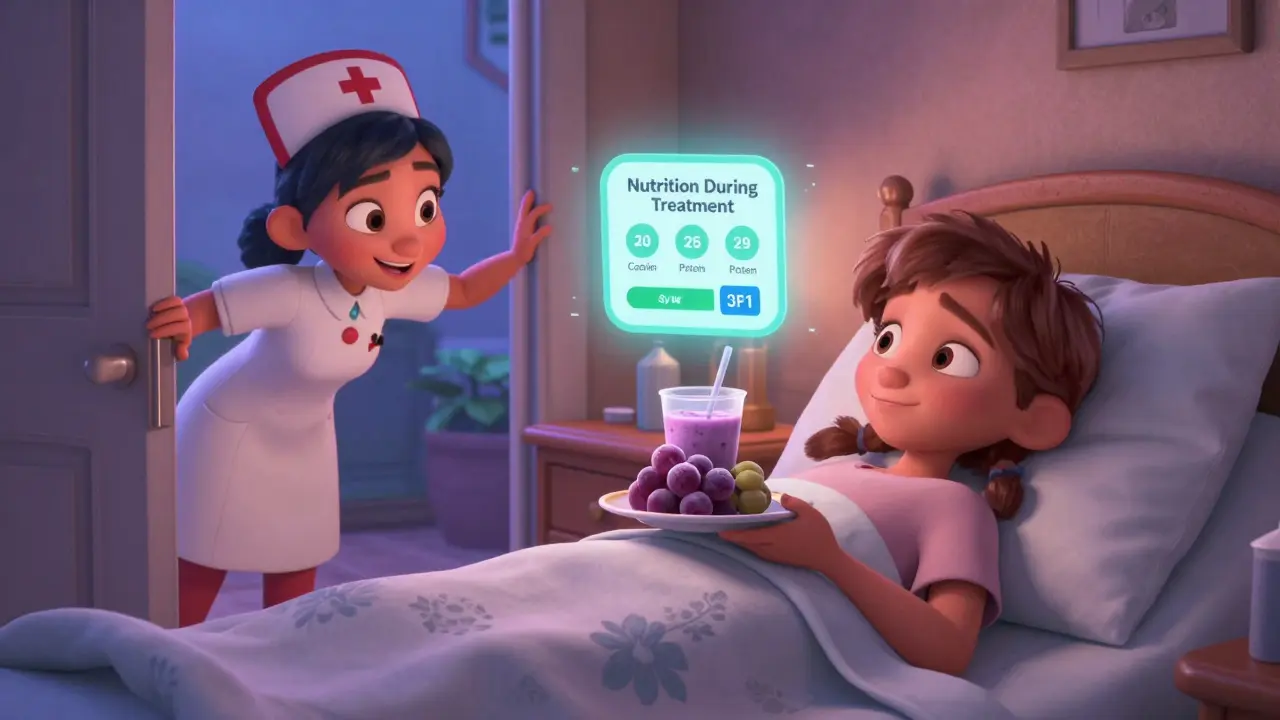
- Freeze grapes or berries. They’re cool, sweet, and help numb mouth sores. One patient said: “I kept a bag in the freezer. When my mouth burned, I ate a few. It was the only thing that felt good.”
- Medical nutrition drinks like Ensure Plus or Boost Plus provide 350+ calories and 13g protein per bottle. But they cost $35-$45 for a 12-pack. If that’s too expensive, make your own: blend whole milk, banana, oats, peanut butter, and a spoon of honey. Same calories. Half the price.
- Ask for help. The American Cancer Society’s 24/7 helpline fields over 12,000 nutrition questions a month. They can connect you with a free oncology dietitian in your area.
Real People, Real Results
On Reddit’s r/cancer community, 78% of patients said protein shakes were essential. Most made them at home. One man, 62, lost 18 pounds in his first month of chemo. He started blending full-fat yogurt, whey protein, and frozen mango every morning. In six weeks, he gained back 11 pounds. His oncologist said: “You didn’t just gain weight-you gained time.”Another woman, 49, couldn’t eat solid food for 10 days after her third chemo cycle. Her dietitian gave her a simple plan: sip a high-calorie shake every 2 hours, even if she only drank 2 ounces at a time. She didn’t feel better right away-but she didn’t lose more weight. That kept her treatment on track.
What Doesn’t Work
Don’t fall for myths.- “Eat only organic”-Not necessary. Wash your food. That’s enough.
- “Cut carbs to starve cancer”-Cancer cells use sugar, but so do your brain and muscles. Cutting carbs makes you weaker, not healthier.
- “I’ll lose weight later-I’ll eat healthy after chemo”-If you lose muscle now, you’ll need months to rebuild it. And you might not finish treatment.
- “I don’t need a dietitian-I know what to eat”-Only 35% of community clinics have an oncology dietitian. But if you’re getting chemo, you deserve one. Ask your oncologist for a referral.
Tools That Help
The National Cancer Institute launched a free app in September 2023 called “Nutrition During Treatment.” It tracks calories, protein, nausea triggers, and even reminds you when to eat. Over 42,000 people downloaded it in six months.Other tools:
- Keep a food diary-even just three lines a day. What you ate. How you felt. What helped.
- Pre-portion snacks. Put 10 peanut butter crackers in a bag. Put it on the counter. No thinking needed.
- Use a small plate. Big plates feel overwhelming. Small portions feel doable.
When to Call Your Team
You don’t have to power through this alone. Call your doctor or dietitian if:- You’ve lost more than 5% of your body weight in a month.
- You can’t keep down liquids for 24 hours.
- Your mouth is so sore you can’t swallow.
- You’re too tired to even think about food.
There are options: liquid nutrition, feeding tubes, or IV nutrition. They’re not failures. They’re tools. And they work.
Can I drink alcohol during chemotherapy?
It’s best to avoid alcohol. It dehydrates you, irritates your mouth and throat, and can interfere with how your body processes chemo drugs. Even one drink can make nausea worse. If you’re unsure, ask your oncologist or dietitian.
Should I take protein supplements?
Whole food sources are preferred, but supplements can help if you’re struggling to meet your protein goal. Whey, soy, or casein powders mixed into smoothies are safe and effective. Look for ones with at least 15g protein per serving. Avoid ones with added sugar or artificial sweeteners if they upset your stomach.
Is it okay to eat sweets during chemo?
Yes-if they help you eat. Sugar doesn’t feed cancer more than other carbs. If a spoonful of honey or a small piece of dark chocolate helps you take a sip of a protein shake, then it’s worth it. Focus on getting calories and protein first. Nutrition isn’t about perfection-it’s about survival.
Why am I still losing weight even though I’m eating?
Chemotherapy changes how your body uses energy. You might be eating enough, but your body is burning through muscle faster than it can rebuild it. That’s why protein intake needs to be so high. If you’re eating regularly but still losing weight, talk to your dietitian. You may need higher-calorie options or medical nutrition formulas.
How long does it take to adjust to eating small meals?
Most people need 7 to 10 days to get used to eating five or six small meals instead of three big ones. By two weeks, 85% of patients who stick with it say it feels normal. The trick? Set alarms. Put snacks where you’ll see them. Don’t wait until you’re hungry-eat before you feel like it.
Final Thought: This Is About More Than Food
Nutrition during chemotherapy isn’t about diets, detoxes, or superfoods. It’s about keeping your body strong enough to finish treatment. Every bite you eat is a step toward your next chemo session. Every gram of protein helps your immune system fight infection. Every calorie keeps you from losing muscle you’ll need to walk, breathe, and recover.You don’t have to love eating right now. You just have to keep doing it. Even if it’s just a spoonful of yogurt. Even if it’s a handful of nuts. Even if you have to force yourself. Your body is counting on you-not to be perfect, but to be persistent.
Look, I get it - chemo’s rough. But let’s not turn this into a cult of protein worship. I’ve seen guys on this stuff chugging protein shakes like they’re prepping for a bodybuilding contest while their kidneys scream for mercy. You don’t need 140g of protein a day unless you’re a 200lb bodybuilder on steroids. Most people just need to eat something - anything - without turning dinner into a math problem. Stop overcomplicating it.
Also, ginger? Really? I tried that. Tasted like wet cardboard. My nausea didn’t care. Maybe stick to meds that actually work instead of wellness TikTok hacks.
Let me ask you something - who approved this article? The National Cancer Institute? Or some nutrition influencer with a sponsored yogurt brand? I’ve read peer-reviewed studies on chemo nutrition - and none of this is backed by robust clinical trials. The ‘1.2–2.0g/kg protein’ recommendation? That’s from a 2015 meta-analysis with a 70% dropout rate. Meanwhile, the FDA hasn’t endorsed any of these ‘homemade shakes’ as medical nutrition.
And don’t get me started on the ‘plastic utensils’ thing. That’s not science - that’s placebo. If your taste buds are that sensitive, maybe it’s the chemo, not the fork. Also, why is there no mention of corticosteroids or aprepitant? This reads like a blog post written by a wellness coach with zero medical training.
While the article presents a commendable attempt at elucidating nutritional protocols during chemotherapy, it is imperative to acknowledge the absence of citations from randomized controlled trials (RCTs) for the majority of its assertions. The recommendation to consume 1.2–2.0 g/kg of protein daily, for instance, is not universally endorsed by international oncology societies. The European Society for Clinical Nutrition and Metabolism (ESPEN) suggests 1.0–1.2 g/kg for most patients, reserving higher intakes for cachectic or hypermetabolic cases.
Furthermore, the assertion that ginger reduces nausea by 287 patients is statistically incoherent - it lacks a sample size, control group, or p-value. The anecdotal evidence presented, while emotionally compelling, does not constitute evidence-based practice. One must exercise caution before disseminating such information to vulnerable populations.
Additionally, the promotion of homemade protein shakes without specifying sterility protocols may inadvertently increase the risk of nosocomial infections in neutropenic patients. The omission of food safety guidelines for immunocompromised hosts, beyond basic washing, is a critical deficiency.
bro i was on chemo last year and this is 100% spot on 🙌
plastic utensils changed my life. metal = pure regret. ginger chews = my new best friends. and yeah, i started drinking a peanut butter banana shake at 10am like the guy in melbourne - no nausea, no stress, just vibes.
also, frozen grapes? absolute game changer. kept a bag in my freezer like a snack stash. when my mouth felt like sandpaper, i’d pop 3. instant relief. no meds needed.
and for real - stop listening to people who say ‘just eat more.’ if you can’t eat, you can’t eat. that’s not weakness. that’s biology. the shakes? they saved me. i gained back 15lbs. my oncologist cried. i didn’t.
ps: if you’re still reading this, you’re doing better than you think 💪
I’m an oncology dietitian and I can tell you - this post is one of the most accurate, practical, and compassionate summaries I’ve seen in a long time. The protein targets? Spot on. The emphasis on small, frequent meals? Critical. The warning about raw foods? Life-saving.
One thing I’d add: if you’re struggling to meet protein goals, try adding powdered milk to soups, mashed potatoes, or even coffee. It’s tasteless, cheap, and adds 8g protein per 1/4 cup. Also, if you can’t tolerate dairy, pea protein blends work just as well - and they’re easier on the gut.
And yes, the app mentioned? I recommend it to every patient. It’s free, simple, and tracks what matters: calories, protein, nausea triggers.
You’re not alone. And you’re not failing if you need help. Ask for it. Every single day, someone in this community is doing exactly what you’re doing - and surviving.
Keep going. One spoonful at a time.
My uncle in Mumbai went through chemo and ate nothing but dal-rice with a spoon of ghee and a boiled egg every day. No shakes, no protein powder, no fancy apps. He survived. He didn’t lose weight. He didn’t get infections.
Maybe you don’t need all this tech and science. Maybe you just need food that feels like home. We don’t need to westernize nutrition to survive. Simple, warm, familiar food - that’s what kept him going.
Also, plastic forks? In India, we use steel. But we wash them with boiling water and soap. Cleanliness > utensil material.
Respect the wisdom of tradition. Not every solution needs a patent.
This article is dangerously misleading. The claim that ‘sugar doesn’t feed cancer more than other carbs’ is a dangerous oversimplification. Cancer cells metabolize glucose at a higher rate than normal cells - this is well-established in oncology literature. While it is true that the brain requires glucose, deliberately promoting sweets as ‘acceptable’ during chemotherapy is irresponsible. It normalizes metabolic dysfunction.
Furthermore, the suggestion to consume high-calorie snacks like trail mix and granola bars - many of which contain refined sugars, hydrogenated oils, and preservatives - is counterproductive. These are not ‘food’ - they are processed industrial products. If you must supplement, use whole foods: lentils, paneer, eggs, nuts.
There is no excuse for promoting junk food under the guise of ‘survival.’ This is not nutrition. It is capitulation.
Wow. Just… wow. This isn’t just advice - it’s a lifeline wrapped in a love letter. I’ve read medical journals, sat through endless oncology seminars, and none of it hit me like this did.
That line - ‘Your body is counting on you-not to be perfect, but to be persistent’ - I cried reading it. My mum’s been on chemo for 11 months. We’ve had days where she could only sip broth. But she did it. Every. Single. Day.
I started making her those shakes - milk, banana, oats, peanut butter, honey. She calls them ‘my little sunshine in a cup.’ She’s gained 8lbs. Her nails stopped breaking. Her energy? Barely there, but it’s there.
And the frozen grapes? She now has a little freezer box labeled ‘Nana’s Magic Ice Beads.’ She eats them like candy. I swear, if this were a movie, it’d win an Oscar.
To the person who wrote this - thank you. Not just for the facts, but for the heart. We don’t need more data. We need more humanity.