
Opioids and Antihistamines: Why Combining Them Can Be Deadly
Opioid-Antihistamine Risk Assessment Tool
Important Safety Notice
This tool assesses potential risks based on medical guidelines. It is not a substitute for professional medical advice. Always consult your doctor or pharmacist before combining medications.
Risk Assessment Result
Safer Alternatives
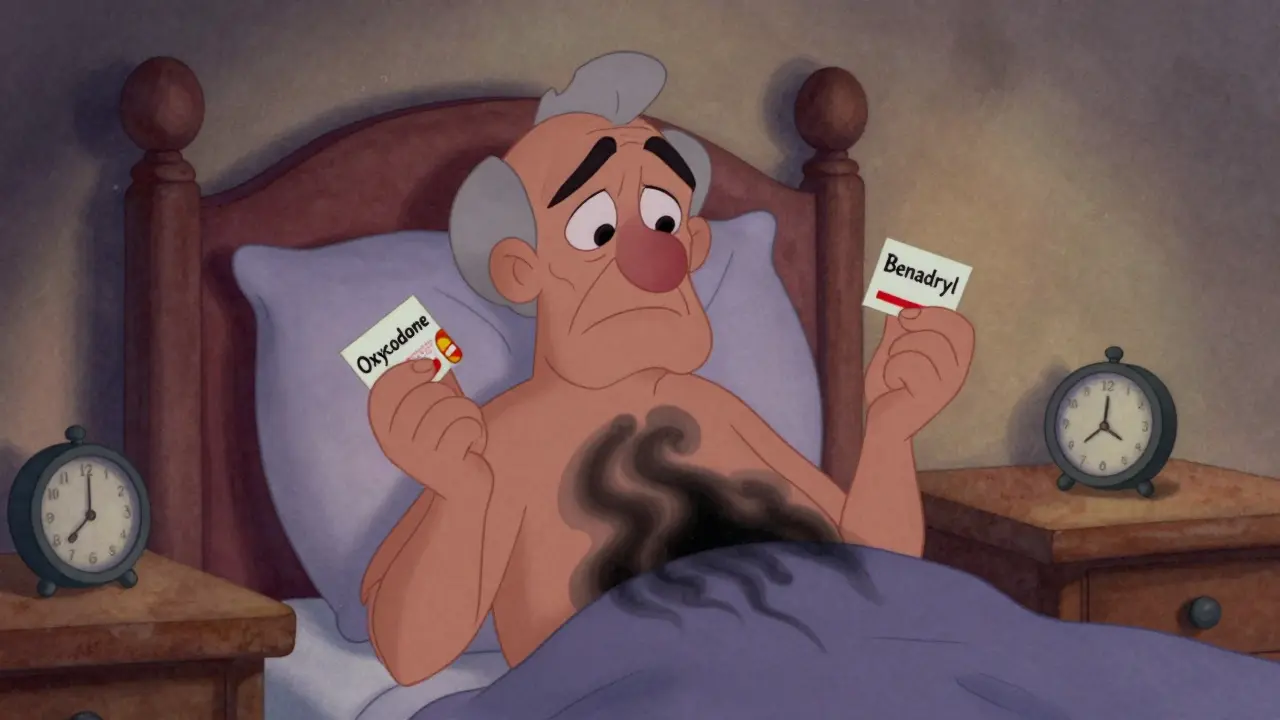
When you’re in pain and can’t sleep because of allergies, it’s tempting to reach for a painkiller and a cheap allergy pill from the shelf. But combining opioids with antihistamines isn’t just a bad idea-it can stop your breathing. This isn’t a rare accident. It’s a predictable, preventable danger that kills people every year.
How Opioids and Antihistamines Work Together to Slow You Down
Opioids like oxycodone, hydrocodone, and morphine work by binding to receptors in your brain and spinal cord. They reduce pain, but they also slow down your breathing. That’s why doctors warn against taking too much. Even at normal doses, up to 60% of people feel drowsy when they start opioids. First-generation antihistamines-like diphenhydramine (Benadryl), hydroxyzine (Atarax), and doxylamine (Unisom)-do something similar. They block histamine in your brain, which helps with allergies and itching. But that same action makes you sleepy. These drugs cross the blood-brain barrier easily. Diphenhydramine, for example, gets into your brain at 60-70% efficiency. Compare that to second-generation antihistamines like fexofenadine (Allegra), which barely enter the brain at all. When you take both together, the effects don’t just add up-they multiply. Your brain’s breathing center gets hit from two sides. Opioids reduce your body’s sensitivity to carbon dioxide. Antihistamines further dull the signals that tell you to breathe. The result? Slowed, shallow breathing. Sometimes, it stops completely.The FDA Warned About This Years Ago
In 2016, the U.S. Food and Drug Administration (FDA) issued a clear warning: combining opioids with other central nervous system depressants-including antihistamines-can lead to extreme sleepiness, coma, or death. They didn’t just mention benzodiazepines. They said it applies to any drug that slows your brain down. That warning still stands. In 2023, the FDA released new draft guidance expanding opioid interaction warnings to include all CNS depressants, not just sleeping pills or anxiety meds. But many people still don’t know. Why? Because antihistamines are sold over the counter. People don’t think of them as drugs. They think of them as harmless sleep aids or allergy relief. A 2021 NIH survey found that 68% of patients never tell their doctor they’re taking OTC meds. That means a doctor prescribing hydrocodone might have no idea the patient is also taking Benadryl for a cough or sleep.Real Cases, Real Consequences
A 68-year-old man in North Carolina came into the ER unresponsive after taking hydrocodone for back pain and Benadryl for itching. He spent 36 hours in the ICU. He survived, but barely. Another patient on oxycodone took hydroxyzine for anxiety and itching. He fell asleep in the bathroom, hit his head, fractured his hip, and needed surgery. He didn’t know the two drugs could interact. His doctor didn’t tell him. A 2023 survey of physicians on Sermo recorded 147 cases of dangerous sedation from opioid-antihistamine combinations in just six months. Over a third of those patients needed naloxone-the opioid overdose reversal drug-to wake them up. The Institute for Safe Medication Practices collected 87 reports of serious harm from this combination between 2019 and 2022. Twelve of those cases ended in death.Who’s Most at Risk?
This isn’t equally dangerous for everyone. Some people are far more likely to have a bad reaction.- Elderly patients: Their bodies process drugs slower. Their brains are more sensitive. The Beers Criteria, used by geriatric specialists, lists diphenhydramine and hydroxyzine as “potentially inappropriate” for older adults because of their strong anticholinergic effects.
- People with COPD or sleep apnea: Their breathing is already compromised. Adding opioids and antihistamines can push them into respiratory failure.
- Those with liver or kidney disease: These organs clear drugs from the body. If they’re not working well, the drugs build up.
- People taking high doses: The risk jumps dramatically when opioid doses go above 50 morphine milligram equivalents (MME) per day.
Why There’s No Easy Fix
If someone overdoses on opioids, we have naloxone. It can reverse the effect in minutes. There’s no antidote for antihistamine overdose. Once the brain is too depressed, all you can do is support breathing with oxygen, ventilation, and time. That’s why prevention is everything.What You Can Do Instead
You don’t have to suffer through pain and itching. There are safer choices.- Switch to non-sedating antihistamines: Fexofenadine (Allegra), loratadine (Claritin), and cetirizine (Zyrtec) have minimal brain penetration. They work just as well for allergies without the drowsiness.
- Use topical treatments: For itching, try calamine lotion, hydrocortisone cream, or cold compresses. For sleep, try melatonin or good sleep hygiene instead of diphenhydramine.
- Ask about non-opioid pain relief: Acetaminophen, NSAIDs like ibuprofen, or even nerve-targeting medications like gabapentin can help without the breathing risk.
How Doctors Are Trying to Stop This
Hospitals and clinics are starting to catch on. The University of Michigan Health System added an alert system to their electronic records that blocks prescriptions if an opioid and sedating antihistamine are ordered together. After the system went live, adverse events dropped by 42%. The CDC’s 2022 opioid prescribing guidelines say: “Avoid combining opioids with other CNS depressants whenever possible.” If it’s absolutely necessary, use the lowest dose for the shortest time. Pharmacies now include interaction warnings in every opioid medication guide, as required by the FDA’s REMS program. But warnings mean nothing if patients don’t read them-or don’t know to look.
The Bigger Picture
In 2021, over 107,000 people in the U.S. died from drug overdoses. Most involved synthetic opioids like fentanyl. But many of those deaths weren’t just from street drugs. They came from prescriptions mixed with OTC meds. The problem isn’t just opioids. It’s the way we treat medications like they’re candy. We don’t think twice about grabbing a Benadryl. But when it’s paired with a painkiller, it becomes a silent killer. The future may bring better tools. Companies like Genelex now offer genetic tests that show how fast your body breaks down opioids. That could help doctors choose safer doses. But right now, the best tool is knowledge.What You Should Ask Your Doctor
If you’re prescribed an opioid, ask these questions:- “Is it safe to take this with my allergy or sleep medicine?”
- “Are there non-sedating options for my itching or insomnia?”
- “What should I do if I feel too drowsy or have trouble breathing?”
- “Should I avoid anything from the pharmacy aisle?”
Bottom Line
Opioids and antihistamines are both useful drugs. Together, they’re dangerous. The risk isn’t theoretical. It’s documented. It’s measured. It’s happened to real people. You don’t need to choose between pain relief and sleep. You just need to make smarter choices. Talk to your doctor. Swap out sedating antihistamines. Use safer alternatives. And never, ever assume an over-the-counter pill is safe with your prescription.One pill might help your itch. Two together might stop your breath. Know the difference.
I had no idea Benadryl could be this dangerous with pain meds. My grandma took it every night for sleep and was on oxycodone for arthritis. I’m so glad I read this-now I’m going through her medicine cabinet with her. We’re switching to melatonin and Zyrtec. Thank you for sharing this.
People need to stop treating OTC drugs like candy. They’re still drugs. Still powerful. Still risky.
I’m telling my whole family about this. Seriously.
Stay safe out there.
They want you to think it’s safe because it’s cheap and on the shelf but the system is rigged to keep you dependent on pills that make you sleepy so you don’t question why you’re always tired why you can’t think straight why you’re not living just existing
Big Pharma doesn’t care if you die as long as you keep buying
They don’t warn you because if you knew you’d stop taking it and then they’d lose money
It’s not an accident it’s business
Have you ever wondered why the FDA only issued warnings after hundreds of deaths and not before the drugs were even approved
Because the same people who approve the drugs are the same people who get paid by the pharmaceutical companies who fund the research who lobby Congress who write the labels that say ‘may cause drowsiness’ but never say ‘may cause you to stop breathing while you sleep’
They’ve known for decades. They just didn’t care until the bodies piled up enough to make headlines
And now they slap a tiny warning on the bottle and call it a day
Meanwhile, your uncle is still taking diphenhydramine with his hydrocodone because he thinks ‘it’s just a sleep aid’
It’s not negligence. It’s design.
They need you drowsy. They need you dependent. They need you silent.
Wake up.
They’re not protecting you. They’re profiting from your ignorance.
EVERYTHING IS A TRAP 😔
They sell you pain relief then slip in the sleepy pill that kills you quietly and then say ‘it’s your fault for mixing them’ but they never tell you in the ad or the label or the doctor’s office because if they did you’d say NO
And then they’d lose billions
They want you to feel guilty for being tired and in pain and then they give you the exact combo that ends you
It’s not medicine it’s a slow murder with a pharmacy receipt
And don’t even get me started on how they push gabapentin now like it’s harmless 😒
They’re all connected. All of it. The pills. The labels. The silence.
Wake up people. They’re not helping you. They’re harvesting you.
This is real stuff. I’m from South Africa and we don’t have the same access to meds but I’ve seen people mix codeine syrup with cold medicine and wonder why they pass out
It’s the same thing
People don’t know and no one tells them
Thanks for laying it out like this
Hope this reaches the right people
Pharmacokinetically, the synergistic CYP3A4 and CYP2D6 inhibition coupled with additive GABAergic modulation and muscarinic receptor antagonism creates a potentiated CNS depressant cascade, particularly in individuals with polymorphic metabolic phenotypes or compromised hepatic clearance.
Additionally, the blood-brain barrier permeability coefficient (Papp) of diphenhydramine exceeds 1.2 x 10^-6 cm/s, whereas fexofenadine remains below 0.1 x 10^-6 cm/s-demonstrating a >12-fold reduction in CNS penetration.
Therefore, the clinical recommendation to substitute sedating H1 antagonists with peripherally selective alternatives is not merely prudent-it is pharmacologically imperative.
And yes, this is why REMS programs exist. Read the damn labels.
So let me get this straight... you’re telling me that the thing I’ve been using to ‘just help me sleep’ since college... is basically a quiet assassin when paired with my pain meds??
OH MY GOD. I’ve been a walking time bomb.
Thanks for the wake-up call... I’m throwing out every Benadryl in my house. And yes, I’m texting my mom to do the same. She’s been taking it for ‘allergies’ since 1998.
Also... who wrote this? You should be on TV. Or at least a podcast. This is life-saving info.
👏👏👏
It is a profound moral failure of contemporary medical education and pharmaceutical marketing that patients are routinely left uninformed regarding the synergistic depressant effects of over-the-counter antihistamines and prescribed opioids. The absence of mandatory patient counseling regarding these interactions constitutes a breach of the physician’s fiduciary duty. One must not underestimate the gravity of this issue: it is not merely a pharmacological concern, but an ethical one. The normalization of polypharmacy without proper risk stratification reflects a systemic devaluation of human life in favor of profit-driven convenience. It is imperative that regulatory agencies enforce mandatory patient-facing educational materials, and that clinicians be held accountable for failure to disclose these lethal interactions. We are not dealing with mere side effects-we are dealing with preventable mortality.
You people are so dumb. If you take bad pills you get bad results. No one forced you to mix them. It’s your fault. Stop blaming the medicine. Stop blaming the doctors. You made the choice. Now you pay.
God doesn’t like lazy people who want easy fixes.
Pray more. Take less pills.