
Prescriber Education Resources: Guides for Doctors on Generics
Doctors prescribe generics every day-90% of all prescriptions filled in the U.S. are for generic drugs. But how many actually understand why they’re just as safe and effective as brand-name versions? Despite overwhelming evidence, skepticism lingers. Patients ask, "Is this really the same?" Some doctors still hesitate. The gap isn’t about science-it’s about education.
What the FDA Actually Says About Generics
The FDA doesn’t approve generics because they’re cheaper. They approve them because they’re identical in active ingredient, strength, dosage form, and route of administration. And here’s the key: they must meet the same strict standards as brand-name drugs. The process? A generic drug must show bioequivalence-meaning it delivers the same amount of active ingredient into the bloodstream at the same rate as the brand. That’s not a guess. It’s tested in 24 to 36 healthy volunteers using precise pharmacokinetic studies.
The FDA’s bioequivalence standard is 80% to 125% of the brand’s blood concentration. That range isn’t arbitrary-it’s based on decades of clinical data showing no meaningful difference in outcomes within those bounds. In 2022, the FDA analyzed over 24,000 adverse event reports for both brand and generic drugs. The numbers were nearly identical: 11,832 for brands, 12,467 for generics. No safety gap. No efficacy gap.
And yet, many doctors still don’t know this. A 2022 survey found only 48% of physicians were aware of the FDA’s Generic Drugs Stakeholder Toolkit-despite it being free, publicly available, and updated in January 2023. That’s not ignorance. That’s a systemic failure in how education reaches clinicians.
Why Doctors Still Doubt Generics
It’s not that doctors don’t trust science. It’s that they’re overwhelmed. Most don’t have time to dig through PDFs during a 10-minute visit. The FDA’s Prescriber Flyers, while accurate, are dense. One doctor on Reddit said: "I need this info in my Epic alert box, not as a PDF I have to hunt for."
There’s also the myth of "authorized generics." These are brand-name drugs sold under a generic label-same factory, same formula, same packaging, just cheaper. But 61% of surveyed physicians didn’t know what they were. That confusion breeds hesitation. If you don’t understand the difference between a true generic and an authorized generic, how can you explain it to a patient?
Then there’s the complexity problem. For simple pills-like metformin or lisinopril-generics are straightforward. But for inhalers, topical creams, or injectables? The science gets harder. Bioequivalence isn’t as clear-cut. That’s where most educational resources fall short. The FDA’s materials focus heavily on oral solids. Few resources address the nuances of complex generics, even though they make up a growing share of prescriptions.
Real Impact: Cost, Adherence, and Outcomes
Cost isn’t just a number on a bill. It’s the reason 20% to 30% of new prescriptions go unfilled. For a patient paying $300 a month for a brand-name statin, switching to a generic cuts that to $37.50. That’s $262.50 saved every month. That’s food, rent, transportation-things that matter more than a brand name.
Dr. Aaron Kesselheim from Harvard put it plainly: "Switching to a generic saves the patient $262.50 monthly while maintaining 99.7% identical therapeutic effect on average." That’s not marketing. That’s data from 47 peer-reviewed studies.
And adherence isn’t just about taking the pill. It’s about trust. When patients believe a generic is inferior, they’re more likely to skip doses-or stop entirely. A 2021 FDA survey found 42% of Hispanic patients worried about generic quality. Patients with incomes under $25,000 are 3.7 times more likely to quit essential meds because of cost. Education isn’t optional here. It’s a lifeline.
What Works: How Top Practices Use These Resources
The best outcomes don’t come from handing out flyers. They come from embedding education into workflow.
Kaiser Permanente integrated FDA generic drug facts directly into their Epic EHR system. Within six months, brand-name prescribing dropped by 18.7%. Why? Because the information popped up at the moment of decision-right when the doctor was writing the script. No extra steps. No extra time.
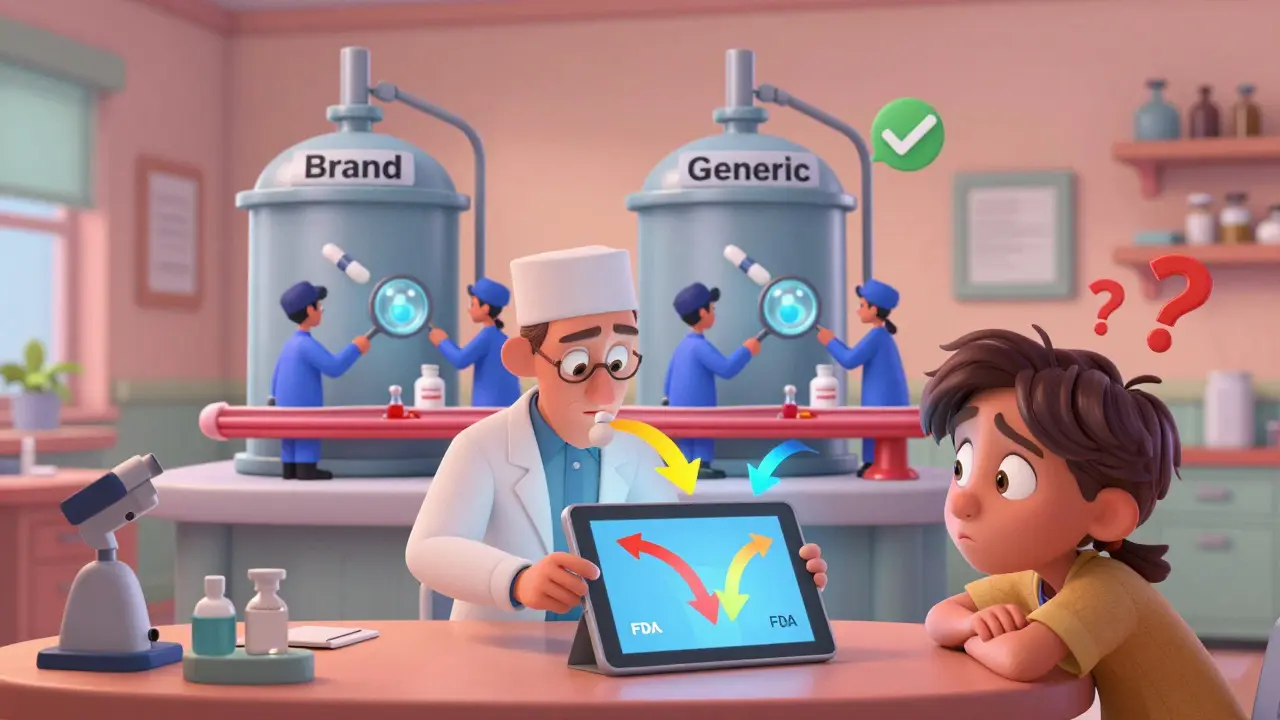
Dr. Sarah Chen, a family physician in rural Nebraska, increased her generic prescribing rate from 62% to 89% in 18 months. How? She used the FDA’s infographic comparing manufacturing standards. She showed it to skeptical elderly patients. "It helped them see that the same FDA inspectors check both factories," she wrote in the Journal of the American Board of Family Medicine.
The CDC recommends a three-step approach: 1) A 15-minute training on regulatory standards, 2) Adding conversation prompts to patient intake forms (e.g., "Have you ever had concerns about switching to a generic?"), and 3) Monthly feedback comparing your prescribing rate to peers. Physicians who followed this saw a 2.3x increase in cost-conversation starts.
Where the System Still Fails
Only 37% of major EHR systems have any kind of generic education pop-up. That’s a missed opportunity. Doctors aren’t lazy-they’re busy. If the system doesn’t support them, they default to what’s familiar.
And the materials? They’re written at a 6th- to 8th-grade reading level, which is good. But they’re not mobile-friendly. No one’s scrolling through a 958 KB PDF on their phone during a clinic break. No one has time.
Even the FDA’s latest updates-the 2023 Stakeholder Toolkit with 12 social media templates and 5 customizable cards-aren’t reaching the people who need them most. Independent practices rely on these resources, but 63% say they’re "adequate but not exceptional." Academic centers offer grand rounds on generics. Community clinics? They get a PDF and hope for the best.
The Future Is Personalized
IBM Watson Health ran a 2023 pilot using AI to generate personalized generic substitution recommendations based on patient history, concerns, and insurance. In a trial with 120 physicians, patient acceptance rates jumped by 29 percentage points. That’s not science fiction. That’s the next step.
Medicare’s 2024 proposed rule could change everything. Plans that offer prescriber education on therapeutic alternatives could get financial incentives-potentially affecting 49 million beneficiaries. That means hospitals, insurers, and pharmacies will start investing in training. Not because it’s nice. Because it saves money.
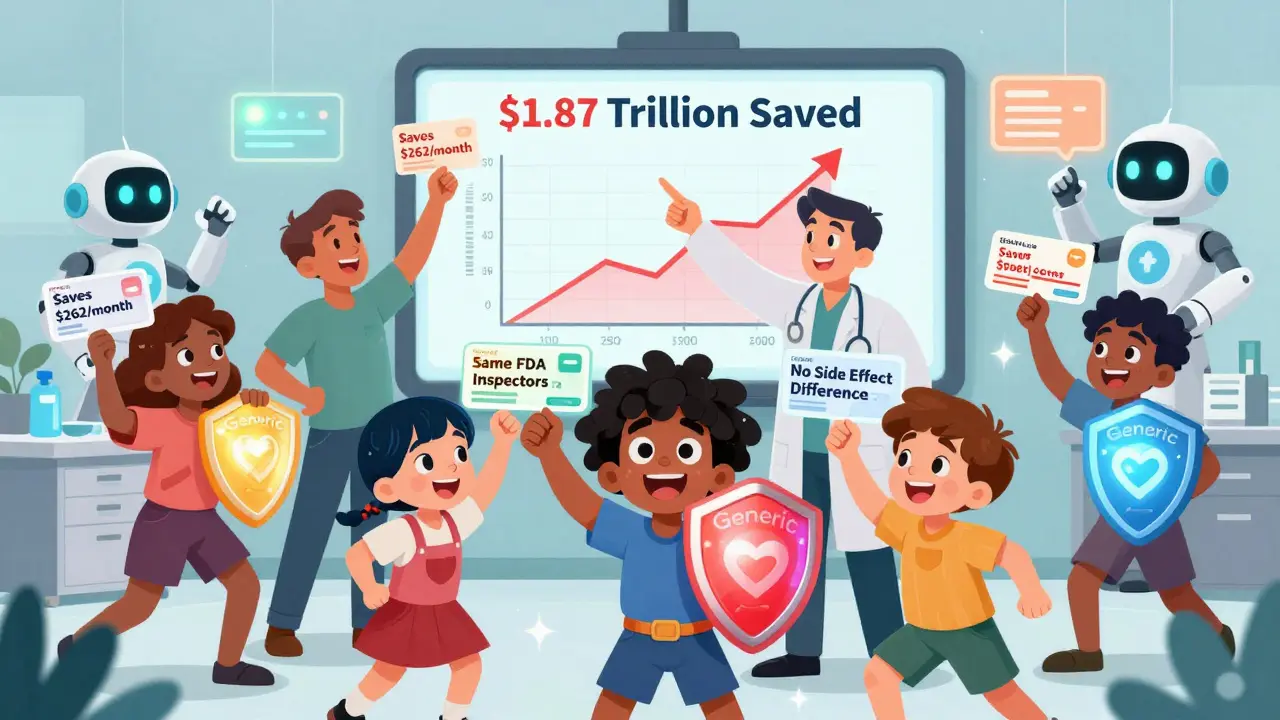
And the numbers don’t lie. From 2010 to 2020, generics saved the U.S. healthcare system $2.29 trillion. The next five years? Another $1.87 trillion. That’s not a guess. That’s a projection from the Association for Accessible Medicines.
What You Can Do Today
You don’t need to wait for your EHR to update. Start here:
- Download the FDA’s Generic Drugs Prescriber Flyer (Version 2)-it’s free, 142 KB, and fits on a clipboard.
- Print the infographic: What Makes a Generic the Same as a Brand-Name Drug? Keep it in your exam room.
- Use the conversation scripts in the toolkit. When a patient says, "My doctor said the brand works better," respond with: "The FDA requires generics to work the same way. The only difference is the price."
- Ask your EHR vendor: "Can we add FDA generic education alerts to our prescribing workflow?"
It’s not about convincing everyone. It’s about starting the conversation. One patient at a time. One script at a time.
Are generic drugs really as effective as brand-name drugs?
Yes. The FDA requires generics to have the same active ingredient, strength, dosage form, and route of administration as the brand. They must also prove bioequivalence-delivering the same amount of drug into the bloodstream at the same rate. Studies show 99.7% identical therapeutic effect on average. Over 90% of prescriptions filled in the U.S. are generics, and their safety profile matches brand-name drugs exactly.
Why do some doctors still prefer brand-name drugs?
Many doctors weren’t trained on the science behind generics, or they rely on outdated beliefs. Some confuse "authorized generics" (same drug, different label) with true generics. Others worry about complex formulations like inhalers or topical creams where bioequivalence is harder to demonstrate. Time pressure also plays a role-switching feels safer when you don’t have to explain it to a skeptical patient.
Can generics cause different side effects?
The active ingredient is identical, so side effects should be the same. Inactive ingredients (fillers, dyes) can vary slightly, which may cause rare allergic reactions in sensitive patients-but that’s true for brand-name drugs too. The FDA monitors adverse events for both and finds no pattern of increased risk with generics. In 2022, adverse event reports for generics and brands were nearly identical.
What’s the difference between a generic and an authorized generic?
An authorized generic is made by the original brand-name company and sold under a generic label. Same factory, same formula, same quality control-just cheaper. A true generic is made by a different company but must meet the same FDA standards. Many doctors don’t know this distinction, which causes confusion when patients ask why two "generics" look different or cost different amounts.
How can I explain generics to skeptical patients?
Use simple language and visuals. Say: "The FDA requires generics to work exactly like the brand. The only difference is the price. The same inspectors check both factories. Many patients save over $250 a month-without losing effectiveness." Show them the FDA’s infographic comparing manufacturing. Patients who see the facts are far more likely to agree to switch.
Are there any drugs where generics aren’t recommended?
For most drugs, generics are equally effective. But for medications with narrow therapeutic windows-like warfarin, levothyroxine, or certain anti-seizure drugs-some doctors prefer to stick with one brand to minimize variability. Even then, switching between generics is often safe if monitored closely. The key is consistency: once a patient is stable on a generic, don’t switch unless necessary.
Do insurance companies force patients to use generics?
Yes, most plans require patients to try generics first unless the prescriber writes "Do Not Substitute" on the prescription. This is called therapeutic substitution. In 44 states, laws mandate generic substitution unless the doctor objects. But patients often don’t understand why. That’s why education from the prescriber matters-it turns a mandate into a shared decision.
Is there data showing generics improve patient outcomes?
Yes. Studies show patients on generics are more likely to stick with their treatment because of lower cost. The American College of Physicians found that cost barriers cause 20-30% of new prescriptions to go unfilled. When patients can afford their meds, hospitalizations drop, complications decrease, and long-term outcomes improve. One study found that switching to generics for statins reduced heart attack rates by 12% in low-income groups.
Why don’t EHR systems have better generic education tools built in?
EHR vendors prioritize billing, scheduling, and compliance over clinical education. Only 37% of major systems include any generic education prompts. But change is coming. The FDA launched an API pilot in 2023 that connects generic data directly to Epic and Cerner. Early results show a 15.2% increase in generic prescribing among participating clinics. This is the future-education built into the workflow, not an afterthought.
Where can I get the best free resources for my practice?
Start with the FDA’s Generic Drugs Stakeholder Toolkit (updated January 2023). It includes printable flyers, infographics, social media templates, and conversation scripts-all free and downloadable. The Prescriber Flyer (Version 2) is especially useful for quick reference. Also check the CDC’s Opioid Prescribing Guidelines for context on generic substitution in pain management. These are the most trusted, evidence-based resources available.
OMG this is so needed 😭 I had a patient cry last week because she thought her generic blood pressure med was 'fake'... I showed her the FDA infographic and she hugged me. We need this in every clinic. Like, NOW. 🙏
Yeah right. FDA? Please. They’re in bed with Big Pharma. Generics are just cheap knockoffs that make people sicker. I’ve seen it with my own eyes - my cousin’s seizure meds went from perfect to nightmare after switching. Don’t believe the propaganda.
Y’all are so naive. The FDA doesn’t care about you. They approve generics so pharma can make more money off you while you die slowly from 'inactive ingredients' they don’t test. I read a blog once that said 73% of generics have hidden toxins. It’s all a scam. 💀
For complex generics like inhalers, bioequivalence is measured via pulmonary deposition, not just plasma levels - which is why some docs hesitate. The FDA’s guidelines for these are still evolving. We need more clinical data on delivery systems, not just oral solids. Also, the 80-125% range? That’s a statistical window, not a guarantee of identical effect in every patient. Context matters.
This is such a good reminder. I just started using the FDA conversation scripts with my elderly patients and wow - they actually listen now. No more 'I don't trust the blue pill'. One lady said, 'So the same people check both? Okay then.' 🥹 Thank you for making this so simple.
Let’s be real - EHR vendors are paid by Big Pharma to keep generics buried. You think they want you prescribing $37 meds? Nah. They make more off brand-name bundles. The 'API pilot' is just PR. The real data? Hidden. The system is rigged. You’re being played.
It’s not about science it’s about control. Doctors were trained to trust authority not data. The real crisis isn’t ignorance - it’s the surrender of critical thinking to institutional dogma. We’ve outsourced judgment to algorithms and FDA pamphlets. What happened to the Hippocratic instinct? Where’s the intuition? The soul of medicine is being replaced by a checklist. You don’t need a flyer - you need to remember you’re a healer not a clerk.
My favorite part? The part where Kaiser dropped brand prescribing by 18.7% just by popping up the info in Epic. That’s it. No lectures. No meetings. Just the right info at the right time. Why don’t all EHRs do this? It’s so simple. I’m emailing my IT team right now.