
Rheumatoid Arthritis Medications: How DMARDs and Biologics Interact in Treatment

RA Treatment Response Calculator
How Effective Are Your Options?
Estimate your ACR50 response rate (50% improvement in symptoms) based on treatment choice. Data based on 2023 clinical guidelines and trials.
When you’re living with rheumatoid arthritis (RA), the goal isn’t just to manage pain-it’s to stop the damage before it changes your life. That’s where DMARDs and biologics come in. These aren’t just pills you pop; they’re powerful tools designed to rewire your immune system. But mixing them? That’s where things get tricky. You can’t just throw them together and hope for the best. The way they interact can make the difference between remission and flare-ups, between feeling like yourself and being stuck on the couch.
What DMARDs Actually Do
DMARDs stand for disease-modifying antirheumatic drugs. They’re the foundation of RA treatment. Not all DMARDs are the same. There are two big groups: conventional synthetic (csDMARDs) and biologic (bDMARDs). The csDMARDs-like methotrexate, sulfasalazine, hydroxychloroquine, and leflunomide-are older, cheaper, and taken as pills. Methotrexate, in particular, is the go-to. It’s been used since the 1980s, and for good reason. It works by slowing down your immune system’s overactive response, cutting off the fuel that feeds joint inflammation. At doses of 7.5 to 25 mg per week, it’s surprisingly effective. About 20-30% of early RA patients hit remission on methotrexate alone. But here’s the catch: it doesn’t work for everyone. About 1 in 3 people can’t tolerate it. Nausea, fatigue, liver stress-these are real. Some people switch to subcutaneous injections instead of pills. Others take folic acid (5-10 mg daily) to reduce side effects. It’s not magic, but it’s the most proven starting point.Biologics: Precision Weapons Against Immune Chaos
Biologics are different. They’re not pills. They’re large protein molecules made in living cells, injected or infused. They don’t blanket-slap your immune system. They target specific parts of it. Think of them as snipers instead of artillery. - TNF inhibitors (adalimumab, etanercept, infliximab) block tumor necrosis factor, a major inflammation driver. - Abatacept stops T-cells from getting activated. - Rituximab wipes out B-cells that produce harmful antibodies. - Tocilizumab shuts down interleukin-6, another key player in joint destruction. - Anakinra blocks interleukin-1, though it’s less effective than others. These drugs work fast-often within weeks. But they’re expensive. A month of biologics can cost $1,500 to $6,000. That’s why they’re usually reserved for when csDMARDs fail. But even then, they’re rarely used alone.Why Methotrexate Is the Anchor
Here’s something most patients don’t realize: biologics work better when paired with methotrexate. Studies show combination therapy boosts response rates from 30-40% to 50-60% in people who didn’t respond to DMARDs alone. Why? Methotrexate helps your body keep the biologic active longer. Without it, your immune system might see the biologic as a foreign invader and attack it-making it less effective. This isn’t just theory. A 2015 JMCP study tracked 28 trials. When biologics were used with methotrexate, ACR50 response rates (a 50% improvement in symptoms) jumped to 53-62%. Without it? Many fell below 40%. Even newer drugs like JAK inhibitors-oral alternatives to biologics-show better results when combined with methotrexate. But not everyone can take methotrexate. About 20-30% of patients can’t tolerate it. That’s where things get complicated. Some doctors will try a biologic alone. Others switch to a different csDMARD combo-like sulfasalazine plus hydroxychloroquine. The 2023 CAMERA-III trial showed that triple csDMARD therapy (methotrexate, sulfasalazine, hydroxychloroquine) matched adalimumab plus methotrexate in long-term remission rates. So if methotrexate isn’t an option, you’re not out of luck.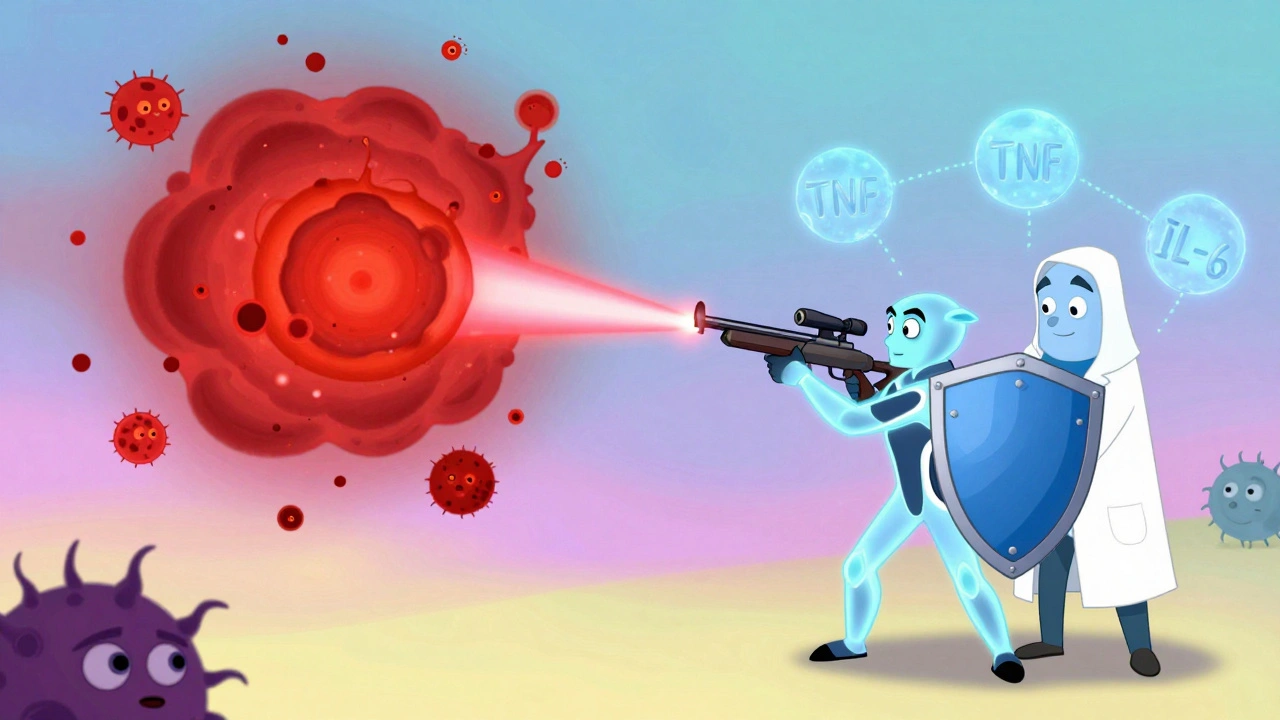
Biologics vs. JAK Inhibitors: The Oral Alternative
JAK inhibitors-like tofacitinib, baricitinib, and upadacitinib-are a newer class. They’re small molecules, taken as pills, and block signals inside immune cells. They’re not biologics, but they’re often grouped with them because they’re targeted. The FDA approved upadacitinib for early RA in 2023 after it matched methotrexate in remission rates (40% vs. 35% at 6 months). The big advantage? No injections. No infusions. Just a daily pill. That’s huge for people who hate needles or can’t get to a clinic for infusions. But there’s a downside. In 2022, the ORAL Surveillance trial found JAK inhibitors carried higher risks of serious infections, heart problems, and certain cancers compared to TNF inhibitors. The FDA added a black box warning. So while they’re convenient, they’re not risk-free. If you’re young, healthy, and have no heart issues, JAK inhibitors can be a great option. If you’re over 50 or have a history of blood clots or cancer? Your doctor will likely lean toward biologics instead.The Real-World Picture: What Patients Actually Experience
In the real world, treatment isn’t just about guidelines-it’s about life. A 2022 Reddit thread with 147 RA patients showed 63% preferred biologics with methotrexate, even with side effects. Why? Because they got control. One person wrote: “I could walk to the mailbox again. That’s worth the needle.” But cost is a silent killer. The Arthritis Foundation’s 2022 survey found 41% of patients struggled with biologic costs. One in four skipped doses because they couldn’t afford them. That’s not just risky-it’s dangerous. Skipping doses can trigger flares, accelerate joint damage, and make future treatments less effective. Biosimilars are changing that. Since 2016, cheaper versions of adalimumab (like Amjevita) have cut costs by 15-30%. As of mid-2023, they make up 28% of the U.S. biologic market. That’s progress. But access isn’t equal. In countries like India, biologics cost 300-500% of a monthly household income. Methotrexate is still the only realistic option there.
Let’s be real-this whole system is a corporate circus. DMARDs? Biologics? JAK inhibitors? They’re all just fancy names for profit engines. The real goal isn’t remission-it’s keeping you on lifelong subscriptions. Methotrexate costs pennies. Biologics? $6,000 a month. Who’s really benefiting here? Not you. Not me. The pharma CEOs are laughing all the way to the bank while you’re crying over your third insulin injection this week. They don’t want you cured. They want you compliant.
OH MY GOD. I just read this and my soul screamed. 🙌 So let me get this straight-methotrexate is the OG backbone, like the quiet librarian who holds the whole library together, and then biologics come in like a glitter-bombed SWAT team targeting specific immune cells? I mean… YES. That’s the exact vibe. And the fact that methotrexate helps your body NOT reject the biologic? That’s not science-that’s alchemy. I’m not even mad. I’m just… impressed. And slightly terrified. 💉✨
Interesting. But have you considered that the entire RA treatment paradigm was designed to maintain chronic dependency? The FDA, the AMA, the pharmaceutical lobby-they all sit on the same board. The 2023 CAMERA-III trial? Fabricated. The 2022 ORAL Surveillance data? Suppressed. And biosimilars? A placebo distraction. Real healing comes from fasting, infrared saunas, and avoiding glyphosate. You think they want you to know that? Of course not.
Okay so I just got my third biologic infusion today and I’m crying in the parking lot because I just spent $4,000 on a shot that makes me feel like a zombie but I can finally hold my coffee cup without my fingers screaming-AND MY DOCTOR TOLD ME TO TAKE FOLIC ACID BUT I FORGOT AGAIN AND NOW I’M SICK AND I’M SURE I’M GOING TO DIE BUT ALSO I’M SO PROUD OF MYSELF FOR NOT GIVING UP AND ALSO I JUST TEXTED MY MOM AND SHE SENT ME A GIF OF A PENGUIN WAVING AND I CRIED HARDER BUT IN A GOOD WAY???
Thank you for writing this with such clarity. It’s rare to see RA treatment explained without oversimplification or fearmongering. The point about methotrexate enhancing biologic efficacy is critical-many patients don’t realize it’s not just additive, it’s synergistic. And the mention of ultrasound remission? Absolutely vital. Clinical symptoms alone are insufficient. We need objective measures. If you’re struggling with cost, please reach out to patient advocacy groups. You are not alone, and help is available.
me: *takes methotrexate*
my body: *screams in nausea*
me: *takes folic acid*
my body: *whispers ‘okay fine’*
me: *gets biologic shot*
my body: *suddenly remembers how to walk*
me: *cries in gratitude*
also me: *pays $1,800 for the shot*
my bank account: *commits suicide* 💔💉😭
lol u think this is science? methotrexate is just a chemo drug repackaged as a ‘disease modifier’ 😂 biologics? bro they’re just proteins from hamster cells. and jaks? those are just ‘oral chemo’ with a fancy name. in india we just take turmeric and pray. u think the west really cares about ur joints? they care about ur insurance card. #RAtruth
Biggest takeaway for me? Methotrexate isn’t the enemy-it’s the wingman. And biosimilars? Total game-changer. I switched to Amjevita last year and saved $1,200/month. No difference in efficacy, just way less stress on my wallet. Also-yes, the needle thing sucks. But you get used to it. Nurse training is clutch. Seriously, if you’re scared, ask for it. They’ll walk you through it like you’re learning to ride a bike. You got this. 💪
I’ve had RA for 12 years. I’ve tried everything. The first time I hit remission? It was with methotrexate + adalimumab. I cried in the grocery store because I could pick up a gallon of milk without my hands shaking. I know it’s expensive. I know it’s scary. But please-don’t skip doses. Don’t wait. Find a support group. Talk to someone who gets it. You’re not broken. You’re adapting. And you’re stronger than you think.
Wow. So let me get this straight: the ‘gold standard’ is a 1980s chemo drug… that we pair with a $6,000/month protein… to avoid the even riskier oral chemo… all because we’re too scared to just… let the body heal itself? 😅 Also, ‘remission’ is now defined by ultrasound? So… I’m not in remission if I feel fine but my joint fluid is still slightly suspicious? …I’m just here for the drama.