
Routine Monitoring to Catch Medication Side Effects Early: Tests and Timelines

Medication Test Scheduler
Check Your Medication Tests
Select a medication to see your monitoring schedule
Early detection of side effects can prevent serious complications
When you start a new medication, you’re told to watch for side effects. But what does that really mean? Most people think it’s just about noticing a headache or nausea and calling the doctor. The truth is, catching side effects early isn’t about waiting for something obvious-it’s about routine monitoring and knowing exactly what to track, when to test, and how to connect the dots before things get serious.
Why Most Side Effects Go Undetected
It sounds surprising, but only about 6% of serious drug reactions are ever reported to official systems like the FDA’s FAERS database. That’s not because people are careless-it’s because many side effects are subtle, slow to develop, or mistaken for something else. A dry cough might be blamed on allergies. Fatigue? "Just stress." A change in mood? "I’m getting older." Meanwhile, the real culprit could be a new blood pressure pill interacting with your cholesterol med. Clinical trials only test drugs on a few thousand people for months. Real life? Millions take the same drugs for years, often with five or more medications at once. That’s where things break down. A 2020 study in Nature Communications showed that computational models could predict unknown side effects of drugs like Semagacestat by analyzing patterns in early trial data-with 85% accuracy. That’s not magic. It’s data.What You Should Track (And How)
If you’re on a new medication, start a simple log. Not a fancy app. Just a notebook or a notes app on your phone. Record these every time you take your pill:- Date and time you took the medication
- Exact dose (e.g., 10 mg, not "one pill")
- What you felt-not "tired," but "head foggy, couldn’t focus after 2 hours"
- Severity on a scale of 1 to 10
- Duration-did it last 30 minutes? All day?
- Triggers-did you eat grapefruit? Drink coffee? Take another drug?
What Tests Should You Get, and When?
Not every drug needs blood work-but many do. Here’s a simple guide based on common medications:| Medication Type | Key Test | First Test | Follow-Up |
|---|---|---|---|
| Statins (cholesterol) | Liver enzymes (ALT, AST) | Before starting | 6 weeks, then every 6 months |
| ACE inhibitors / ARBs (blood pressure) | Kidney function (creatinine, eGFR) | Before starting | 1 week, then 1 month, then every 3-6 months |
| Lithium (mood stabilizer) | Blood level, thyroid, kidney | Before starting | Every 3 months |
| Antibiotics (long-term, e.g., doxycycline) | Complete blood count (CBC) | After 2 weeks | Every 4 weeks if used over 30 days |
| Antidepressants (SSRIs) | Serotonin levels (if symptoms), liver enzymes | Before starting | At 4 weeks if symptoms appear |
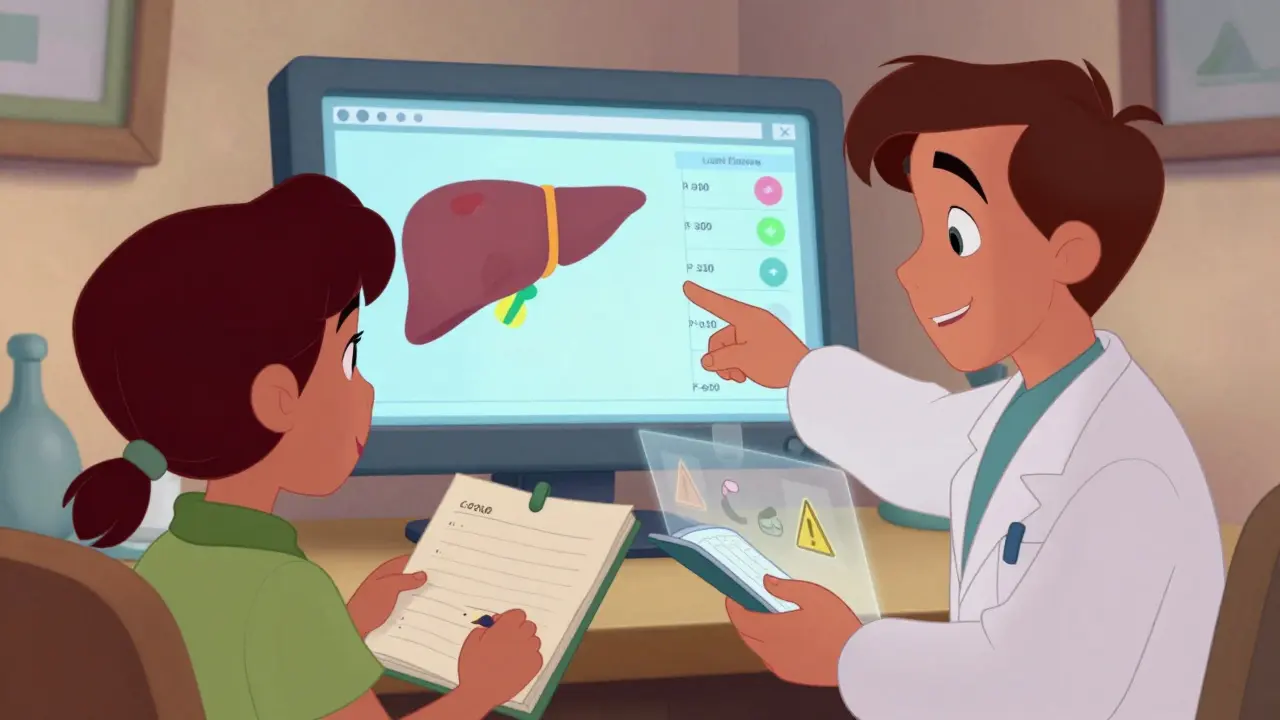
What Your Doctor Should Be Doing
Doctors don’t just guess. They use Clinical Decision Support Systems (CDSS)-software built into electronic health records that flags potential drug interactions. For example, if you’re on warfarin and your doctor tries to add a new antibiotic, the system will alert them: "Risk of bleeding increased. Consider alternative." But here’s the catch: CDSS only works if the data is accurate. If your doctor doesn’t know you’re taking an over-the-counter herb, or if your pharmacy record isn’t synced, the system misses it. That’s why your personal log matters. Bring it to every appointment. Don’t wait for them to ask. Stanford University researchers found that mining unstructured clinical notes-like doctor’s handwriting in EHRs-could detect side effects up to two years before official alerts. That’s because real-world symptoms don’t always fit into neat categories. A patient might write, "I feel like I’m moving in slow motion," and that’s enough to trigger a red flag.What’s Changing Now
The future of monitoring isn’t just blood tests and doctor visits. Wearables are starting to help. A smartwatch that tracks your heart rhythm might catch atrial fibrillation triggered by a new thyroid med. A glucose monitor could reveal insulin resistance caused by long-term steroid use. Even simple step counts can show if a drug is causing muscle weakness before you even notice it. The FDA is now pushing for real-world evidence-data from daily life, not just labs. That means your log, your wearable, your pharmacy records-they all matter now. You’re not just a patient. You’re part of a network that helps everyone.
What to Do If You Notice Something
Don’t panic. Don’t stop the med. Don’t wait. Do this:- Check your log. Is this new? Has it gotten worse?
- Look for patterns. Does it happen only after meals? Only on certain days?
- Call your doctor. Say: "I’ve noticed X since starting Y. Here’s what I’ve tracked."
- Ask: "Could this be the drug? Should we test something?"
Final Thought: You’re the First Line of Defense
No algorithm, no lab test, no EHR system will catch everything. The most powerful tool you have is your own awareness. Track. Record. Communicate. You don’t need to be a scientist. You just need to be consistent. Every time you log a symptom, you’re not just helping yourself. You’re adding data that helps doctors spot patterns in thousands of others. That’s how new warnings get issued. That’s how safer drugs get made. That’s how the system gets better.It’s not about fear. It’s about control.
I've been tracking my meds for two years now. Not because I'm paranoid, but because I learned the hard way that doctors don't remember what you told them last month. I write down everything: time, dose, how my hands feel, if I dreamt in color, if my coffee tastes like ash. One day I noticed my pulse spiked every time I ate avocado. Turns out, my blood thinner reacts with potassium. No one else would've caught that. You're not crazy for logging. You're the only one who can.
So... you're telling me the government doesn't already have a chip in my pill bottle that sends a text to the FDA when I feel weird? Why am I writing in a notebook? This is 2025. I'm not a lab rat. I'm a data point. And someone's selling my data. Again.
It is imperative to note that the statistical validity of patient-reported outcomes is inherently compromised by cognitive bias, selection bias, and recall error. The referenced 2022 study in PMC10113351 does not account for confounding variables such as socioeconomic status, access to healthcare, or linguistic ability to articulate symptoms. Furthermore, the notion that a handwritten log is ‘far more reliable’ than structured clinical data is not only empirically unsound-it is a dangerous oversimplification of pharmacovigilance systems that have evolved over seven decades.
I'm from Nigeria, and here, most people don't even get prescriptions. We buy pills from roadside shops. But I started logging anyway-because my uncle died from a hidden interaction between his hypertension meds and herbal tea. I wrote it down. His daughter saw it. She changed her own routine. Now she's a nurse. Your log isn't just data. It's a lifeline. Even if no one else sees it, it matters.
The discipline of consistent self-monitoring is a quiet act of self-respect. In many cultures, medical authority is not questioned. But the truth is, medicine is not a cathedral-it is a conversation. Your observations, however small, contribute to a collective understanding that transcends borders. I have seen patients in rural India identify side effects weeks before their doctors did, simply because they tracked their symptoms with patience and honesty. You are not alone in this practice. You are part of a global network of quiet healers.
This whole post is just a marketing ploy by Big Pharma to make you feel guilty for not being a data-entry slave. You think they care if you log your headaches? They care if you keep taking the pills. They don't want you to stop. They want you to log more so they can tweak the next drug to be even more addictive. Wake up. Your ‘personal pharmacovigilance system’ is their new profit center.
I used to think logging was overkill. Then my mom started on a new antidepressant. She didn’t say anything until she almost passed out. I started logging after that. Just simple stuff: time, mood, sleep. Within a week, we saw a pattern. She was fine until 8 p.m., then she’d spiral. We called her doctor. Dose adjusted. No hospital. No crisis. It’s not about being obsessive. It’s about being present.
I like that this doesn't just say 'call your doctor.' It tells you how to talk to them. That’s the real win. Most people freeze when they say 'I feel weird.' But if you say 'I’ve noticed X since Y, here’s the pattern,' suddenly you’re not a nervous patient. You’re a collaborator. That changes everything.
log ur meds smh
This is why I love this community. You’re not just telling people to track-they’re telling you how to do it with heart. I’ve been using a notes app for my meds since my anxiety meds messed with my sleep. Now I look back and see patterns I never knew existed. It’s like having a conversation with myself. 🙏
I started this after my doctor said 'it's probably just stress' for the third time. Two weeks later I found out I had mild liver inflammation. My log saved me. I don't even use an app. Just my phone notes. It's not about being techy. It's about being alive.
This is so basic. Any half-decent med student knows this. Why is this even an article? It's like publishing a guide on how to breathe. Also, 'personal pharmacovigilance system'? Sounds like someone who read a buzzword dictionary and thought they were smart.
I’m a Black man in America. I’ve been told my symptoms are 'anxiety' or 'laziness' too many times. This log? It’s armor. I write down every symptom like it’s evidence in court. Because it is. And when I walk into that office, I don’t ask if it’s the drug. I say: 'Based on my log, here’s what it looks like.' And suddenly, they listen.