
Subclinical Hypothyroidism: When to Treat Elevated TSH
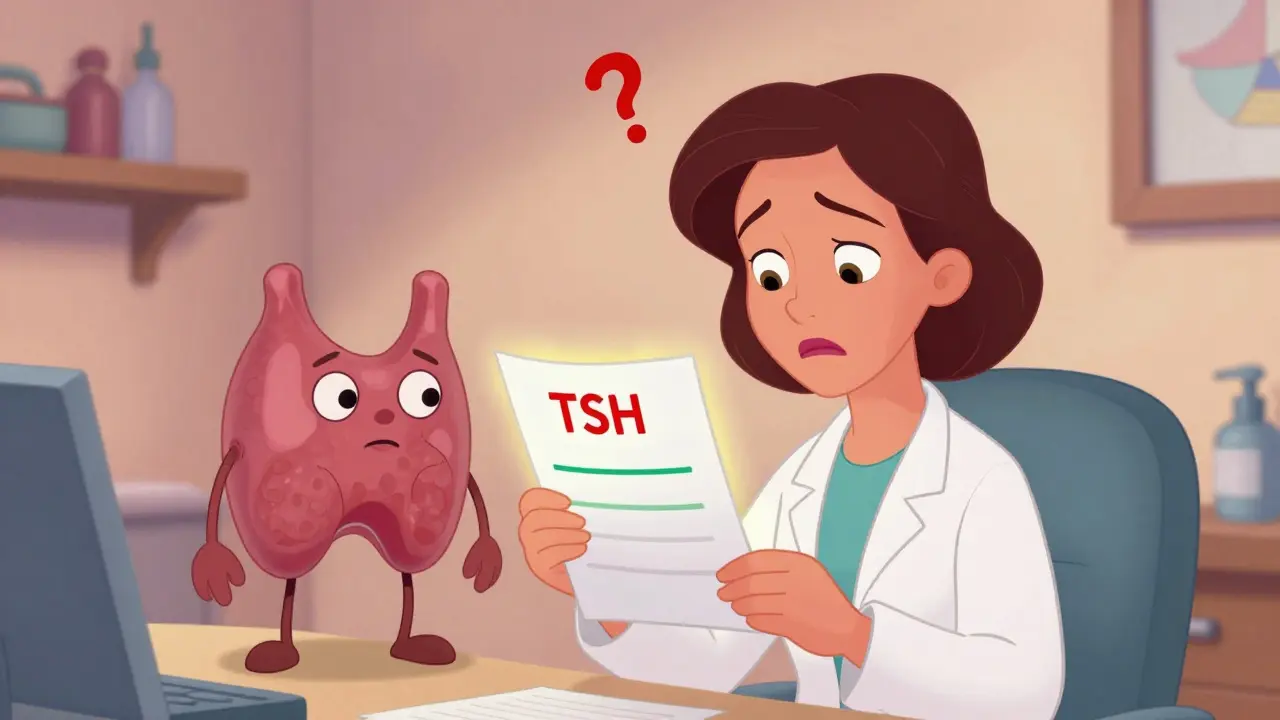
When your thyroid-stimulating hormone (TSH) is high but your free T4 is normal, you have subclinical hypothyroidism. It’s not overt disease, but it’s not nothing either. You might feel tired, gain weight, or notice your mood has shifted. Or you might feel perfectly fine. The big question isn’t whether you have it-it’s whether you should treat it.
What Exactly Is Subclinical Hypothyroidism?
Subclinical hypothyroidism means your pituitary gland is working harder than it should, pumping out more TSH because your thyroid isn’t responding as well. But your body still makes enough thyroid hormone to keep your free T4 in the normal range. This is different from overt hypothyroidism, where both TSH is high and T4 is low. In subclinical cases, your thyroid is struggling, but not failing yet.
It’s surprisingly common. About 4% to 20% of adults have it, depending on age and how labs define "normal." Older adults are more likely to have it. Women over 60? Up to 1 in 5 may fall into this category. The condition shows up on routine blood work-often by accident-during a checkup or pre-op screening.
Diagnosis isn’t just one test. You need two elevated TSH readings taken at least 2 to 3 months apart. Why? Because TSH can spike temporarily due to stress, illness, or even sleep deprivation. One high number doesn’t mean you need treatment. It means you need monitoring.
When Does TSH Become a Problem?
The real confusion starts when TSH is between 4.0 and 10.0 mIU/L. That’s the gray zone. Below 4.0? Usually fine. Above 10.0? Most experts agree treatment helps. But what about in between?
Here’s what the data says:
- Patients with TSH over 8 mIU/L have a 70% chance of progressing to overt hypothyroidism within 4 years.
- Those with positive thyroid antibodies (TPOAb) are 2.3 times more likely to progress.
- People over 65 with TSH under 10 mIU/L who are treated have a 12.3% higher risk of death-not because of the disease, but because of overtreatment.
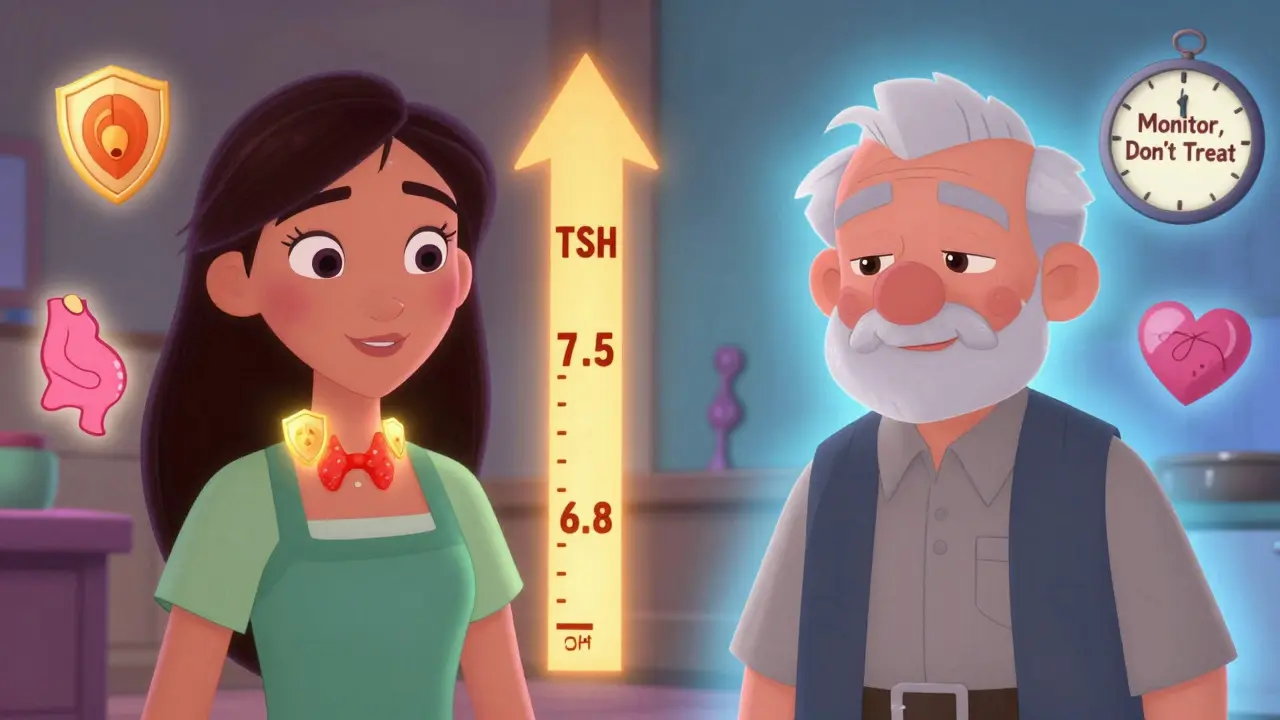
So if you’re 28 and your TSH is 7.5 with positive antibodies, your risk is real. If you’re 72 with a TSH of 6.8 and no symptoms? The risks of treatment might outweigh the benefits.
Do Symptoms Matter?
Many patients with elevated TSH report fatigue, cold intolerance, dry skin, or brain fog. But here’s the catch: studies show 30% to 40% of people with these symptoms have them even when their thyroid is perfectly normal.
That’s why doctors can’t just treat based on how you feel. You need objective tools. The Thyroid-Related Quality of Life Patient-Reported Outcome (ThyPRO) questionnaire is one of the most reliable ways to measure symptom burden. A 10-item symptom scale can help separate real thyroid-related fatigue from general burnout, poor sleep, or depression.
A 2020 study in Thyroid found that patients under 50 with TSH between 7 and 10 and positive antibodies had a 32% reduction in symptoms after starting levothyroxine. But in older adults? The TRUST trial showed zero improvement in energy, mood, or quality of life after a year of treatment.
What Do the Guidelines Say?
There’s no global consensus. Major organizations disagree-and that’s why your doctor might treat you while another wouldn’t.
Here’s how they compare:
| Organization | Recommendation for TSH 4-10 mIU/L | Recommendation for TSH >10 mIU/L |
|---|---|---|
| American Thyroid Association (ATA) | Do not routinely treat | Treat |
| American Association of Clinical Endocrinologists (AACE) | Consider treatment if TSH >7-8 | Treat |
| American College of Physicians (ACP) | Do not treat | Treat |
| American Academy of Family Physicians (AAFP) | Treat only if TSH >10 OR positive TPO antibodies | Treat |
| European Thyroid Association | Insufficient evidence | Treat |
The ATA and ACP say: wait. AACE says: act earlier. The AAFP says: wait unless you have antibodies. There’s no right answer-only context.
Who Should Be Treated?
Not everyone with elevated TSH needs medication. But some definitely do. Here’s who should consider levothyroxine:
- Anyone under 50 with TSH >7 mIU/L and positive TPO antibodies. Progression risk is high, and symptoms are more likely to be real.
- Women planning pregnancy. Even mild thyroid dysfunction can affect fetal brain development. The American Society for Reproductive Medicine recommends treating TSH >2.5 mIU/L in women trying to conceive.
- Those with cardiovascular risk factors. Elevated TSH is linked to higher LDL cholesterol and increased arterial stiffness. If you have high blood pressure, high cholesterol, or a family history of heart disease, treatment may reduce long-term risk.
- People with clear, persistent symptoms confirmed by a validated tool like ThyPRO.
On the flip side, avoid treatment if you’re over 65 with TSH under 10, especially if you have heart rhythm issues or osteoporosis. Overtreatment can cause atrial fibrillation or bone loss.
How Is It Treated?
If you and your doctor decide to treat, levothyroxine is the only option. It’s safe, cheap, and effective-when used correctly.
- Start low: 25 to 50 micrograms daily. Older patients or those with heart disease start at 25.
- Wait 6 to 8 weeks before retesting TSH. It takes time for the body to adjust.
- Goal: TSH between 0.5 and 4.0 mIU/L. Not "normal"-just within the lower half of the range.
- Don’t take it with calcium, iron, or antacids. They block absorption. Take it on an empty stomach, 30-60 minutes before breakfast.
Most people stabilize on 50 to 75 mcg/day-less than what’s needed for overt hypothyroidism. You don’t need to be "cured." You just need to stay in range.
What About Monitoring?
Once your TSH is stable, check it every 6 to 12 months. If you’re over 65, check every 6 months. Thyroid function changes with age, weight, medications, and even seasons.
Also, get a lipid panel yearly. Many people with subclinical hypothyroidism have higher LDL. Treatment often brings it down.
What’s Next?
The big research question isn’t whether to treat-it’s who to treat. The SHINE trial, a 5-year study of 1,000 patients with TSH between 4 and 10, is tracking heart disease outcomes. Results are due in late 2024. If it shows clear benefit for younger patients, guidelines will shift.
Meanwhile, new tools are emerging. Roche Diagnostics launched a TSH velocity calculator in 2023. It looks at how fast your TSH has been rising over the past year. A rise of more than 1 mIU/L per month means your risk of progression jumps 1.8 times. That’s more useful than a single number.
And there’s growing evidence that the current "normal" TSH range (up to 4.12) might be too high for younger adults. A 2022 study of 27,000 people found the ideal upper limit for people under 50 is closer to 2.5 mIU/L. If adopted, millions more would be diagnosed-raising questions about overmedicalization.
Bottom Line: Don’t Panic, Don’t Ignore
Subclinical hypothyroidism isn’t a diagnosis you treat on instinct. It’s a signal. A nudge. A reason to look closer.
If you’re young, have antibodies, or are trying to get pregnant? Talk to your doctor about treatment.
If you’re over 65 and feel fine? Don’t rush to start a pill. Monitor. Re-test. Ask about your cholesterol and heart health.
And if you’re in the middle-TSH 5 to 8, no symptoms, no antibodies? Wait. Watch. Repeat the test in 6 months. Most people never need treatment. But if you do, catching it early matters.
Is subclinical hypothyroidism real, or just a lab artifact?
It’s real. It’s not just a lab quirk. Elevated TSH with normal T4 means your thyroid is under stress. Many people with this condition eventually develop overt hypothyroidism, especially if they have thyroid antibodies. It’s a warning sign, not a mistake.
Can I treat subclinical hypothyroidism with natural remedies?
No. Selenium, iodine, or thyroid-support supplements don’t reliably lower TSH or prevent progression. Levothyroxine is the only evidence-based treatment. Natural remedies may even interfere with lab results or mask worsening function.
Why do some doctors treat TSH >7 and others wait until >10?
It’s because guidelines differ. Some doctors follow the American Thyroid Association, which says treat only above 10. Others follow the American Association of Clinical Endocrinologists, which recommends earlier action based on progression risk. Your doctor’s specialty, training, and patient population influence their approach.
Should I get tested for thyroid antibodies?
Yes-if your TSH is elevated. TPO antibodies tell you if your immune system is attacking your thyroid. Positive antibodies mean you’re 2.3 times more likely to progress to overt disease. This changes management.
Can subclinical hypothyroidism cause weight gain or depression?
It can contribute, but it’s rarely the only cause. Studies show symptom improvement only in specific groups-younger patients with high TSH and antibodies. If you’re older or have no antibodies, your weight gain or low mood is more likely due to stress, sleep, or other health issues.
What happens if I don’t treat it?
Many people never progress. About 30% to 50% of people with TSH under 8 and negative antibodies never develop overt hypothyroidism. But if you’re at high risk-under 50, positive antibodies, TSH over 8-then untreated, you’re likely to need treatment later. Monitoring is key.
Been there. TSH was 7.2, no symptoms, negative antibodies. Doctor said wait. Re-tested six months later-down to 5.1. No meds needed. Sometimes the body just needs time.
It's critical to remember that subclinical doesn't mean insignificant. For younger patients, especially women with positive TPO antibodies, early intervention can prevent irreversible changes. Don't dismiss a rising trend just because you 'feel fine.' Prevention is power.
Let me guess-you're one of those people who thinks a TSH of 5 is a crisis because your naturopath told you so. The data doesn't support treating people under 50 unless they're at high risk. Most of these cases are just noise. You're overmedicalizing normal variation. Stop chasing lab numbers like they're lottery tickets.
Oh please. The entire medical establishment is a circus. The ATA says one thing, AACE says another, and the AAFP? They're just trying to avoid lawsuits. Meanwhile, real science is being buried under layers of bureaucratic nonsense. The truth? TSH above 2.5 in anyone under 40 should be treated. The current guidelines are outdated relics from a time when we didn't know better.
My cousin was diagnosed with this at 32. She took levothyroxine and suddenly had energy, lost 15 pounds, and stopped crying for no reason. Now she's telling everyone to get tested. I get it-you want data. But sometimes real life doesn't care about your p-values.
Thyroid is the silent conductor of the body's symphony. When TSH rises, it's not a malfunction-it's a song of imbalance. In Ayurveda, we call this Vata aggravation. The body whispers before it screams. Listen. Not to labs. To yourself.
my doc just said 'eh, watch it' and i did. two years later, still normal. i think a lot of this is just fear marketing. people panic over numbers that are technically 'out of range' but still in the 'probably fine' zone. also, i take my pill with coffee now and i'm still alive. deal with it.
Just want to say-this post saved me. I was convinced I had hypothyroidism because I was tired and gained 10 pounds. Got tested, TSH was 6.3, antibodies negative. My doctor said no treatment needed. I started sleeping better, cutting sugar, and walking daily. Six months later? TSH down to 4.8. I didn't need a pill-I needed better habits. You're not broken. You're just out of balance.
You Americans are obsessed with treating everything. In India, we don't run to pills at the first sign of a lab anomaly. Our grandmothers ate turmeric, got sunlight, and slept well. That's medicine. Not some synthetic hormone you swallow because a machine said so. Stop trusting machines over tradition.
The real issue isn't whether to treat-it's why we treat at all. We've turned physiology into a spreadsheet. A number goes up, we inject a hormone. But what if the body's trying to tell us something deeper? Stress, sleep, inflammation? Maybe the thyroid isn't the problem. Maybe it's the reflection of a life out of rhythm. We fix the symptom. We never fix the context.