
Therapeutic Interchange: What Providers Really Do When Substituting Medications Within the Same Class
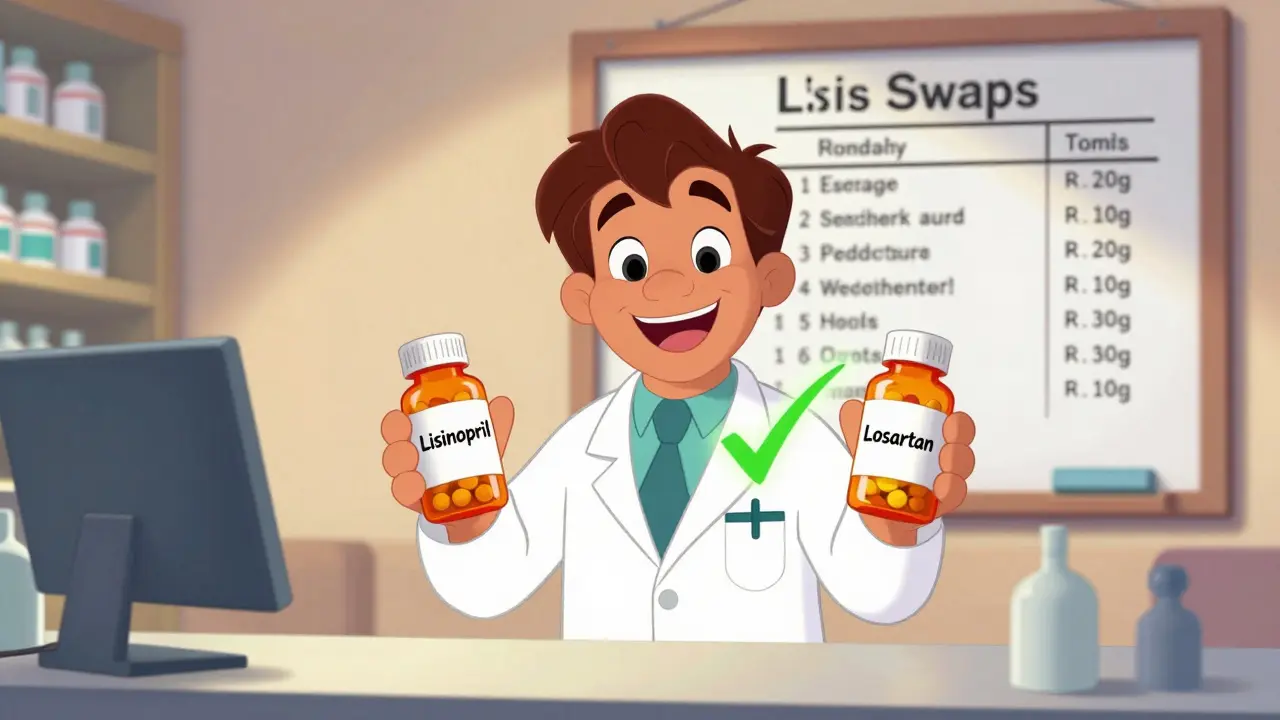
When a doctor prescribes a medication and the pharmacist gives a different one, it’s easy to assume they’re just swapping brands. But if that new drug is from a different class, it’s not therapeutic interchange. It’s a whole other thing. And here’s the truth: therapeutic interchange doesn’t cross drug classes. It stays within them.
Let’s cut through the noise. Therapeutic interchange is when a pharmacist, following a hospital or long-term care facility’s official drug list, swaps one medication for another in the same class-like switching from lisinopril to losartan, both ACE inhibitors or ARBs for high blood pressure. Not from an ACE inhibitor to a beta-blocker. Not from a statin to a fibrate. The drugs have to do the same job, just with a different chemical structure. This isn’t about guessing. It’s about evidence.
How It Actually Works in Hospitals and Nursing Homes
Most therapeutic interchange happens behind the scenes in institutional settings. You won’t see it in your local pharmacy unless your doctor signed off on it months ago. Here’s how it works: a Pharmacy and Therapeutics (P&T) Committee-made up of doctors, pharmacists, nurses, and sometimes even patients-reviews all the drugs in a class. They look at clinical data, side effect profiles, cost, and how often each drug is used. Then they pick one or two as the preferred options. That’s the formulary.
When a patient comes in with a prescription for, say, atorvastatin (Lipitor), the pharmacist checks the formulary. If rosuvastatin (Crestor) is on the list as an equivalent alternative and costs 30% less, they can swap it out-no new prescription needed. But only if the facility has a formal policy, and only if the prescriber agreed to it upfront. This isn’t a pharmacist’s call. It’s a system.
Skilled nursing facilities save tens of thousands of dollars a month this way. One facility in Florida cut its monthly statin bill from $18,000 to $11,000 just by switching 80% of patients from brand-name to generic within the same class. No drop in effectiveness. No rise in hospital readmissions. Just smarter spending.
Why It Doesn’t Work Across Different Classes
Here’s where people get confused. If a patient is on metformin for diabetes and the pharmacist switches them to glimepiride, that’s not therapeutic interchange. That’s a different class-big difference. Metformin works by reducing liver glucose production. Glimepiride forces the pancreas to make more insulin. They’re not interchangeable. One might work for some people, the other for others. But you can’t assume equivalence.
The American College of Clinical Pharmacy says it straight: therapeutic interchange only applies to drugs that are therapeutically equivalent and within the same class. The National Library of Medicine backs this up. Any substitution across classes is a clinical decision, not a formulary decision. It requires a new prescription. It’s not a cost-saving hack. It’s a treatment change.
Trying to interchange across classes opens the door to dangerous mismatches. A patient with heart failure on an ARB might get switched to a calcium channel blocker thinking it’s "the same"-but that could worsen their condition. That’s not smart. That’s risky.
The Role of the Prescriber and the Paper Trail
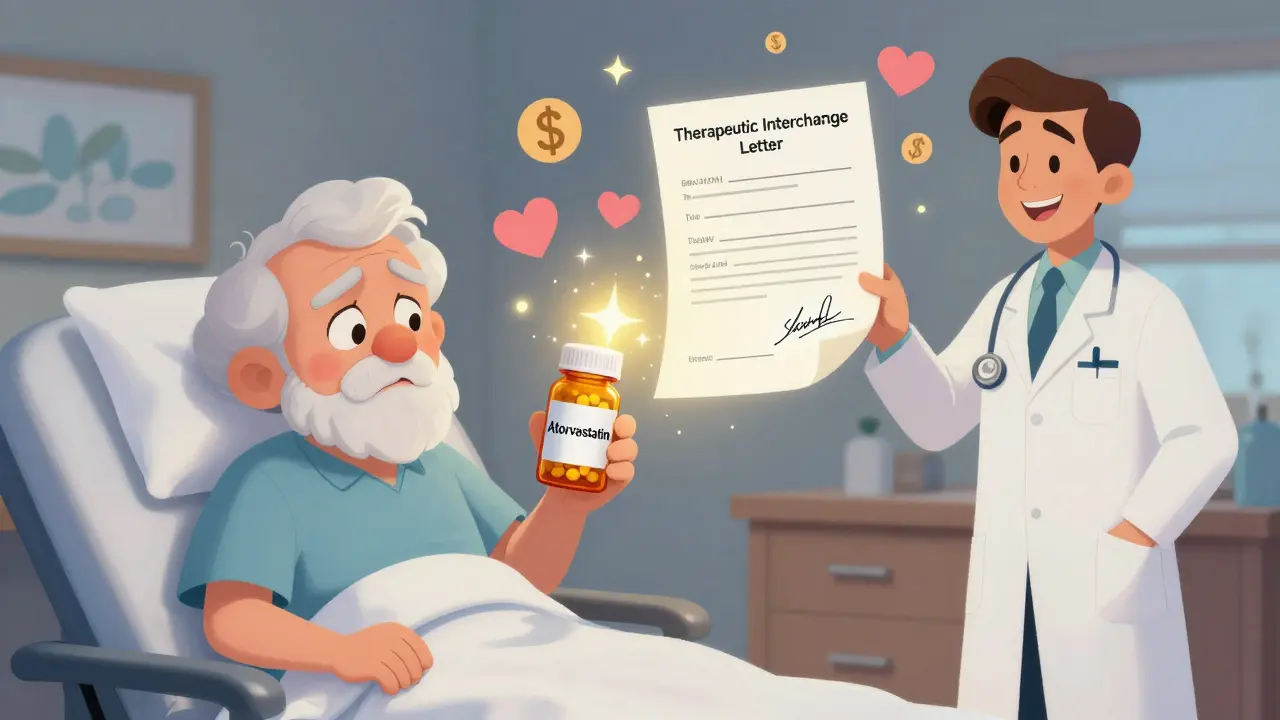
Even in institutions, no pharmacist can just swap drugs on their own. There’s always a paper trail. In most cases, the prescriber signs a "Therapeutic Interchange Letter"-a one-time authorization that says, "I approve swapping drug A for drug B in this setting." Once signed, the pharmacy can make the swap every time, as long as the formulary hasn’t changed.
But here’s the catch: not every prescriber will sign. Some are skeptical. Others don’t know the process. In long-term care homes, pharmacy directors spend hours tracking down signatures. One director in Texas told me they had to send 147 TI letters last year. Only 89 got signed. The rest? Patients kept getting the more expensive drug.
Community pharmacies? Forget it. Unless the prescriber has pre-approved the swap, pharmacists can’t do it. If they try, they risk liability. So they call the doctor. And that delays care. That’s why therapeutic interchange is almost invisible outside hospitals and nursing homes.
State Laws Make or Break the System
It’s not the same everywhere. In some states, like California and New York, pharmacists can initiate therapeutic interchange if the formulary allows it. In others, like Texas and Florida, every swap needs a prescriber’s signature-even if the drug is on the approved list. And in a few states, it’s outright banned outside specific settings.
One 2018 study found that 80% of U.S. hospitals had therapeutic interchange programs. But only 40% of long-term care facilities did. Why? Because state laws don’t always support it. And without legal backing, administrators won’t risk implementing it.
Pharmacists have to know their state’s rules. One pharmacist in Arizona got fined for swapping a patient’s medication without a signed TI letter-even though the drug was on the facility’s formulary. The law didn’t match the policy. And the patient was fine. But the system didn’t care. Rules are rules.
When It Works Best-and When It Doesn’t
Therapeutic interchange shines in settings with stable patients and clear guidelines. Think nursing homes, VA hospitals, or large health systems with centralized formularies. Patients on chronic meds for hypertension, diabetes, or cholesterol are ideal candidates. The drugs are well-studied. The outcomes are predictable. The savings are real.
It fails when:
- The patient has unique needs-like kidney disease or allergies
- The drug has narrow therapeutic windows-like warfarin or lithium
- The prescriber hasn’t signed off
- The formulary isn’t updated regularly
A 2021 study found that 12% of therapeutic interchange swaps led to confusion or patient complaints. Why? Because no one told the patient. Or the family. Or the nurse. It’s not just about the drug. It’s about communication.
The Bottom Line for Providers
Therapeutic interchange isn’t about cutting corners. It’s about cutting waste. It’s a tool that lets providers deliver the same care at lower cost-without changing outcomes. But it only works when:
- It’s within the same drug class
- It’s backed by a formal formulary
- It’s approved by a multidisciplinary team
- It’s documented and communicated
If you’re a provider and you see a drug swap, ask: "Is this the same class? Was this approved? Was the patient informed?" If the answer is no, it’s not therapeutic interchange. It’s something else-and you need to know what.
Because in healthcare, the difference between smart savings and dangerous substitution isn’t just a label. It’s a line.
Is therapeutic interchange the same as generic substitution?
No. Generic substitution means swapping a brand-name drug for its exact chemical copy-like switching from Lipitor to atorvastatin. Therapeutic interchange swaps one drug for another that’s chemically different but does the same job-like switching from lisinopril to valsartan. Both are cost-saving, but generic substitution is simpler and more common. Therapeutic interchange requires a formulary and approval.
Can a pharmacist do therapeutic interchange without the doctor’s permission?
In most cases, no. Even in hospitals, pharmacists need a signed Therapeutic Interchange Letter from the prescriber. In community pharmacies, they almost always have to call the doctor for approval. Some states allow pharmacists to make the swap if the formulary permits it, but even then, documentation is required. Never assume you can swap without authorization.
Why do some drugs get swapped and others don’t?
It depends on the formulary. Hospitals and nursing homes build their drug lists based on clinical effectiveness, safety, and cost. For example, in the statin class, rosuvastatin might be preferred over atorvastatin because it’s cheaper and has fewer drug interactions. But for a patient with liver disease, atorvastatin might be safer. The formulary includes exceptions for those cases. Not all drugs are interchangeable-even within the same class.
Is therapeutic interchange only for expensive drugs?
Not at all. It’s used for any drug where a cheaper alternative exists within the same class-even if the original is generic. For example, switching from brand-name metformin ER to a different manufacturer’s generic version might save $10 a month. Multiply that across 200 patients, and it’s $2,400 saved monthly. It’s not about the price tag. It’s about consistency and savings across the board.
What happens if a patient has a bad reaction after a therapeutic interchange?
The facility’s P&T Committee reviews the case. If the drug was on the approved formulary and the swap followed protocol, it’s not considered a medical error. But if the patient had known risks (like kidney issues) and those weren’t considered, the decision could be questioned. That’s why formularies include exceptions. If a patient has a history of adverse reactions, they’re exempt from interchange.
I've seen this play out in my hospital and honestly? It's a game-changer. We switched 90% of our hypertensive patients from lisinopril to losartan last year. Same effect, half the cost. No one even noticed.
Pharmacists aren't just order-takers anymore. We're clinical partners. But yeah, paperwork is a nightmare.
One guy got mad because his 'brand' was swapped. Dude, it's the same class. Same mechanism. Same outcomes. Chill out.
This is why I love pharmacy work. We're not just filling scripts we're optimizing care. I've watched patients on $400/month meds drop to $12 after a smart swap. No side effects. No complaints. Just better access.
And yeah the formulary team does their homework. They don't just pick the cheapest. They pick the safest, most effective, most consistent. That's professionalism.
This post is painfully naive. Therapeutic interchange is a cost-cutting gimmick disguised as clinical wisdom. You think a P&T committee knows better than a prescriber who's managed a patient for 10 years?
I'm sorry but I have to say: the fact that anyone thinks this is "evidence-based" is alarming. The American College of Clinical Pharmacy? Really? That's the same group that endorsed that one-size-fits-all diabetes protocol that led to 12% of patients having hypoglycemic events.
Also: "formulary" is just corporate speak for "we're cutting your drug because it's not profitable."
They're not swapping drugs. They're swapping lives.
Do you know how many people have died because a pharmacist decided their lisinopril was "too expensive"?
And don't give me that "same class" nonsense. Every drug has a fingerprint. Every patient has a story.
They're doing this because they don't care. Because they're paid to cut costs. Not save lives.
And don't tell me about "studies". I've seen the charts. I've seen the readmissions. I've seen the families crying in the hallway.
This isn't healthcare. It's accounting with a stethoscope.
The most dangerous part? No one tells the patient.
Honestly? This is the quiet revolution in healthcare. We're not talking about magic pills. We're talking about making sure grandma can afford her meds.
I had a patient last week who was choosing between insulin and her rent. We swapped her brand-name to a generic in the same class. She cried. Not because she was scared. Because she could finally sleep at night.
That's not a gimmick. That's dignity.
In India we don't have this luxury. We don't have formularies. We don't have P&T committees. We have pharmacists who sell whatever the patient can afford.
Here in the US you're debating whether to swap drugs within the same class?
Meanwhile in my country people are dying because they can't even get the original drug.
Stop pretending this is a moral dilemma. This is a privilege.
I think we're missing the bigger picture. Therapeutic interchange isn't just about money. It's about consistency.
Imagine a nursing home with 200 residents. Each on 5 different meds. Now imagine 10 different brands of the same drug floating around.
That's a recipe for disaster. One nurse gives the wrong pill. One chart gets mixed. One patient dies.
Standardizing within the class? That's not cost-cutting. That's harm reduction.
And yes, we need better communication. But the system itself? It's a lifeline.
This entire system is a lie.
They say "evidence-based." But the evidence is cherry-picked.
They say "cost-effective." But the cost is borne by the patient’s trust.
They say "same class." But what is a class? A label. A marketing category. A corporate convenience.
I’ve seen patients on stable regimens for 15 years, switched because a new generic came out. No consultation. No consent. Just a note in the chart.
And now? They’re confused. Anxious. Off their meds.
This isn’t innovation. It’s erosion.
And they call it progress.