
Thyroid Medications: How to Take Levothyroxine Right to Avoid Absorption Problems

Thyroid Medication Timing Calculator
Medication Timing Calculator
Most people taking thyroid medication don’t realize that levothyroxine isn’t like other pills you can swallow with your morning coffee and toast. If you take it wrong, it might as well not work at all. Even small mistakes-like swallowing it with breakfast or a cup of coffee-can cause your TSH levels to spike, leaving you tired, cold, and foggy-headed. And if you’re one of the millions managing hypothyroidism, that’s not just inconvenient-it’s dangerous.
Why Timing and Absorption Matter More Than You Think
Levothyroxine is a synthetic version of the thyroid hormone T4. Your body needs it to regulate metabolism, energy, temperature, and brain function. But here’s the catch: it only works if your body absorbs it properly. And absorption happens almost entirely in the upper part of your small intestine. That means what’s in your stomach at the time you take it makes a huge difference.
Studies show that when people take levothyroxine with food, absorption drops by up to 50%. One 2009 study tracked 65 patients and found their TSH levels jumped 176% higher when they took the pill with breakfast compared to taking it on an empty stomach. That’s not a minor fluctuation-it’s enough to throw your entire treatment off track. For someone with thyroid cancer or a pregnant woman, that kind of inconsistency could have serious consequences.
The American Thyroid Association says your target TSH should be between 0.4 and 4.0 mIU/L for most people. But if your absorption is inconsistent, your TSH might bounce between 2.5 and 5.0 without you realizing why. You might think your medication isn’t working, when really, you’re just taking it at the wrong time.
What Ruins Levothyroxine Absorption?
It’s not just food. A lot of everyday things interfere with how well your body absorbs this medication. Here’s what you need to avoid for at least 3 to 4 hours before and after taking your pill:
- Calcium supplements - Reduce absorption by 27-36%. That includes antacids, Tums, and multivitamins with calcium.
- Iron supplements - Cut absorption by nearly 40%. Common in women with heavy periods or anemia.
- Coffee - A 2017 study found it lowers absorption by 36%. Even black coffee, without cream or sugar, does this.
- Soy products - Tofu, soy milk, edamame-all can block absorption.
- Proton pump inhibitors - Drugs like omeprazole (Prilosec) and lansoprazole (Prevacid) change stomach pH, which messes with how levothyroxine dissolves.
- Fiber supplements - Psyllium, methylcellulose, and high-fiber cereals can trap the medication before it’s absorbed.
One patient on a thyroid forum said she took her pill with her morning protein shake-full of soy and fiber-and her TSH jumped from 1.9 to 4.7 in just three weeks. She thought her dose was too low. It wasn’t. She was just taking it wrong.
Should You Take It in the Morning or at Night?
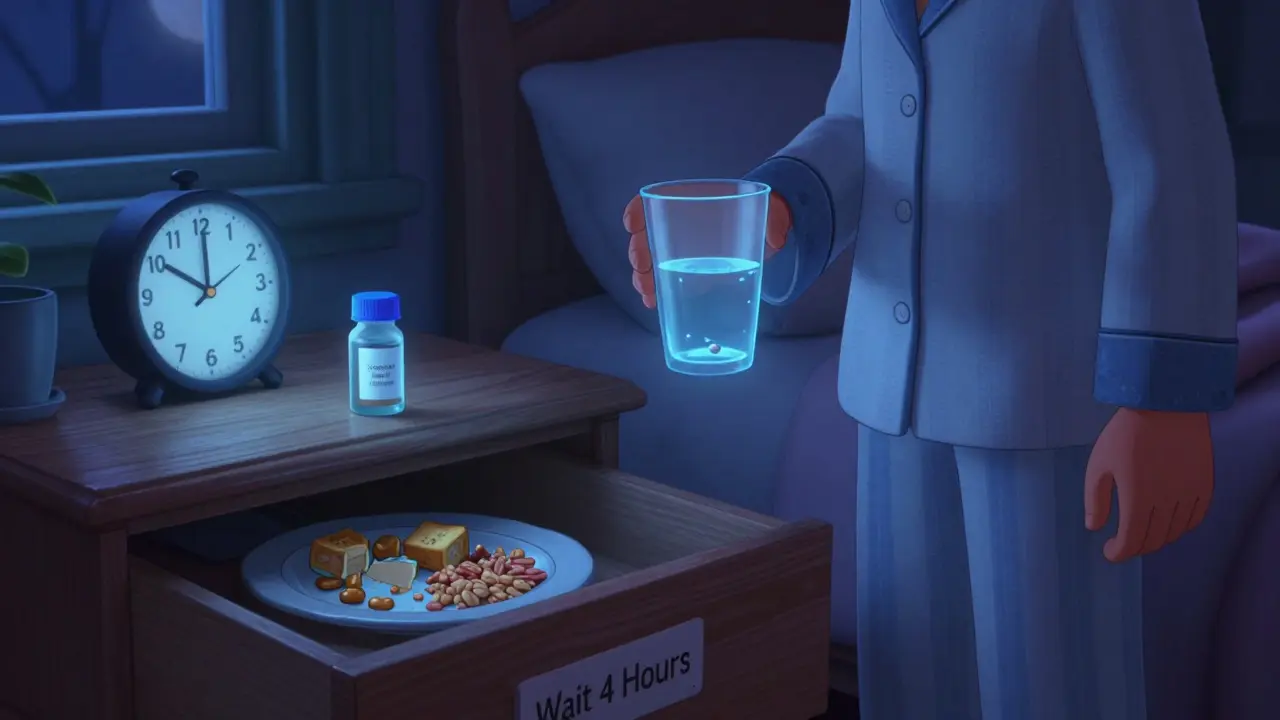
The classic advice has always been: take it first thing in the morning, 30 to 60 minutes before eating. That’s still the gold standard. But here’s the twist-some people do better taking it at night.
A 2020 review of 12 studies with over 1,000 patients found that nighttime dosing led to slightly lower TSH levels and higher free T4 levels compared to morning dosing. That means your body might absorb it better when your stomach is empty after dinner.
But not all studies agree. Some show no difference. Others show worse absorption at night. Why the confusion? Because everyone’s body works differently. Your digestion, your sleep schedule, your other medications-all of it matters.
Here’s what the data actually supports:
- If you can reliably take it on an empty stomach in the morning, that’s ideal.
- If you keep forgetting, or breakfast makes you nauseous, or you’re pregnant and need rock-solid control-stick with morning.
- If you’ve tried morning dosing for months and your TSH still won’t stabilize, talk to your doctor about switching to bedtime. Take it at least 3-4 hours after your last meal.
One patient in Melbourne, 54, switched from morning to night dosing after three years of erratic TSH results. Within eight weeks, her levels dropped from 3.8 to 1.3 and stayed there. She didn’t change her dose. She just changed the time.
What About Newer Forms of Levothyroxine?
There’s a reason your doctor keeps prescribing the same little white pill. It’s cheap, effective, and widely available. But it’s also finicky.
In 2017, the FDA approved Tirosint-SOL, a liquid form of levothyroxine. Unlike tablets, it doesn’t need an empty stomach. Studies show it absorbs just as well whether you take it with food or not. That’s huge for people who can’t fast for an hour every morning.
There’s also a delayed-release tablet in late-stage trials that’s designed to release the hormone after it passes through the stomach-bypassing food interference entirely. Early results from the 2023 American Thyroid Association meeting showed 92% of patients stayed in target range even when they took it with meals.
But here’s the reality: 89% of prescriptions are still for the old tablet form. So unless you’re on a specialty formulation, timing still matters.
Real-Life Strategies That Actually Work
Knowing what to do isn’t enough. You need a system that fits your life.
Here’s what works for real people:
- Set a phone alarm - A 2022 study found smartphone reminders boosted adherence by 38%. Set it for the same time every day, whether morning or night.
- Keep your pill next to your toothbrush - If you brush your teeth first thing, take your pill right after. Wait 30 minutes before eating or drinking anything but water.
- Use a pill organizer with labeled times - If you take other meds, separate your thyroid pill. Don’t put it in the same compartment as calcium or iron.
- Check your supplements - Read labels. Many multivitamins contain iron or calcium. If yours does, take it at dinner, not breakfast.
- Wait 60 minutes before coffee - If you can’t live without your morning cup, make it a ritual: pill → water → wait → coffee.
One woman in Sydney told her endocrinologist she couldn’t take it before breakfast because she had morning nausea from Hashimoto’s. They switched her to bedtime dosing. She now takes it right after brushing her teeth at night, before her last snack. Her TSH has been stable at 1.7 for over a year.

Special Cases: Pregnancy, Cancer, and Aging
Some people can’t afford to be flexible.
- Pregnant women - Your baby’s brain depends on your thyroid hormone, especially in the first trimester. The American Thyroid Association says TSH must stay below 2.5 during pregnancy. No exceptions. Stick to the morning fasting rule.
- Thyroid cancer patients - If you’re on suppressive therapy (TSH target below 0.1), even a 10% drop in absorption could mean the cancer comes back. Consistency isn’t optional.
- Older adults - If you take calcium for osteoporosis or iron for anemia, space them out by at least 4 hours. About 43% of women over 60 take calcium supplements. Don’t let that sabotage your thyroid treatment.
When to Get Your TSH Checked
If you change your dosing time-whether from morning to night, or you start taking it with water only-you need to get your TSH retested.
The American Association of Clinical Endocrinologists recommends checking your levels 6 to 8 weeks after any change. Once you’re stable, once a year is fine.
But if you’ve been inconsistent for months and suddenly feel worse-more fatigue, weight gain, brain fog-don’t wait. Get tested. Your TSH might have drifted out of range without you noticing.
One patient on Drugs.com wrote: ‘I took my pill with coffee for two weeks. My TSH jumped from 1.8 to 4.3. I felt like I was dying. I didn’t realize it was the coffee.’
It’s not your fault. No one told you.
Bottom Line: Do This Today
If you take levothyroxine:
- Take it with a full glass of water.
- Take it on an empty stomach-30 to 60 minutes before food, coffee, or other meds.
- Avoid calcium, iron, soy, and fiber for 4 hours before and after.
- If you can’t do morning, try bedtime-3-4 hours after your last meal.
- Set a daily alarm and keep your pill where you’ll see it.
- Get your TSH checked 6-8 weeks after any change.
You don’t need to be perfect. But you do need to be consistent. Because when it comes to thyroid medication, timing isn’t just advice-it’s the difference between feeling fine and feeling lost.