
Verbal Prescriptions: Best Practices for Clarity and Safety in Healthcare
Every year, thousands of patients are harmed not because of the medicine they were given, but because of how it was ordered. Verbal prescriptions-when a doctor says a medication order out loud instead of typing it into a computer-are still common in hospitals, ERs, and clinics. They’re fast. They’re necessary in emergencies. But they’re also one of the most dangerous steps in patient care.
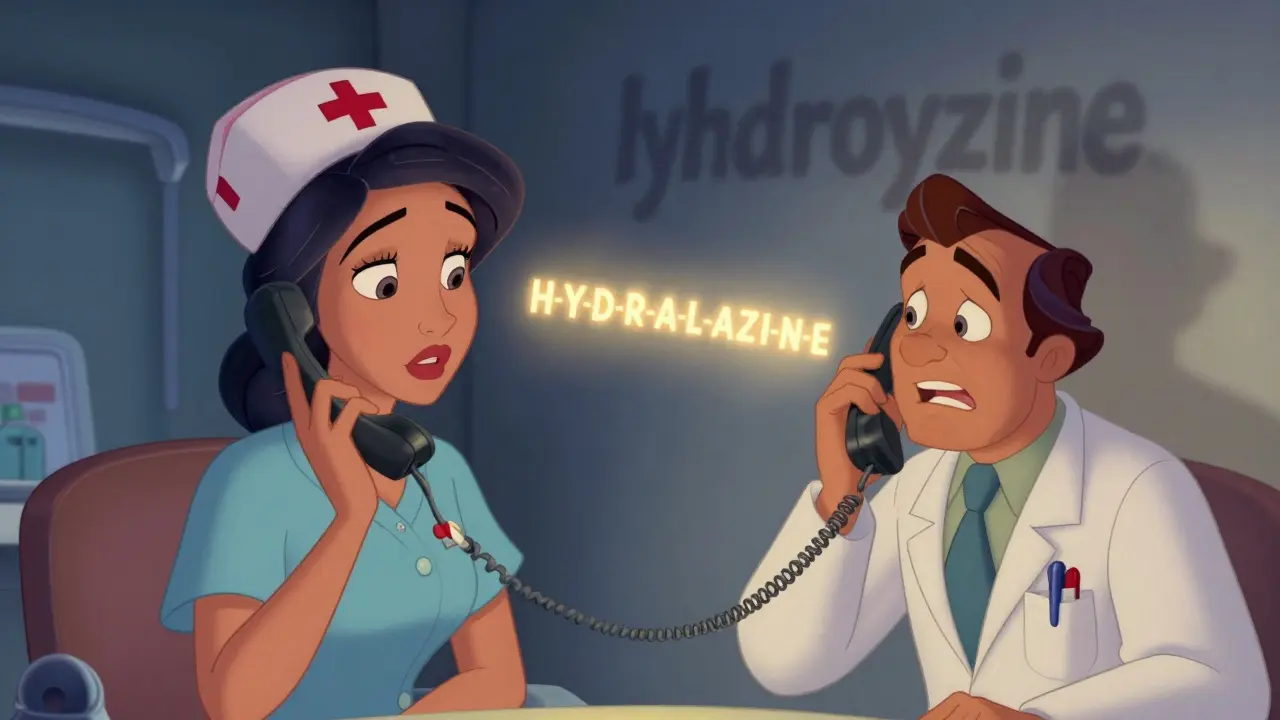
Imagine this: a nurse on night shift gets a call from a busy ER physician. "Give the patient 10 mg of hydralazine IV." The nurse writes it down. The patient gets the dose. But the doctor meant hydroxyzine, a completely different drug used for anxiety, not blood pressure. The patient goes into shock. This isn’t fiction. It happened. And it’s not rare.
Sound-alike drug names like hydralazine/hydroxyzine, Celebrex/Celexa, or Zyprexa/Zyrtec cause nearly one-third of verbal order errors, according to the Institute for Safe Medication Practices. And it’s not just the names. It’s how numbers are said, how units are spoken, and whether the order is written down immediately. Without strict rules, verbal prescriptions become a game of telephone with lives at stake.
Why Verbal Prescriptions Still Exist
You might think electronic systems would have killed verbal orders by now. But they haven’t. In fact, as of 2025, 10-15% of all hospital medication orders are still given verbally. In emergency rooms, that number jumps to 25-30%. Why? Because sometimes, there’s no time.
During cardiac arrest, a surgeon in the operating room, or a trauma case where every second counts, typing into a computer isn’t an option. The patient needs medication now. Verbal orders fill that gap. But they’re not a shortcut-they’re a high-risk procedure that demands discipline.
According to the Agency for Healthcare Research and Quality, hospitals that switched to full computerized order entry (CPOE) cut verbal orders from 22% to 10% of all orders-and saw a 37% drop in medication errors. That’s powerful. But even the most advanced hospitals still need verbal orders for certain situations. The goal isn’t to eliminate them. It’s to make them safe.
The Four Rules of Safe Verbal Prescriptions
There’s no room for guesswork. If you’re giving or receiving a verbal order, you follow these four rules-every single time.
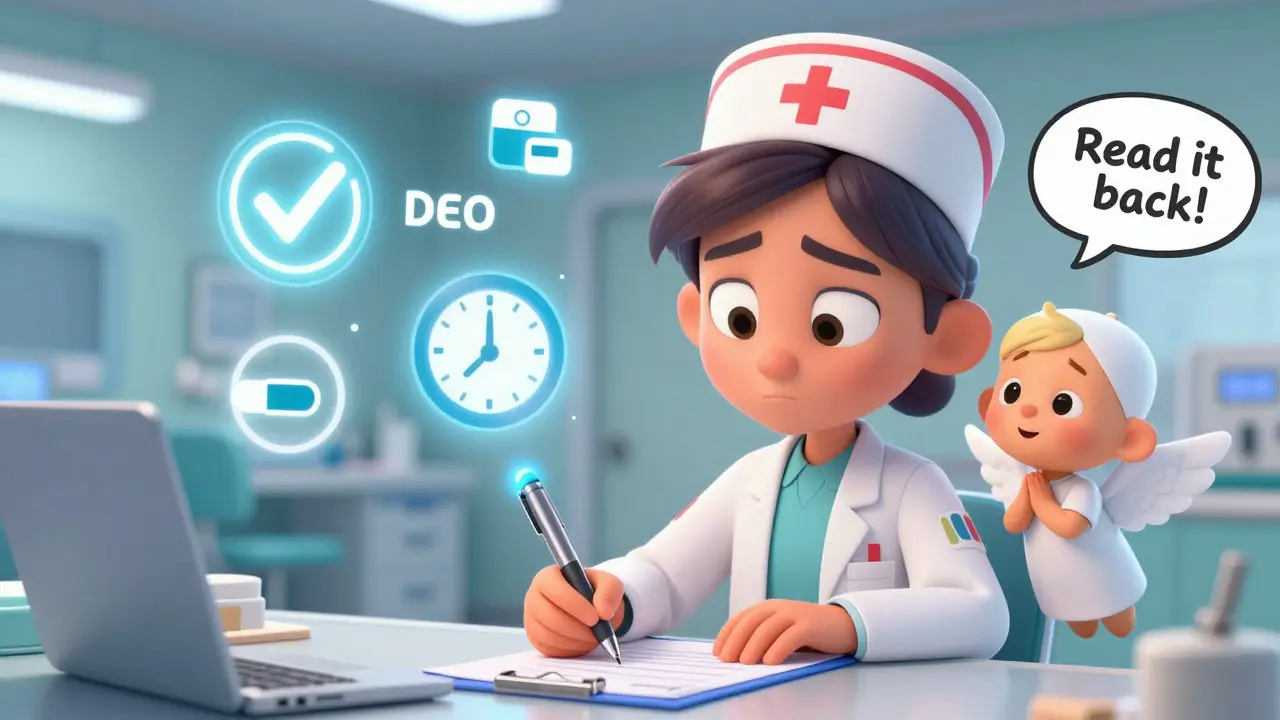
- Read-back is mandatory. The person receiving the order must repeat it back word-for-word. Not "I think you said 5 mg," but "You ordered 5 milligrams of heparin, IV, every 8 hours, for DVT prophylaxis." If the prescriber doesn’t confirm it’s correct, don’t proceed. This single step reduces errors by up to 50%, according to The Joint Commission.
- Spell it out. Say it twice. Never say "ampicillin." Say "A-M-P-I-C-I-L-L-I-N." Say numbers in two ways: "fifteen milligrams, one-five milligrams." Don’t say "BID" or "PO." Say "twice daily" and "by mouth." Abbreviations are a known trigger for errors. The Institute for Safe Medication Practices Canada made this rule official in 2020-and every hospital should enforce it.
- Never give high-alert meds verbally unless it’s an emergency. Insulin, heparin, opioids, chemotherapy-these drugs can kill if given wrong. The Pennsylvania Patient Safety Authority says verbal orders for these should only happen in life-threatening situations. Even then, double-check everything. One nurse in a 2023 AllNurses thread shared how spelling out "hydralazine" prevented a 10-fold overdose. That’s the difference between life and death.
- Document it immediately. The moment the order is given, write it down. Not later. Not when you get a free minute. Right then. Include: patient name, medication name (spelled out), exact dose with units, route, frequency, reason for the drug, who gave the order, and the exact time. The Joint Commission requires this. CMS requires authentication within 48 hours. Leading hospitals like Johns Hopkins require it before the shift ends.
What You Should Never Say (and What to Say Instead)
Some phrases are landmines. Here’s what to avoid-and what to say instead.
| Unsafe Phrase | Safe Alternative |
|---|---|
| "Give 10 mg of Lasix" | "Give 10 milligrams of furosemide, intravenous, once now" |
| "BID" | "Twice daily" |
| "PO" | "By mouth" |
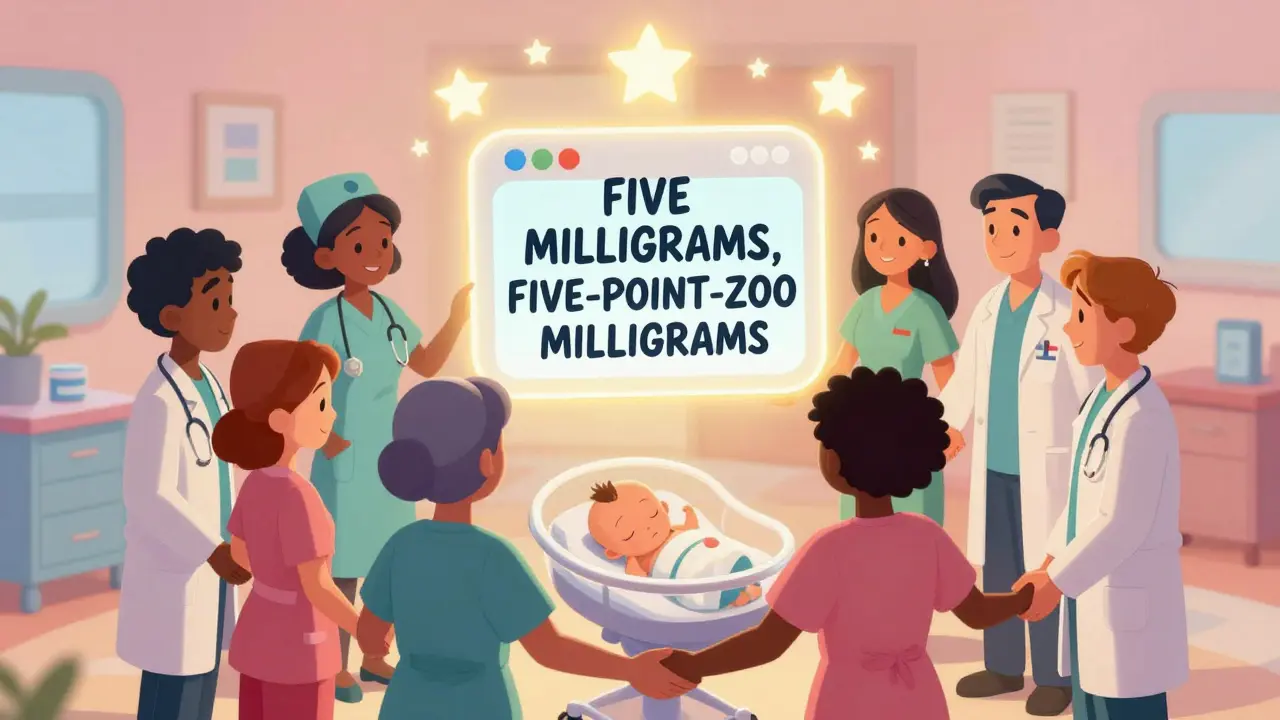
| "5.0 mg" | "Five milligrams, five-point-zero milligrams" |
| "Zyprexa" | "Z-Y-P-R-E-X-A" |
| "Hydralazine" | "H-Y-D-R-A-L-A-Z-I-N-E" |
These aren’t suggestions. They’re safety standards. A 2021 Medscape survey of 1,200 nurses found that 68% had a near-miss error every month because a prescriber mumbled or used an abbreviation. That’s not bad luck-it’s a system failure.
Who’s at Risk-and When
Verbal order errors don’t happen randomly. They cluster in predictable places.
- Shift changes: 42% of errors happen when one team hands off to another. Fatigue, rushing, and incomplete handoffs create perfect conditions for mistakes.
- Non-native English speakers: If a doctor’s pronunciation is unclear or their accent makes similar-sounding words hard to distinguish, the risk jumps. That’s why phonetic spelling is non-negotiable.
- Multiple orders at once: A 2006 case in a NICU involved a premature infant getting the wrong antibiotics because two orders were given back-to-back. One nurse remembered one drug. The other got lost. Never give more than one order at a time.
- High-pressure environments: ERs, ICUs, and ORs have the highest rates of verbal orders. That’s why protocols there must be stricter, not looser.
And here’s the hard truth: nurses report that read-back verification happens "less than half the time" for some doctors. Why? Because they’re rushed. Because they think it’s "obvious." Because they don’t want to be "bothered." But if you skip read-back, you’re not saving time-you’re gambling with a life.
What Happens When It Goes Wrong
One case from the Pennsylvania Patient Safety Authority still haunts staff: a premature baby received 200 mg of ampicillin and 5 mg of gentamicin instead of the intended 20 mg and 0.5 mg. The error happened during a transfer. The orders were given verbally. No read-back. No documentation. The infant suffered kidney damage.
These aren’t rare outliers. They’re symptoms of a broken system. The American Nurses Association’s 2022 survey found that 79% of nurses believe verbal orders are "sometimes necessary but always risky." And 87% support mandatory read-back. The problem isn’t the people. It’s the culture.
Doctors resist read-back because they see it as a lack of trust. Nurses resist speaking up because they fear being yelled at. That’s the real danger-not the phone call. It’s the silence after it.
How to Fix It
Change doesn’t come from new rules. It comes from culture.
- Train everyone: Staff need 3-5 supervised verbal order exchanges to get comfortable with the process. Don’t assume they know it.
- Use scripts: Create a simple, standardized phrase: "I’m giving a verbal order. Please read it back to me." Make it part of the routine.
- Enforce consequences: If a doctor refuses to use read-back, document it. Report it. This isn’t about punishment-it’s about safety.
- Protect the nurse: Make it clear that asking for clarification isn’t a sign of weakness. It’s a sign of professionalism. One nurse said it best: "I’d rather look dumb than bury a patient."
Technology helps, but it doesn’t solve everything. Even with CPOE, verbal orders still happen. And they always will. The goal isn’t to eliminate them. It’s to make sure every single one is done right.
What Comes Next
The future of verbal prescriptions isn’t about eliminating them-it’s about making them foolproof. The FDA is working on standardizing how high-risk drug names are pronounced. Hospitals are rolling out voice-to-text systems that can flag unsafe terms in real time. Some are even testing AI that listens to verbal orders and alerts staff if a drug name sounds like a high-risk match.
But none of that matters if the culture doesn’t change. If a doctor still thinks read-back is "unnecessary," if a nurse still hesitates to speak up, if documentation still gets pushed to the bottom of the to-do list-then errors will keep happening.
Verbal prescriptions aren’t going away. But the way we handle them can-and must-get better. Every time you spell out a drug name. Every time you read it back. Every time you write it down before you walk away. That’s how you protect someone’s life.
Just read this after my shift. I’ve seen the hydralazine/hydroxyzine mix-up happen twice. No read-back. No spelling. Just a tired doc on the phone saying "ten of the blue one." I wrote it down. Patient went into hypotensive shock. We lost 45 minutes before we caught it. Never again. Ever.
It’s not about the rules-it’s about the metaphysics of authority. The doctor’s word is sacramental. To demand a read-back is to secularize the sacred act of healing. We’ve replaced trust with procedure, and in doing so, we’ve hollowed out the very human connection that medicine was meant to preserve.
Let’s be precise: the Institute for Safe Medication Practices is not a regulatory body-it’s a think tank with funding from EHR vendors. The real issue? The over-reliance on protocol as a substitute for clinical judgment. And why are we spelling out drug names? Because we’ve normalized incompetence. If you can’t pronounce 'furosemide' correctly, you shouldn’t be prescribing it. End of story.
Man, this hits home. I’ve worked in Lagos, Atlanta, and now Nairobi-and the pattern’s the same. Busy docs, tired nurses, no time to spell things out. But here’s the twist: in Nigeria, we’ve got this unspoken rule-when you hear a drug name you’re unsure of, you say, "Bros, say that again like I’m five." And you know what? It works. No fancy protocols, just human honesty. Maybe we don’t need more rules-we need more humility.
Wait-so you’re saying nurses are the ones who have to be perfect? What about the doctors who mumble like they’re gargling gravel? I had a doctor say "morphine 2 mg" and I heard "methadone 20 mg"-I didn’t catch it until the patient started nodding off. Now I’m on anti-anxiety meds. Thanks, system.
There’s something deeply human about this whole issue. It’s not just about drug names or read-backs-it’s about power dynamics, fear, and silence. Why do nurses hesitate to speak up? Because they’ve been trained to be quiet. Why do doctors resist? Because they’ve been trained to be infallible. The fix isn’t in the protocol-it’s in the culture. And culture changes one conversation at a time.
Let’s cut through the noise. This whole "verbal prescription safety" movement is a distraction. The real problem? The FDA and CMS are forcing hospitals to use EHRs that are so clunky, doctors can’t type fast enough during emergencies. So they revert to verbal orders. The solution? Fix the software. Stop blaming nurses for being "lazy" and fix the system that makes them rely on phone calls in the first place.
I’ve been a charge nurse for 18 years. I’ve seen everything. And I can tell you this: the four rules work. Every. Single. Time. But they only work if leadership enforces them-not just with memos, but with consequences. I had a resident who refused to spell out "heparin." I documented it. I reported it. He got a formal warning. He never did it again. Safety isn’t optional. It’s non-negotiable.
hey i was in med school last year and we had a sim where we had to give a verbal order and i said "zyprexa" and the instructor screamed at me and made me spell it out like 10 times. i cried. but now i always spell everything. its kinda dumb but also kinda life saving? idk
Consider the broader epistemological framework: verbal prescriptions are not merely a clinical procedure-they are a manifestation of the tension between embodied knowledge and institutional abstraction. The physician, as the epistemic authority, speaks; the nurse, as the embodied executor, receives. The read-back ritual is not about error prevention-it is a performative act of epistemic humility, a symbolic surrender of the doctor’s absolute authority to the collective accountability of the team. To reject read-back is to reject the very notion that knowledge is distributed, not monopolized. This is not policy. This is philosophy in scrubs.
As a healthcare administrator, I can confirm that the implementation of mandatory verbal order protocols has reduced medication incidents by 41% in our facility over the past 18 months. This is not anecdotal. This is data-driven. We now require all staff to complete quarterly competency assessments on verbal order safety. Non-compliance results in suspension from shift assignments. Safety is not a suggestion. It is a standard.
Who really benefits from all this? The hospitals. The EHR companies. The regulators. Not the patients. They’re just using this as an excuse to track every word you say. Next thing you know, your voice is being recorded, analyzed, and flagged by AI. They’ll say "you said '10 mg' too fast" and suspend you. This isn’t safety-it’s surveillance. And it’s coming for you next.
Let’s get into the nitty-gritty of high-alert meds. Heparin, insulin, opioids-these aren’t just drugs, they’re pharmacokinetic landmines. The Joint Commission’s 2023 update on high-alert medication protocols mandates dual verification for any verbal order involving these agents. But here’s the kicker: most hospitals don’t have a second qualified provider available during off-hours. So the rule becomes performative. We’re creating compliance theater, not safety. We need to staff accordingly, or stop pretending.
you know what i think? i think theyre all just trying to cover their butts. the nurses are scared theyll get sued so they make the doc spell everything. the docs are scared theyll get reported so they say "okay fine" but they hate it. and the hospital just wants to say "we follow all guidelines" so they dont get fined. no one actually cares about the patient. its all about liability. and the patient? they just get the wrong pill and die quietly.
Let me be clear: if you’re a doctor who thinks spelling out drug names is beneath you, you don’t belong in medicine. You’re not a healer-you’re a liability. I’ve watched a child die because a doctor said "Zyrtec" and meant "Zyprexa." And you know what? He didn’t even apologize. He just said, "It was a typo." Typo? That’s not a typo. That’s negligence dressed up as arrogance. If you can’t be bothered to say it right, go work in a call center.