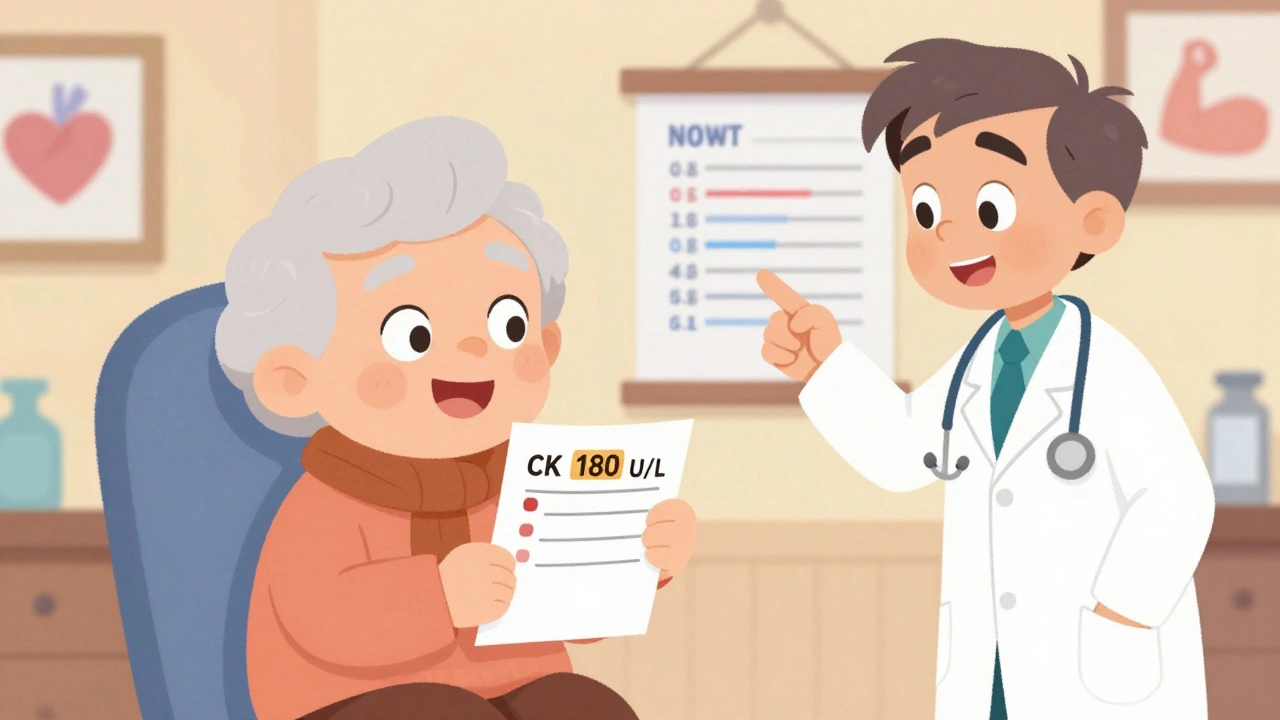
Baseline CK Testing for Statins: When It’s Actually Needed
Baseline CK testing before starting statins isn't needed for everyone-but it's crucial for high-risk patients to avoid unnecessary drug stops and catch real muscle damage early.
Read More
When you take statins, cholesterol-lowering drugs prescribed to reduce heart attack and stroke risk. Also known as HMG-CoA reductase inhibitors, they’re among the most widely used medications in the world. But if you’ve ever felt unexplained muscle soreness or weakness after starting one, you’re not alone. That’s where creatine kinase, an enzyme found in muscle tissue that leaks into the blood when muscles are damaged. Also known as CK or CPK, it’s a key marker doctors check to spot statin-related muscle injury. High CK levels don’t always mean trouble—but they’re a red flag that needs attention.
Most people on statins never have serious muscle issues. But for some, even mild muscle pain can be a sign of statin myopathy, a spectrum of muscle problems caused by statins, ranging from simple soreness to rare, life-threatening breakdown of muscle tissue. The most serious form, rhabdomyolysis, is rare—less than 1 in 10,000—but it can damage kidneys and needs immediate care. That’s why doctors often order a simple blood test for creatine kinase when muscle symptoms appear. If your CK is more than 10 times the upper limit of normal, it’s a strong signal to pause the statin and investigate. But here’s the catch: many people with mild muscle aches have normal CK levels. That means the pain might not be from the statin at all. Stress, overtraining, or even vitamin D deficiency can mimic the same symptoms.
What’s clear from real-world data is that most people who stop statins because of muscle pain don’t actually have true statin-induced myopathy. Studies show up to 90% of those who quit can safely restart a different statin or adjust the dose. The key is not to assume the worst. Work with your doctor to rule out other causes, track your symptoms, and consider a controlled rechallenge. It’s not about avoiding statins—it’s about using them smartly. You’re not alone in this. Thousands of people face the same choice: protect their heart without sacrificing their mobility.
Below, you’ll find real patient stories and clinical insights on how to tell if your muscle pain is from statins—or something else. You’ll learn when to push through, when to pause, and how to get back on track without risking your heart health. These aren’t theory pages—they’re tools built from actual cases, lab results, and doctor-patient conversations.
Baseline CK testing before starting statins isn't needed for everyone-but it's crucial for high-risk patients to avoid unnecessary drug stops and catch real muscle damage early.
Read More